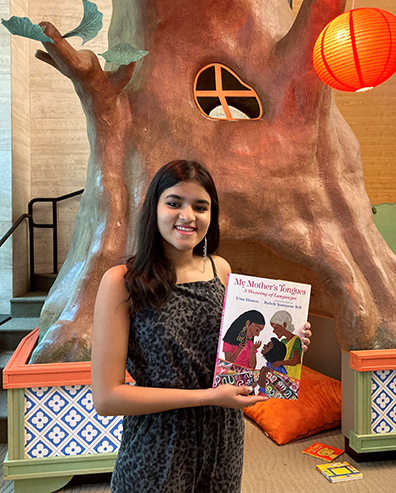
Recently, we were honored to host author and Princeton University student Uma Menon who is also GRADUATING today! CONGRATULATIONS! Uma brought her gorgeous picture book, My Mother’s Tongues: A Weaving of Languages (Candlewick Press, 2024; illustrated by Rahele Jomepour Bell). In the book, Uma describes the beautiful dynamic of her family and the multiple languages they speak. So we designed this sweet home…
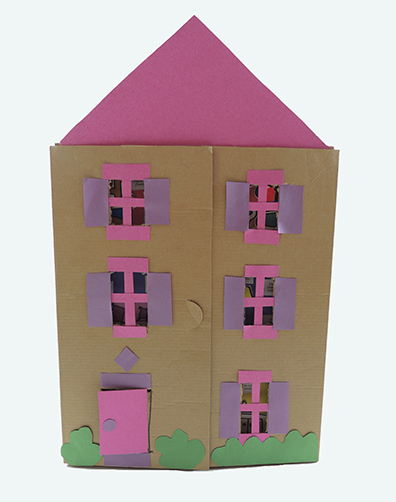 …that opens to reveal the names of everyday household items in all the languages mentioned in her book! Malayalam, Spanish, Hindi, French, and Tamil!
 We used some flat boxes we acquired from our library’s upcycling program, but a folded piece of poster board works too! Just color and cut the household furniture template and household words labels, then glue them into your home. We also provided patterned paper for some extra fancy design elements.
 After story time, I caught up with Uma to ask her about her experiences writing her picture book, and what’s she’s planning to do next:
Hi Uma! Tell us a little about yourself!
I am a senior at Princeton University majoring in the School of Public and International Affairs with minors in South Asian Studies, American Studies, and Gender & Sexuality Studies. Outside of school, I enjoy writing poetry, fiction, and nonfiction. My first children’s book, My Mother’s Tongues, was published by Candlewick Press in February, and it will be followed by a sequel next year, titled Our Mothers’ Names. Both books tell the story of a young Indian American girl who grows up speaking Malayalam and English, inspired by my own childhood. Previously, I wrote a poetry collection, Hands for Language, which was published by Mawenzi House in 2020, and I have also written essays and poetry for many publications including The Washington Post, The Huffington Post, and The Progressive.
What inspired this book?
I began writing this book around high school graduation, when I was 16 years old. Growing up, I did not encounter any stories of children like me who spoke more than one language, so I wanted to write a book that represented this experience shared by millions of children of immigrants across America. As a child, speaking a different language doesn’t always feel like a superpower—it often feels like a point of difference. Through My Mother’s Tongues, I hope to celebrate the beauty and power of multilingualism while highlighting the wonder and confusion young children may experience.
Do you have any insights or reflections to share, growing up in a bilingual home?
Being bilingual is not easy. As we grow up, attend school, and interact primarily with English speakers, it becomes more difficult to maintain native fluency in our mother tongues. Yet, I realized that there is great value in making an active effort to preserve my knowledge of Malayalam. It has allowed me to connect more deeply with family members, consume diverse media and art, and access more cultural perspectives. Growing up bilingual taught me the value of being able to speak multiple languages and hence inspired me to become a lifelong language learner: inspired by my heritage, I decided to study Hindi while at Princeton. As with Malayalam, learning Hindi has allowed me to access a rich body of literature and film as well as understand more perspectives on the world.
What do you enjoy most about writing?
For me, writing is a valuable tool for personal expression and communication with diverse audiences. Throughout my life, reading and writing have allowed me to better understand my own identity and the perspectives of others. Books have made me a more empathetic and global citizen. As a writer, I hope to reach the hearts and minds of people across the world—those who have both similar and different life experiences as me.
What are you planning to do after you graduate from Princeton University?
In the fall, I will be attending Yale Law School, where I am excited to study international law and human rights. Of course, I will also continue writing across many genres, but I especially hope to begin working on more children’s literature this summer!