Bookshelf Treasure Hunt

Have bookshelf, will adventure! Even the smallest shelf can be used to create clues leading to a final treasure. Best of all, this journey can be adjusted to any age level, requires no special materials, and is very budget friendly!

Before we proceed, it’s important to make the distinction between a bookshelf scavenger hunt and a bookshelf treasure hunt. A scavenger hunt involves finding a specific list of items on the shelves (ex: “A blue book” or “A book with a person’s name in the title”). A treasure hunt begins with an initial clue, which leads to more clues that proceed in sequential order to a final prize. That’s what we’ll be focusing on today. A treasure hunt.

treasure hint 2

The biggest bookshelves are in our living room, so I set my treasure hunt there. This 9 clue hunt was designed for my 9 year old daughter. In addition to books, I used objects on the shelves. You can also do this activity with a smaller shelf, books laid out on a table, span it across multiple shelves in the house, or hide individual books around the entire house. It’s very flexible! The only materials I used were paper, scissors, and tape. I typed my clues, but you can hand write them as well.

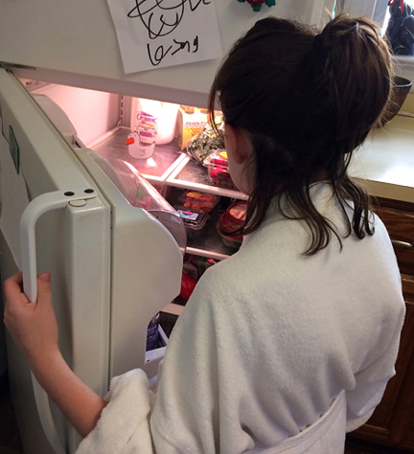
I hid Clue #1 under my daughter’s lunch plate. When she lifted it to clear her place, she immediately spotted a mysterious folded note with question marks. It read: Ready for a treasure hunt? Head to the living room bookshelves. The unicorn will start you on your way…

She immediately knew what the clue was referencing. I love collecting original art from thrift stores, so here’s the unicorn from the clue. Lifting the painting, Clue #2 was revealed, cut in the shape of a unicorn speech bubble.

It read: “My friend the dragon has been captured! Can you free him? Oh, and you’ll need to bring some chewing gum, ribbons, and lollipops for the tigers, lion, and crocodiles!” This is reference to My Father’s Dragon by Ruth Stiles Gannett. Inside that book, may daughter found Clue #3: TIME WILL TELL. This lead her to our shelf clock with a message sneakily taped to its back:

The clue read: Would you want a little brother like this? Hint: He’s NOT sweet like his name! This lead to one of her favorite books, Tales of a Fourth Grade Nothing by Judy Blume. Inside was Clue #4: Third red book from the left. By the way, you might like this series! A bit of maneuvering and counting led to The Anybodies by N.E. Bode. Also, Clue #5, which was a foray into Mom’s non-fiction section: No one knows his name, but everyone sees his art

My daughter recognized the reference, and located Banksy: You Are An Acceptable Level Of Threat And If You Were Not You Would Know About It by CarpetBombingCulture. Inside, Clue #6 read: 1 shelf over 2 shelves up. Find a KINGDOM. The search resulted in The Hollow Kingdom by Clare B. Dunkle plus Clue #7: Upwards! A…B…and behind C!

So, my daughter reports that Clue #7 was definitely the most difficult one. I had to drop one hint (“It says ABC”). But it was awesome to see her start working out that the clue referred to the large letters of three book titles on the upper shelf: Abarat by Clive Barker; Black Duck by Janet Taylor Lisle; and The Evolution of Calpurnia Tate by Jacqueline Kelly (who I interview here!).

Clever girl figured it out, and was awarded with Clue #8, which read: The most secret place on the bookshelf. Hint: A mouse resides in it! Seconds later, she was opening a fake-bookcase-secret-liquor-cabinet. It’s one of my favorite yard sale finds, ever.

Inside was tiny heart card that contained Clue #9: What’s new in your room? There, my daughter found two new books illuminated by her nightstand lamp: When Stars are Scattered by Victoria Jamieson and Omar Mohamed; and The Misadventures oft the Family Fletcher by Dana Alison Levy.

This treasure hunt was fun, and very easy to put together. A couple of hints:

  • I started with books my daughter was already familiar with to get things rolling, then introduced new books I hope she’ll browse later.
  • I put the clues in the same place in every book, so she would know where to look each time. If you want to extend the time of your hunt, place the clues on random pages.
  • With the exception of the clock clue, I kept everything at eye level. You especially want to do this with younger kids. You don’t want them climbing, searching, and reaching all at the same time. They might topple over in their excitement.
  • For older kids, consider including additional codes and ciphers to translate the clues (mirror writing is a great option, and I love the pigpen cipher from this MYSTERY CLOSET post).
  • The treasure doesn’t have to be budget busting. It can be a pack of new pens, books checked out from your local library, a bit of extra dessert, or a message that simply says “Well done!”
  • Once your child completes the bookshelf treasure hunt, invite them to design one for YOU. My daughter currently has one in the works!

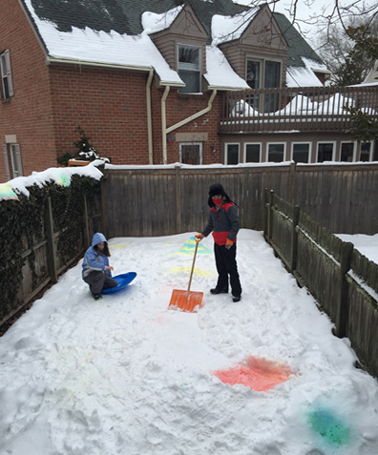
By the way, I hid something in this post for you as well…did you notice there was ONE photo that had nothing to do with the original treasure hunt or the clues? If you guessed the second photo, you are correct! In it, you’ll see my old, beat-up globe resting on a book recommendation for your young readers. The Last Treasure by Janet S. Anderson. It’s a fantastic story about a kid who gets involved in a treasure hunt that stretches far into his family tree, an expansive estate, and a very tricky set of clues (some rather dangerous!). What he discovers is historical, amazing, and touching.

Other treasure-hunting books residing on my home shelves over the years include: The Treasure of Alpheus Winterborn by John Bellairs; The Blackthorn Key by Kevin Sands (interview here); Who Stole the Wizard of Oz by Avi; Addison Cooke and the Treasure of the Incas by Jonathan W. Stokes (project here); Jeremy Fink and The Meaning of Life by Wendy Mass (interview here); Horton’s Miraculous Mechanisms by Lissa Evans (project here, interview here); and Moving Target by Christina Diaz Gonzalez (interview here).

And while most readers would technically classify this book as a scavenger hunt, I would be remiss not to mention Escape from Mr. Lemoncello’s Library by Chris Grabenstein!

The Snack of the Swan

My son is bird-obsessed these days, so I presented him with E.B. White’s classic, The Trumpet of the Swan. He loved it and I was soon fielding questions about swans, trumpets, and what watercress sandwiches taste like. I’m not a swan or a trumpet expert, but watercress sandwiches? That I can do!

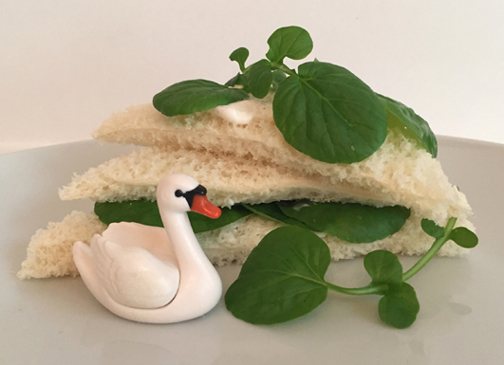
A quick Google search reveled 559,000 recipe results. In the end, I went with the simplest one: white bread, mayonnaise (or in our food allergic house, Vegenaise), and fresh watercress. I did have a little trouble locating the watercress, but finally found success in the produce section of Whole Foods.

And what did my son think of the sandwiches? Here’s his full report…

To be honest, it did not have much of taste, sort of like spinach. But it did have a bit of spicy aftertaste. Which was not much compared to the mustard cabbage I once tried. That was a dark day. I am obsessed with waterfowl (scientific name Anseriformes). And in one part of the book, the swan eats some watercress sandwiches, and it is said in the book that all the swan really wanted was the watercress. I guessed that waterfowl eat watercress, and other stuff that grows underwater. So we tried it to see what it tastes like. So overall, it wasn’t bad or anything. Just a little bit tasteless. Maybe next time I’ll try bird seed.

Yes, I was a bit surprised. Watercress is a tad spicy. Not unlike arugula. However, the spice added a nice kick to counter the creamy mayo. Nom nom nom. Watercress is also a gorgeous green. I couldn’t resist garnishing Fred Marcellino’s illustration of Louis being presented the bill for twelve watercress sandwiches, Ritz Carlton Hotel, Boston (Harper Collins, 2000 paperback reissue).

If you are looking for a few more recipes, yummies, and challenges heading into the holiday season, you might want to try some rock cakes, say hello with this chocolate pen, or take our literary food quiz!

Fly the Friendly Skies

When my son was younger wooooo did we read a lot of transportation and construction books. To this day, I still excitedly point out backhoe loaders, simply by reflex. I think we wore out not one but THREE copies of Richard Scarry’s Cars and Trucks and Things That Go, and my son was the inspiring mind behind this event. Today’s post is also my son’s invention…a simple zip line tram car!

You’ll need:

  • 1 large tissue box
  • 1 paper towel tube
  • String or yarn
  • 2 chairs (plus books to weight them down)
  • Scissors and tape for construction
  • Construction paper, markers for decorating
  • Hole punch

First, the tram car! Flip a large tissue box upside down, and decorate the side with construction paper and markers. Cut a paper towel tube down to 7.5″ then attach firmly to the roof of the tram car (I used hot glue AND tape).

Next, turn the box on it’s side and punch a hole in the back. Knot a 15-24″ string through the hole. This is the string that your kid will use to pull the tram car up and down the zip line. Otherwise, it’s going to be YOU doing it. Probably the very moment you are trying to get lunch on the table while answering work texts during a Zoom meeting while also searching for your daughter’s lost LEGO figurine.

Next comes the zip line! I used kite string, but we tested yarn and it works as well. We  rigged our zip line on stairs, but a tree in the yard or a tall chair & shorter chair works too. Two very important things: WEIGH BOTH CHAIRS DOWN WITH BOOKS. There will be quite a bit of kid traffic on and around the zip line. Weighing both chairs reduces the chance of nudging or tipping.

Next very important thing: if you are doing this on a stair case, SET BOTH CHAIRS BACK FROM THE STAIRS. Especially if you have two or more kids. You don’t want anyone falling down, or tripping up, the stairs. Below is the minimum I would set the chair from the top of stairs. More so for younger kids and.or multiple kids.

Once the chairs are set up and weighted down, thread the zip line string through the paper towel tube on your tram car, then tie the string to the backs of both chairs. Make sure there is plenty of tension in the string so your tram car really zips!


One more helpful hint…if you need to “park” your tram car for a moment, simply tuck the pull string into one of the books weighing down the chair, as demonstrated in the photo below: