A Very Spirited Performance

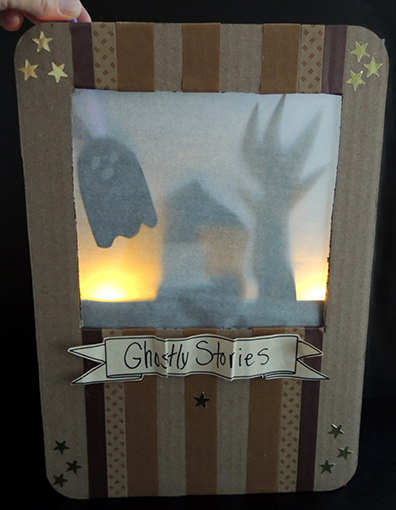
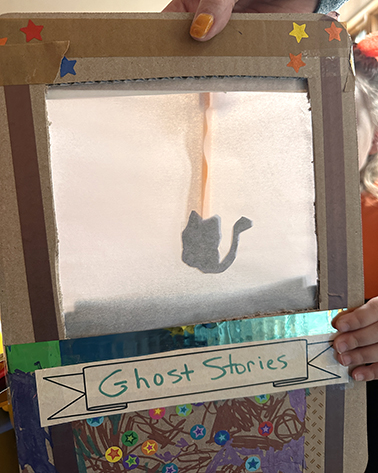
Turn down the lights and astound your audience with tales of adventures, hauntings, and astounding plot twists! Best of all, no special screen needed…it’s parchment paper from your home pantry.

We read Gilbert the Ghost by Guido Van Genechten (Clavis, 2014). Gilbert is not like the other ghosts at Ghost School. For starters, he was born blush, not ghostly white. And while other ghosts are shouting “Booooo!” Gilbert can only say “Ba…ba…bahoo!” For this, he is banished to the Abandoned Tower. But it’s not quite abandoned, and thus begins Gilbert’s wonderful friendship with Meow the cat. The roommates claim the tower for their own, and make it into the coziest little haunt you’ve ever seen. Soon, there are many visitors, but only one ghost who can say “Bahoo!”

You’ll need:

  • A rectangle of corrugated cardboard (we used a 10″ x 14″ cake pad)
  • A theater banner from the template, printed on 8.5″ x 11″ paper
  • Small boxes to prop the theater up
  • Parchment paper
  • Black poster board
  • 3 drinking straws
  • 2 LED votive candles
  • Scissors and tape for construction
  • Markers for decorating
  • Box cutter
  • Hot glue

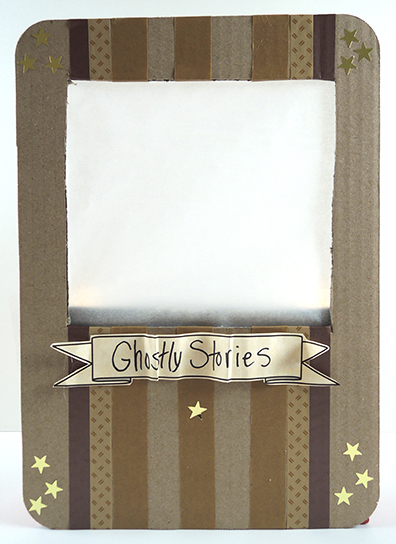
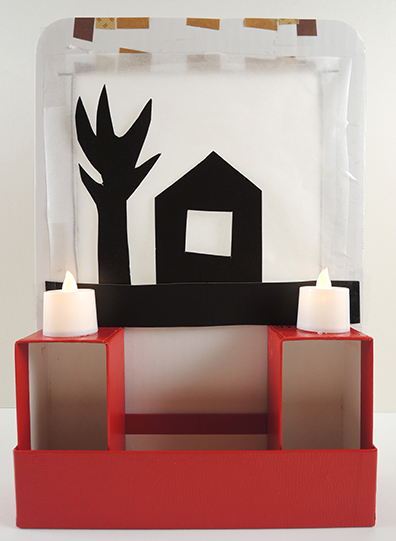
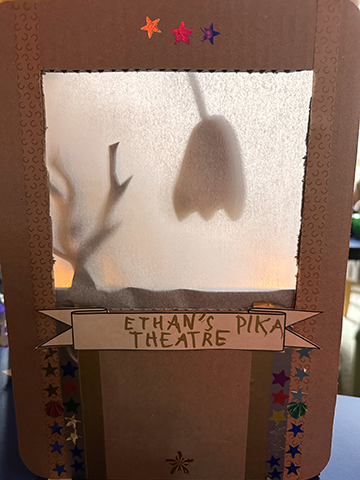
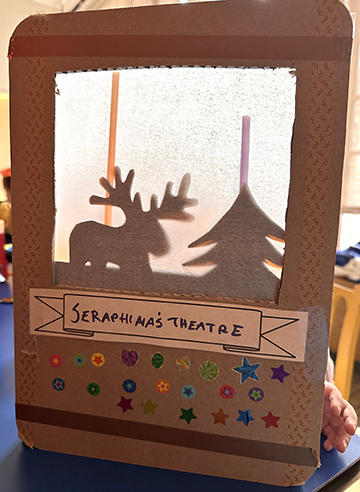
To create the front of your theater, cut a window into a piece of corrugated cardboard. Then use markers to decorate the cardboard stage (or use patterned tape and star stickers like we did). Add a banner from the template, and you’re done!

Flip the cardboard over, then tape or hot glue a piece of parchment paper on top of the window. This is your theater screen. Attach a strip of poster board to the bottom of the screen to create a pocket for your scenery to sit in during performances. Finish by hot gluing small boxes to the base to prop your theater up, making sure they are tall enough for two LED lights to stand on either side of the screen.

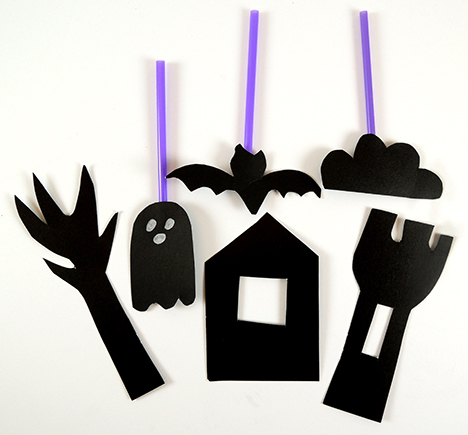
Now for the entertainment! Cut 3 pieces of scenery and 3 puppets from black poster board, then tape drinking straws to the top of the puppets.

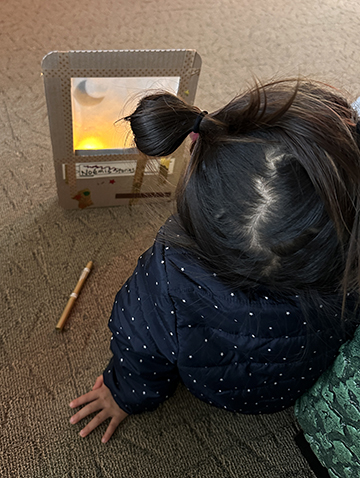
It’s showtime! Fire up those LED votive lights and enjoy!

And while we had some wonderful ghostly tales being told at Ethan’s Pika Theater…

And some intrepid cats on adventures elsewhere in the library…

At Seraphina’s theater, there were some distinct holiday vibes happening!
Sneak Peek: Wicked Science

We’re off to see the Wizard on a yellow brick road that also…wait for it…defies gravity, thanks to the magic of science and magnets!

This weekend, we’re hosting Wicked Science, a thrillifying event in collaboration with Science Outreach at Princeton University and the Department of Chemistry. In addition to a 45 minutes auditorium show, the event features hands-on tables staffed by Princeton University undergraduate and graduate students. The cool golden magnet tiles you see above are part of a game called Kollide (ages 8+, retails for $15).

To play the game, you arrange a rope in a circle and divide the 20 magnets evenly amongst the players (you can have up to four players at a time). Then each player takes a turn placing a magnet in the circle. As you can guess, the more magnets in the circle, the more they get attracted to one another and start scooting, twisting, and snapping together. If that happens, you pick up the bundle of snapped magnets and your turn is over. The first player to get rid of all their magnets without any magnets clumping together wins!

It’s super fun, especially when the magnets start to threateningly wiggle and move as you try to place them, then suddenly snap together. It’s like magic!

Alston’s Awesome Alphabet

Alexander Hay. John Alston of Rosemount, 1778-1846. Hon. Treasurer of the Glasgow Blind Asylum. National Galleries of Scotland Collection. Photo, National Galleries of Scotland.

In today’s post, Katie delves into our special collections vaults and makes some very interesting connections! Let’s join her…


Sometimes doing research in the Cotsen collection feels a bit like the children’s book If You Give a Mouse a Cookie. I start looking for one title, which leads me to a different topic, and then I change directions entirely from what I was originally looking for. During a recent research excursion, I discovered Alston Type books, a new-to-me alphabet created in the 19th century to teach people who are blind or have low vision how to read.

A Selection of Fables with Wood Cuts, for the Use of the Blind by John Alston (1838). The Treasures of the Cotsen Children’s Library Collection, CTSN 40903 Eng 18, Department of Special Collections, Princeton University Library.

Everyone knows Louis Braille, who became blind as a young boy and invented his namesake alphabet in 1824 when he was a student at the National Institute for Blind Children in Paris. The braille alphabet consists of 64 characters, with each letter or number made up of raised dots in a certain pattern and embossed on paper. Today, braille is universally recognized as the common writing system for people who are blind or have low vision. Before braille was used worldwide, there were other tactile reading systems; some are discussed in a post written by Library Collections Specialist Charles Doran on Princeton University Library’s Special Collections blog.

Another such system was created in 1837 by John Alston, who worked with the Asylum for the Blind in Glasgow, Scotland. Alston designed a raised font using the Roman alphabet in two different sizes: the smaller font for school-aged children and a larger version for older adults with a diminished sense of touch. Most of the Alston Type books were religious, but other topics included geography, music, natural history, and popular fables.

A Selection of Fables with Wood Cuts, for the Use of the Blind by John Alston (1838). The Treasures of the Cotsen Children’s Library Collection, CTSN 40903 Eng 18, Department of Special Collections, Princeton University Library.

Alston’s desire was for every blind person in the United Kingdom to have an opportunity to read and learn from the Alston Type books. In a letter sent to directors of institutions throughout Great Britain, he stated: “The advantage to the Blind in having books printed for their use, in a distinct and tangible character is incalculable.”1 Alston was awarded a government grant to assist with printing and by 1844, more than 14,000 volumes were available for purchase. All of the sales proceeds were used to print more Alston Type books.

From A Selection of Fables with Wood Cuts, for the Use of the Blind by John Alston (1838). The Treasures of the Cotsen Children’s Library Collection, CTSN 40903 Eng 18, Department of Special Collections, Princeton University Library.

Glasgow 2 Dec 1841
Sir:
I have much pleasure in presenting you with this specimen of my improved method of writing for the blind, by which they can easily decipher, and are enabled to communicate with their friends.
I am yours respectfully,
John Alston

Children trained to read using Alston Type had a much easier time learning and reading other raised type books. Most importantly and due largely in part to Alston’s contributions, it was soon considered essential by all to provide formal education to people who are blind or have low vision.

Outlines of Natural History: Quadrupeds; Embossed for the Use of the Blind by John Alston (1842). The Treasures of the Cotsen Children’s Library Collection, CTSN 19486 Eng 19, Department of Special Collections, Princeton University Library.

In a modern approach to inclusive education, LEGO introduced braille bricks in 2020. Along with a raised dot pattern on each brick, LEGO included the printed letter or character so sighted people could participate equally with the child who is blind or has low vision. There are multiple languages of braille bricks available for purchase, including French, Spanish, German and Italian.

LEGO. Play with Braille – English Alphabet. Set No. 40656 (The LEGO Group, 2023).

But the best part is the braille LEGO can be incorporated into all LEGO sets for additional ways to learn through play! LEGO also designed an online toolkit, The Braille Program, which provides professionals, teachers and families with courses, lesson plans, tips and tricks, and a multitude of ways to encourage playful learning.

Looking for picture books on this topic to add to your school or personal library? These titles come with our highest recommendation!

Image courtesy of Amazon UK

The Black Book of Colors by Menena Cottin and Rosana Faría (Groundwood Books, 2008) is a groundbreaking picture book written for children who are blind as well as children who are sighted. The entirely black pages throughout the book provide text in braille and printed white font on left, while the right-side pages have tactile raised line drawings of what the text is describing. It’s a beautiful way to challenge readers who are sighted to share the experience of a person who can only see by touch, taste, smell and sound.

Image courtesy of Amazon

Six Dots: A Story of Young Louis Braille by Jen Bryant (Alfred A. Knopf, 2016) shares the story of Louis Braille’s childhood and how he overcame many obstacles and challenges to invent an alphabet for people who are blind that is still in use today.


1 John Alston, Letter to the Directors of the Institutions for the Blind in Great Britain & Ireland, 4 July 1837