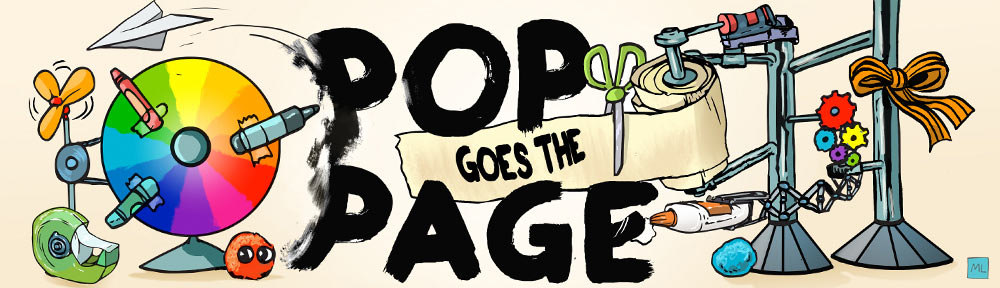
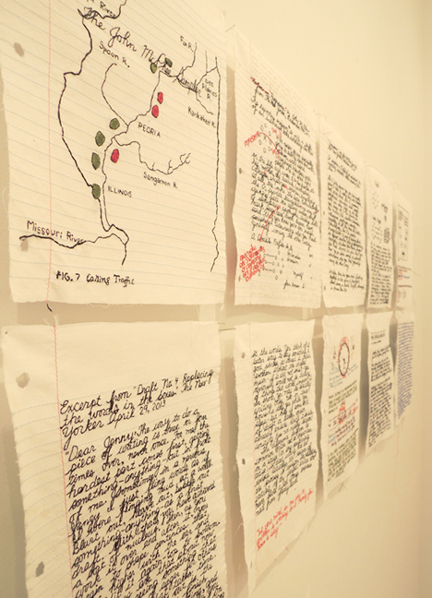
 Look closely and you’ll see that these are not handwritten pages of notes. They’re hand-stitched pages of fabric. The intricacy of the stitching, the re-imagining of lined paper as cloth, and the time it takes to produce a single page make viewing these pieces truly amazing. Also amazing is the touching and mindfully deliberate recording of life – both the extraordinary and the ordinary – through slow and careful stitchery.
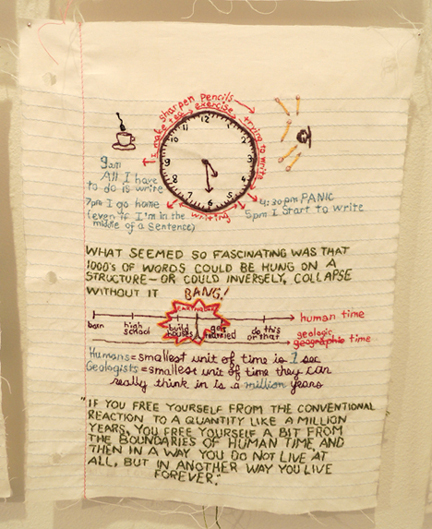 These pages are the works of Diana Weymar, currently the Artist-in-Residence at the Arts Council of Princeton. Diana’s also the curator of Every Fiber of My Being, a group show that explores the use of textiles as a second skin. As part of her residency, Diana has initiated Interwoven Stories, a community stitching project that invites individuals to record their own thoughts, feelings, experiences, and beliefs on fabric pages. Later, the pages will be displayed on five installations around town.
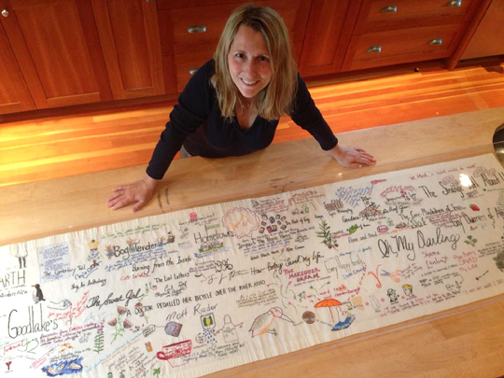 Please tell us a little about yourself!
I am 46 years-old, have four children ages 12-22, and live in the U.S. and Canada. I graduated from Princeton in 1991 after writing a creative thesis with Joyce Carol Oates. I have worked in publishing and film in NYC and the past five years have been focused on my art practice – the basis of which is using familiar materials in unfamiliar ways – and on community-based art projects.
When did you first re-imagine lined notebook paper as fabric?
When both of my maternal grandparents passed away, boxes of their belongings were sent to me. For some reason, I found their crisp white sheets – they belonged to the generation that saturated their sheets with starch – heartbreaking. At the same time, I was reviewing notes from my writing course at Princeton with John McPhee and found that his rules for writing also applied to my art practice. The continuity between the craft of writing and crafting sculptural pieces was surprising and enriching.
My notes and writing pieces from class with John were, in a way, very much like traditional samplers. Instructive. Practice-based learning. I wanted to spend more time with my notes from class and thought of rewriting them in thread. The term “thread consciousness” is often thrown around when discussing contemporary embroidery but it’s a very basic idea: the process of creation is a process of awareness and the longer you spend on a piece – written or stitched – the more aware you become. Communication is so quick now. Quickly created and quickly consumed.
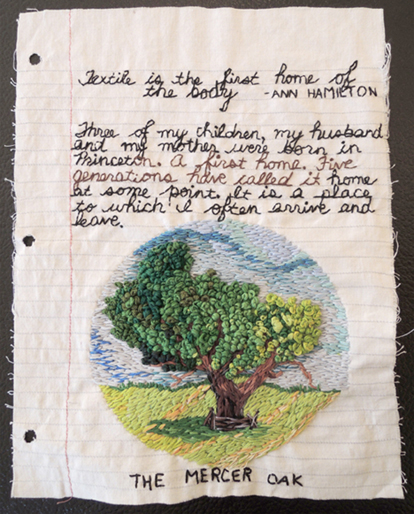 Can you describe the process behind creating a single sheet?
I cut 8 ½ x 11 pages out of bed sheets and then create the blue and pink lines by machine. For Interwoven Stories I created 200 fabric pages. They each take about 25 minutes from start to finish. I started to develop pain in my right hip from shifting my weight to the left to press on the pedal with my right foot. Sometimes I can still feel the vibrations of the machine coursing through my right side. Without music and podcasts to distract myself, I don’t think I would have been able to finish machine sewing the pages. Spending a concentrated amount of time with the sewing machine gave me a deep appreciation for labor-based practices. The final touch was to punch holes in the fabric sheets.
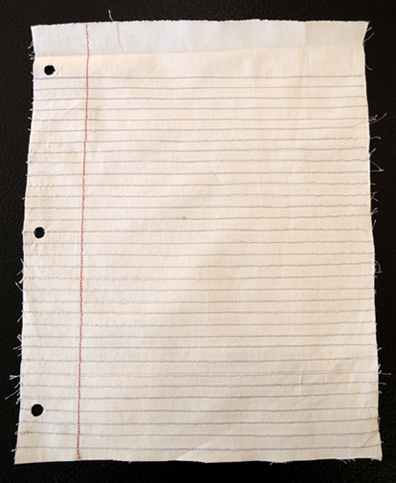 Is it difficult to achieve flow when hand-stitching? I imagine it’s quite a bit slower than writing, painting, or sculpting…
It’s “slow flow” but has exactly the same language and process as painting, drawing, and sculpting. I love the mechanics of stitching, the metaphorical aspects of hand, thread, and fabric. This particular practice has the distinct advantage of being very portable. If I can sit and there is light, I can stitch. With four children and a bi-coastal lifestyle, I’ve worked on planes, while watching squash matches, and at lectures. It’s very hard to put down a piece once I’ve started it.
How do you utilize the different types of stitches in your work?
I’m asked this question frequently because the basic misconception about stitching is that it is exclusively a craft-based language and that to speak it, you must know a series of “trade stitches.” I use thread the same way I use ink or paint. Every stitch is either a line or a dot. There are some fabulous and inventive names for stitches and, at this point, I enjoy the names of technical stitches more than I enjoy them in my practice. The French Knot is essential to many of my pieces but, for now, I am focused on layering, color, and pattern while using a simple stitch.
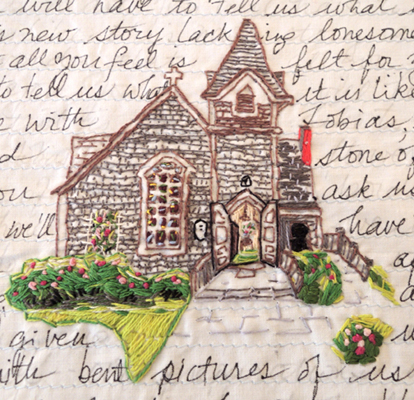 In your mind, what is the relationship between the written word and the stitched word? Are they the same? Vastly different?
When I think of the “written word” I think of the handwritten word. For me, the stitched word and the handwritten word are intimately related. The typed word is vastly different. It’s about looking and watching but not about creating a shape. Both the written and stitched word reveal so much about the author. All typed words look the same; all stitched and written words are different.
I realized recently that I have close friends whose handwriting I have never seen. My 12 year-old has not learned to write in cursive. I find all of this a little strange and disorienting. Would you rather hold a handwritten letter in your hand or read a letter on a screen? And if it’s been stitched, isn’t that almost like holding hands with someone? The next best thing? I find stitching to be very intimate. And caring. I have a friend who knit a blanket for me for Valentines Day. This still amazes me.
Though I am not making work for specific people, I am stitching as a way of sharing. What impresses me is that most people want to touch stitched words and images, to read them with their fingers. We touch screens but only to move content around. Not to read with our fingers.
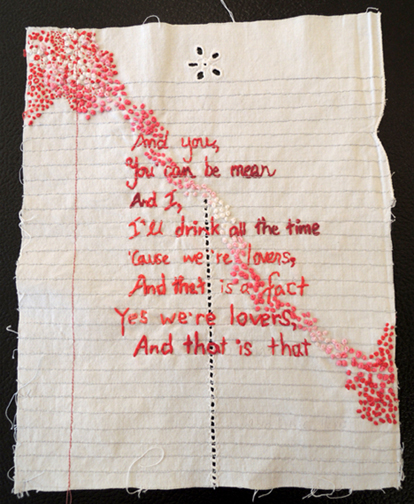 Please tell us about your community art project involving fabric paper.
Interwoven Stories is a version of a project that I did in Nicosia, Cyprus, Spring 2015, with Build Peace. I watched the lectures from the 2014 conference at the MIT Media Lab on video and I wanted to create a project using an “ancient technology” in a contemporary setting. Build Peace focuses on the use of cutting-edge technologies in peace building and the exploration of art as connection.
Interwoven Stories is also a community-based project in which 200 fabric pages have been handed out in Princeton to be stitched by residents of the community. I was recently at a dinner party in Princeton with someone who explained to me that UNESCO uses “cultural mapping” to promote intercultural dialogue and this resonated very strongly with me. Princeton is a very diverse community and I’m very much looking forward to collecting and curating the pages. I cannot wait to “read” them.
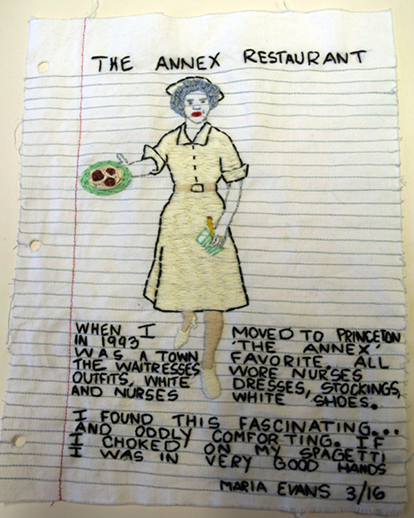
Interwoven Stories submission by Maria Evans
Images courtesy of the artist and the Arts Council of Princeton.
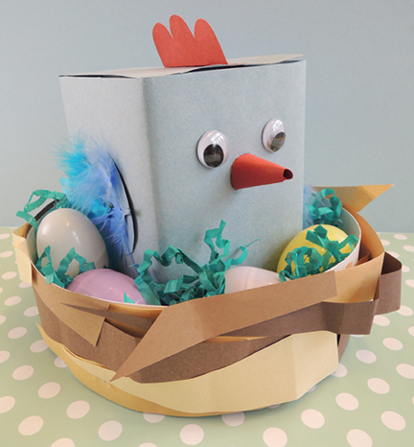 Seeing blue chickens? Do not adjust your monitor. Cerulean poultry are a perfectly normal story time occurrence.
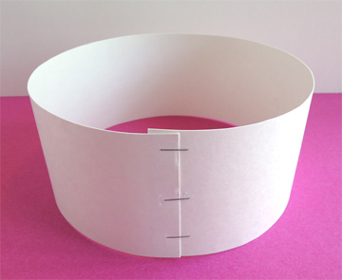 Slide the paper plate back inside the circle, pushing it all the way to the bottom.
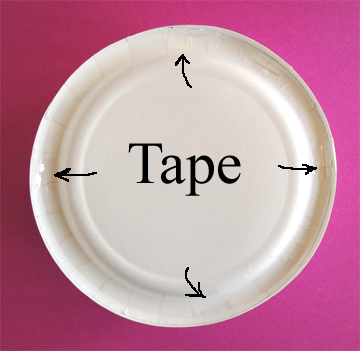
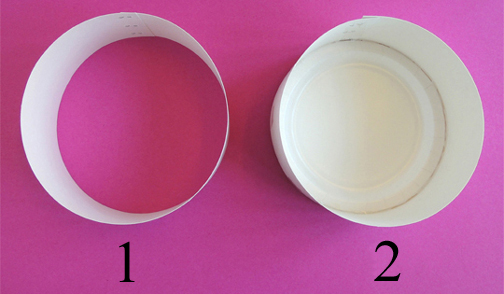 Now flip the “nest” over and use tape to reinforce the connection between the plate and the circle. I used at least 4 pieces of tape:
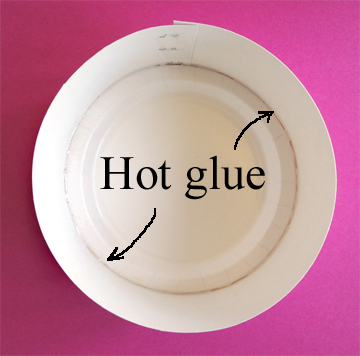
 I also reinforced the inside connection with a ring of hot glue.
 Finally, decorate your nest with uneven and crinkled strips of brown construction paper. Attach the strips to the nest with tape and/or glue.
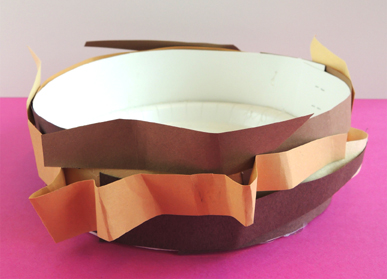 Set the nest aside, it’s time for the chicken!
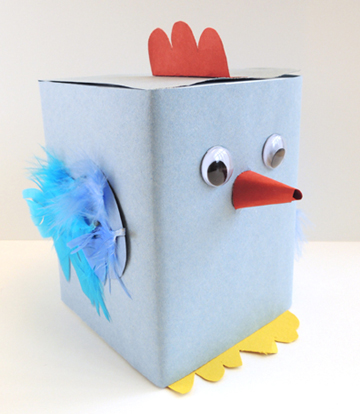 Wrap a box with blue construction paper. Glue a pair of yellow paper feet on the bottom, and blue paper wings on either side. Make a red paper cone beak, and hot glue it to the front of the box. Add a pair of wiggle eyes, or simply draw the eyes on with markers. Glue or tape feathers to the wings (add tail feathers to the rear if desired). Use red paper to make a comb for your chicken’s head. Then tab it and glue or tape it to the top of the box.
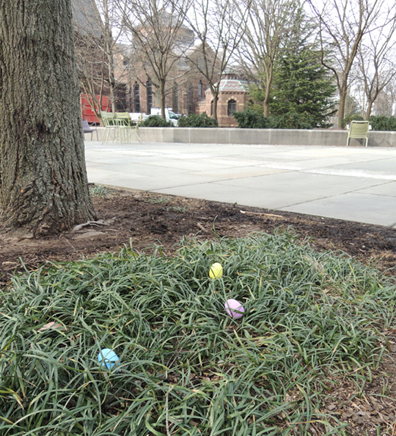
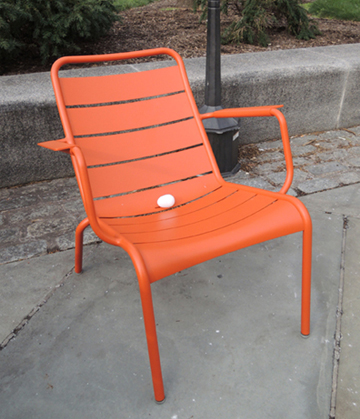
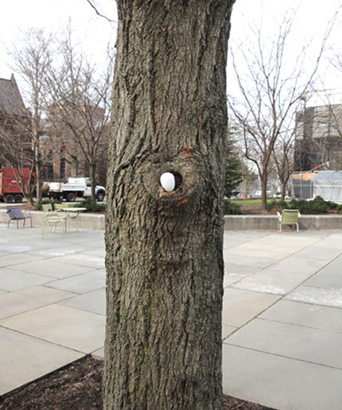
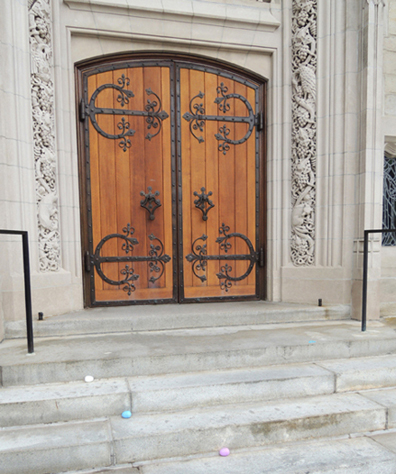
 When the chickens were done, we headed outside to the library’s plaza, where we had hidden a bunch of plastic eggs. We told the kids they needed to find 5 eggs each, then shouted “1-2-3 Go!” To insure success, we tried to make the hiding places fairly obvious (and even held a few back to drop right in front of the kids while they were hunting):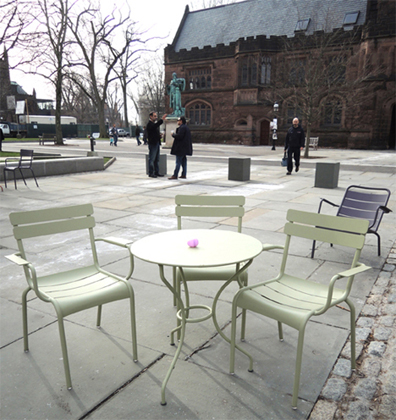
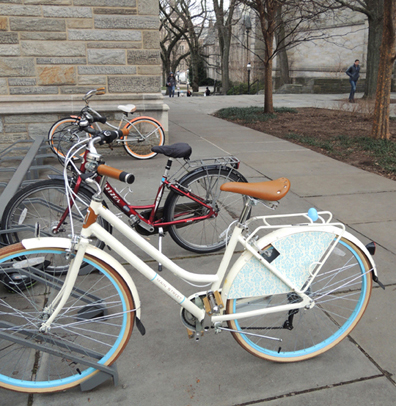
 You might recognize that ornate door from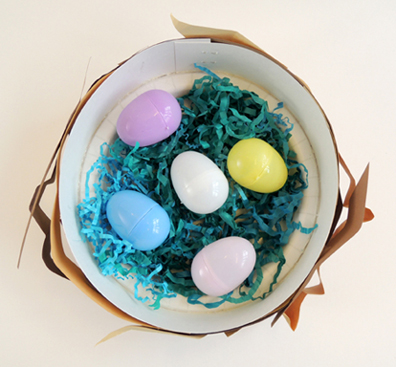
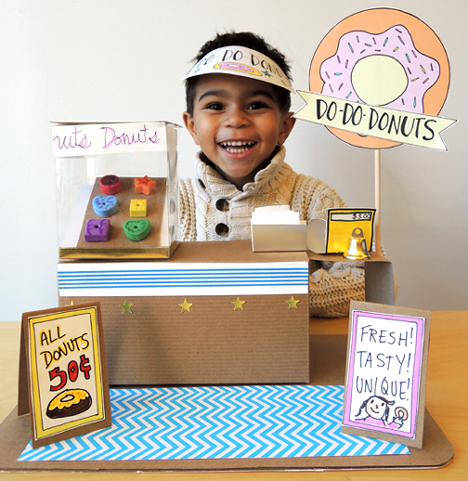 The shop is open, the customers are arriving, and you, the donut chef, must make the most delicious, different, and decadent donuts you possibly can. But wait, there’s more! Your donut shop doubles as a matching game, thanks to the coupons tucked behind the counter!
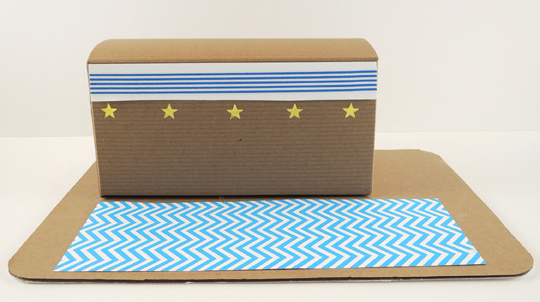
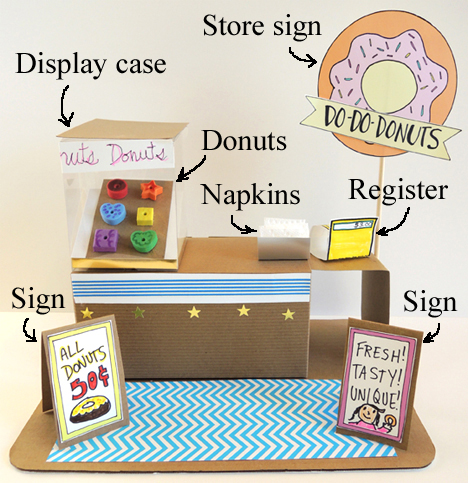 First, glue a piece of patterned paper (or construction paper) to the top of the corrugated cardboard base. It’s OK if it doesn’t cover the entire base. Decorate a box with patterned tape and/or markers (we also used star stickers). Hot glue the box to the base, but not smack in the middle. You’ll need to leave a little room in the front for your shop signs, and a little room on the right-hand side for an extra counter.
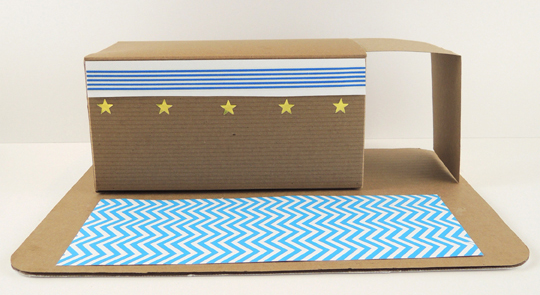
 Fold, then tape a piece of tagboard to the side of the box to create the extra counter.
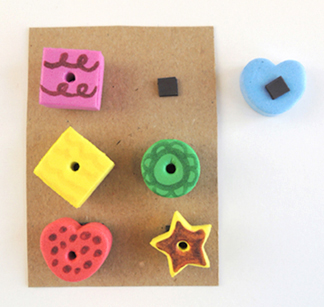
 Set the base aside for a moment, it’s time for donuts! Because we wanted to display, remove, and reset the donuts on the tray, we made them magnetic. Use markers to decorate various foam beads like “donuts,” then attach a little piece of self-adhesive magnetic tape to the back. Attach a matching piece of magnetic tape to a tagboard “tray.” We made 2 trays of donuts for our shops.
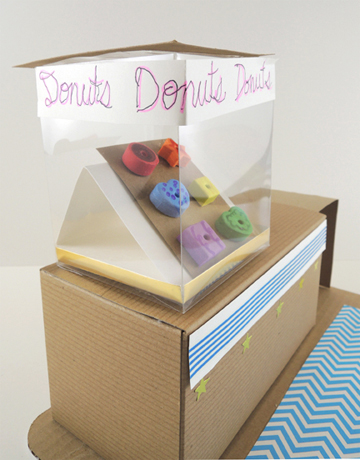
 I made display cases for the shop using leftover plastic boxes from
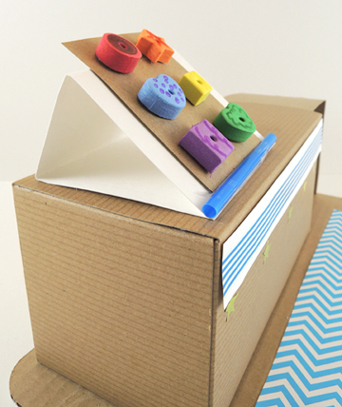
  If you don’t have a plastic box, just use the triangular base! To keep your donut tray from sliding off, tape a small piece of plastic drinking straw to the bottom of the base.
 Your shop will need a cash register, and you might recognize the one on the template from
 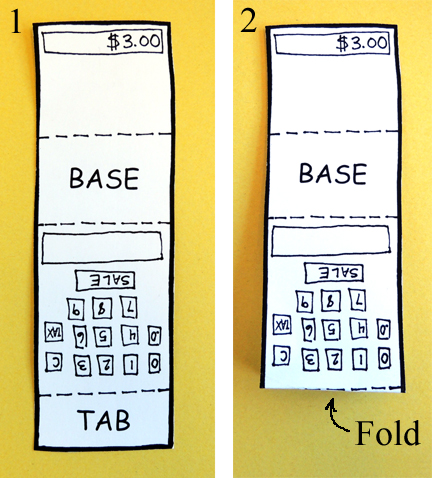 Then, fold both sides downwards from the base like this:
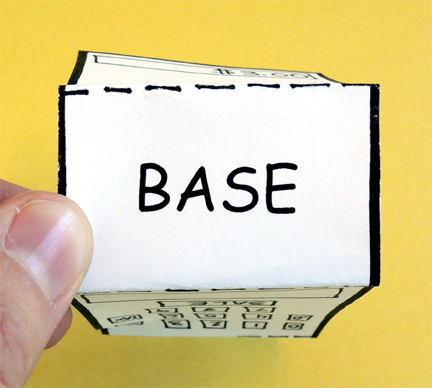 Curl the tab around to meet the opposite side of the register
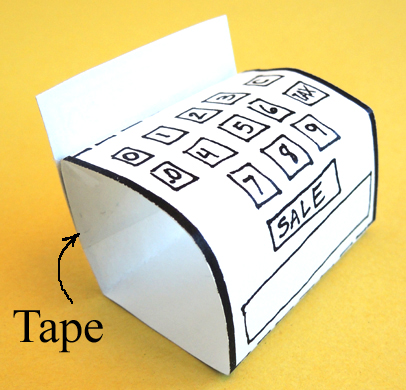
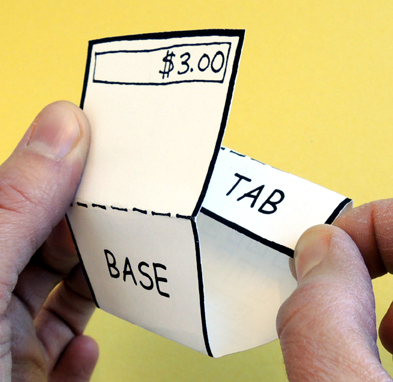 Then secure the tab with tape. Hot glue (or tape) the register to the extra counter.
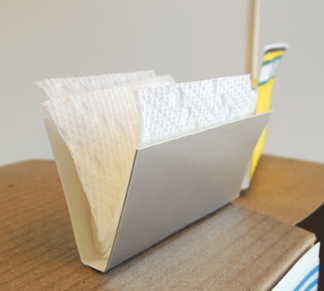
 I couldn’t resist adding a napkin holder to the set too. It’s a folded piece of silver poster board with little bits of paper towel tucked into it. Hot glue (or tape) it to the counter.
 The blank signs on the template get colored in and attached to folded pieces of tagboard.
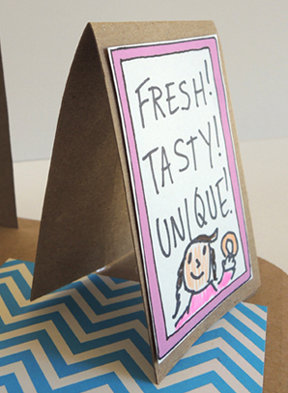 And finally…the giant donut sign! Write the name of your shop on the banner, and tape (or glue) it across the giant donut. Tape the sign to a wooden dowel, then tape the dowel to the side of the extra counter. Here’s a finished stand with a display case:
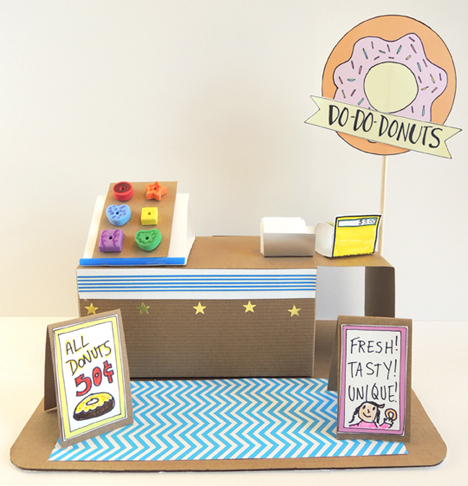
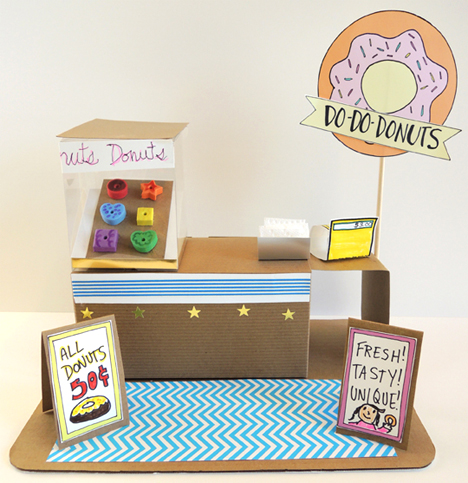 And here’s the version with the simple display stand. Both are totally adorable.
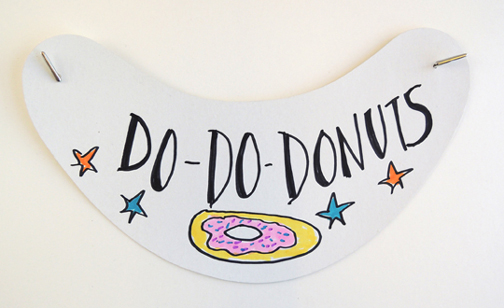
 We had some blank white visors in the art cabinet (from Discount School Supply – 24 cost $9), so I dug them out and we decorated them with the names of our donut shop as well.
 Your shop is ready, now you need to entice your customers to try some donuts! We developed a simple coupon matching game for the kids. Print the coupons from the template, then draw donuts on the coupons that match the donuts in your case. As your customers arrive with their coupons, see how fast you can find and match their orders!
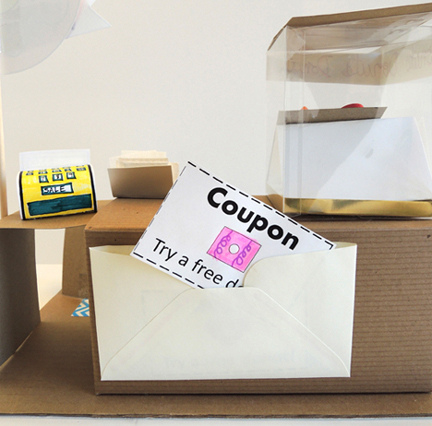
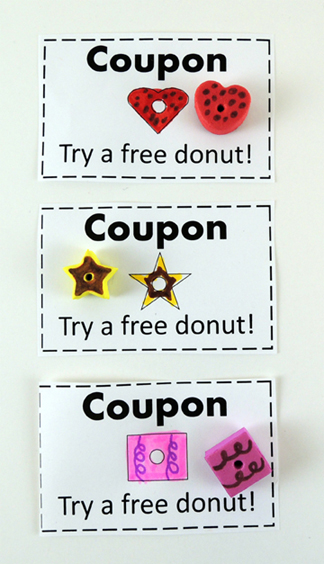 Make sure to hot glue (or tape) an envelope to the back of the counter for convenient coupon storage.
 We wish you the sweetest success in all your donut endeavors!