
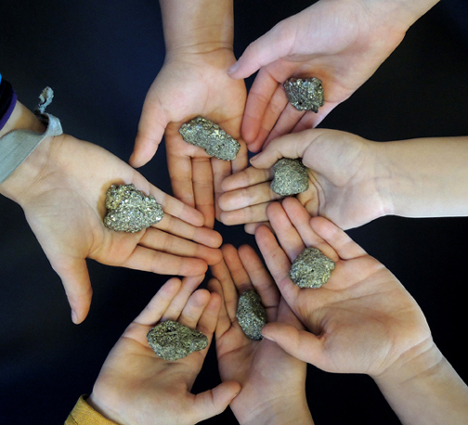
It sparkles and shimmers. Could it be gold? Well, you might strike gold and get rich…or you might be fooled by some glittery pyrite! We made some awesome geology connections at To Be Continued, our story time for 6-8 year-olds, including rocks that sing!
We read Missing on Superstition Mountain by Elise Broach (Henry Holt, 2011). Brothers Simon, Henry, and Jack have moved from Chicago to Superstition, Arizona. The sleepy little town is shadowed by the looming and unforgiving Superstition Mountain, which has a history that none of the adults seem to want to share. The boys have been forbidden to go into the mountains, but when Josie the cat runs away, they follow her and soon uncover a mystery that involves three human skulls, a lost gold mine, and the strange, seemingly supernatural, power of the mountain. Can the boys and their friend Delilah survive Superstition?
In addition to a secret gold mine (which is totally awesome), Missing on Superstition Mountain has quite a bit about rocks, landscapes, and geology. When we finished the book, I thought it would be cool to do some rock-based activities. And Princeton University have some fantastic resources when it comes to geology.
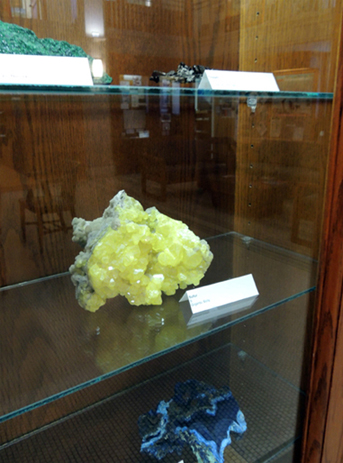
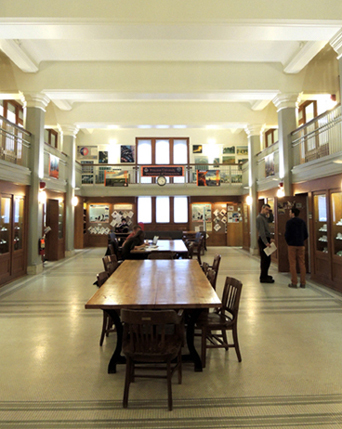 First, we took a walk across campus to Guyot Hall, home of the Department of Geosciences. Their central office space is lined with display cases full of rocks, gems, fossils, and minerals.
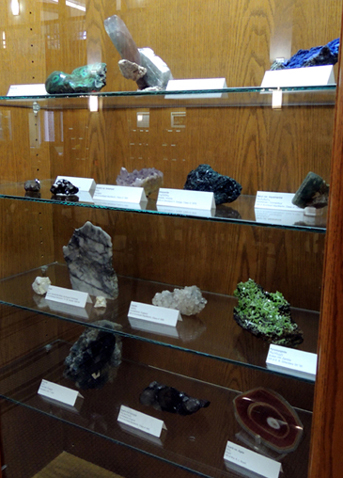 The kids oohed and aahed over some of the precious stones…
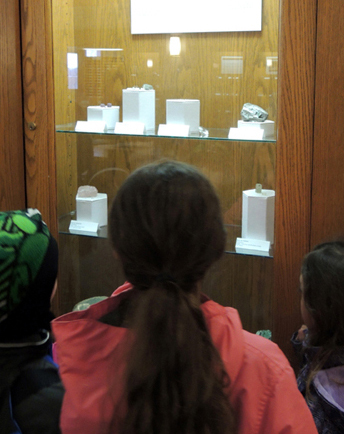 But were equally impressed by the gigantic mineral specimens!
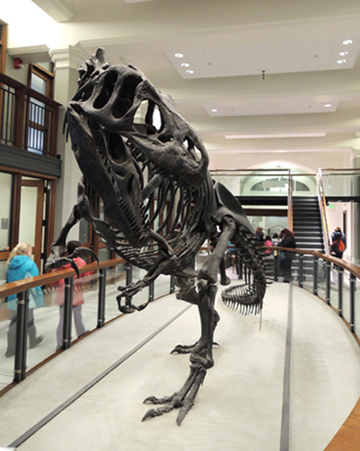
 We visited a Allosaurus skeleton and a T. Rex skull on our way out of the building. Yes!
 Back at the library, I had samples of pyrite for the kids to look at (courtesy of Laurel Goodell, manager of the undergraduate labs in geosciences). Pyrite is called “Fool’s Gold” because of its sparkly gold appearance, but it’s actually a mineral.
 The kids couldn’t take home the big samples of pyrite, but I did find some smaller pieces on Amazon. I bought three, 0.2 ounce boxes of pyrite nuggets for $5.79 a box. They arrived powdered with black grit, so be prepared to do some major rinsing, and maybe a little scrubbing, before you given them to kids. But as you can see below, they cleaned up nicely and there were some pretty good sized pieces in there.
 The kids took their stash home in a cotton drawstring bag (left over from this event). I also tucked a little information sheet inside the bag too (here’s the template if you’re interested). But I saved the best geology connection for last. Did you know that some rocks can produce musical notes?
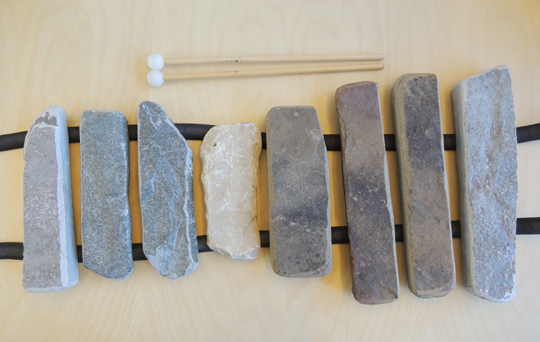 This is a lithophone. It’s a xylophone with tone bars that are made out of stone (as opposed to wood or metal). When you strike the stones with a mallet, they produce a musical tone. But not all rocks sing! It takes a lot of trial and error, as well as a lot of chipping and grinding to make rock tone bars. The stones you see above are limestone, sandstone, and granite.
The lithophone was made by Tom Kaufman, owner of Tinkertunes Music Studio in Michigan. I commissioned him to build it for a Journey to the Centre of the Earth event in 2013. After the event, the lithophone went to its new home in the geosciences lab.
Ready for a little rock concert?
If you think that’s cool, you should check out Tom’s lithophone fence. It plays “Row Row Row Your Boat” as you run around it with a mallet! The fence was installed at the Gerald R. Ford Presidential Museum in Grand Rapids, Michigan for ArtPrize, an annual art contest.
Many thanks to Laurel Goodell and the Department of Geosciences for the pyrite and lithophone loan!
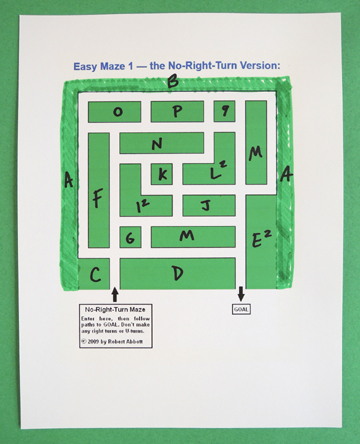
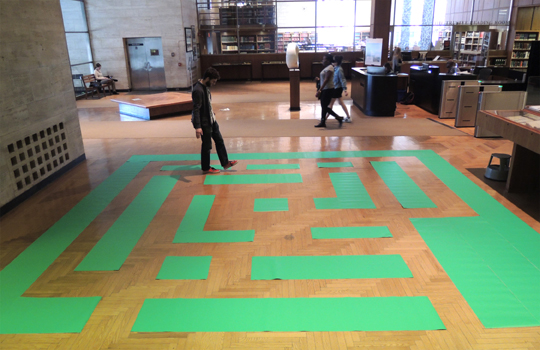
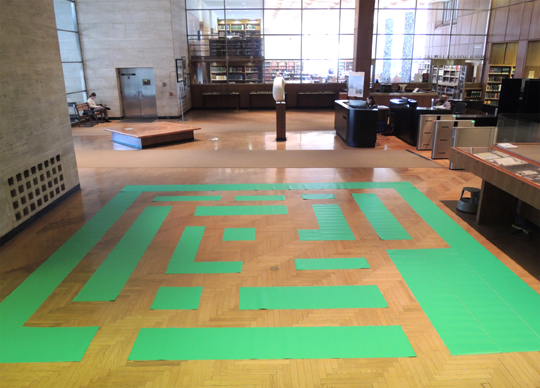 Today, we offer an exclusive first look at something big on our horizon. This month, my library is hosting a major math event. It’s called A Day at Digitopolis (named, of course, after the famed city in The Phantom Tollbooth). Today, you’re going to get a sneak peek at one of the activities – a giant 16′ x 16′ floor maze. But this is no ordinary maze! You have to get from start to finish without taking a single right-hand turn. Want to build one of your own? Read on!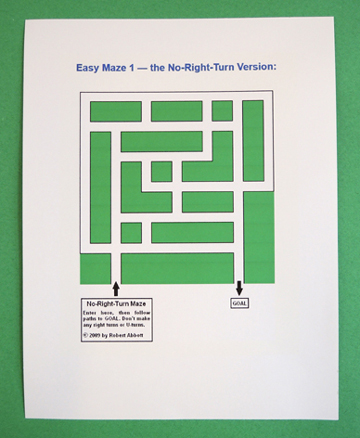
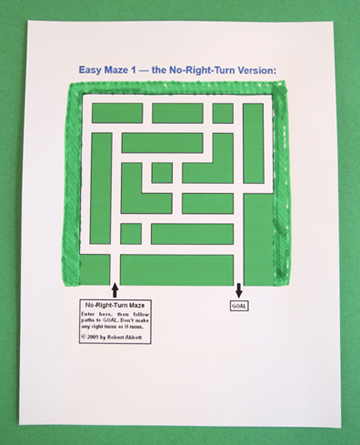 Once I finalized the maze design and decided that it was going to be 16′ x 16′, I had to calculate how much contact paper we needed. The rolls I found on Amazon were a standard width of 18″, so I just had to determine the length. I work best with models, so I crafted a little maze, in which 1″ = 1 foot.
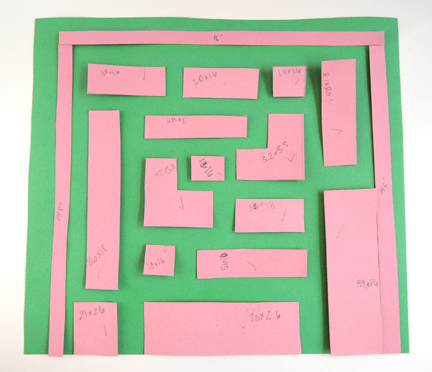 Once I added up the lengths of all the pink pieces, I had a rough estimate of how much contact paper we would need (112.25′). I ordered two, 75′ rolls, which left plenty of extra paper for mistakes. The task of actually building the maze fell on Marissa and Casandra Monroe. Casandra is a Princeton University student and super math whiz!
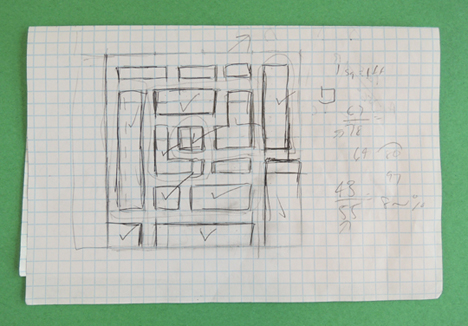
 Casandra sketched the maze on graph paper, in which 1 square = 1 square foot. Then she drew a 16 x 16 square and sketched the various pieces inside it. To make the calculations nice and simple, she made path through the maze 1′ wide.
 Then, Marissa and Casandra headed to the library’s cavernous main lobby and started building. They laid down the outer walls of the maze first:
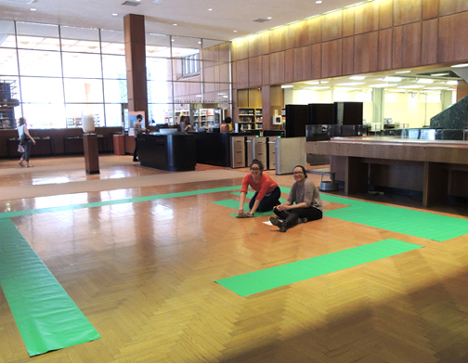 And then cut and placed the internal pieces of the maze.
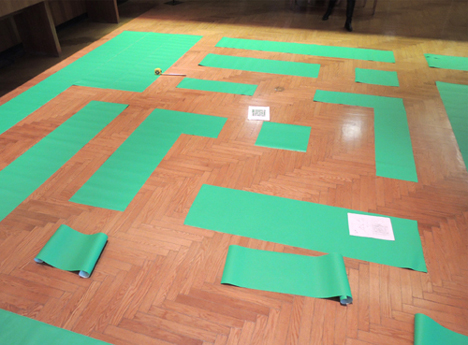 While they were filling in the pieces, they used a measuring tape to keep the path as close to 1′ as possible (even though there were some areas where the path was wider).
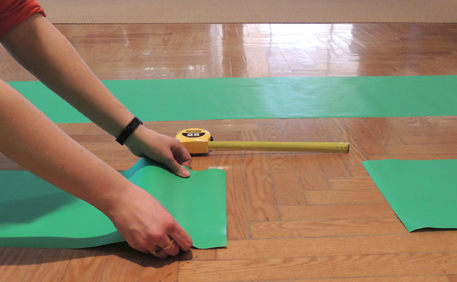 Marissa and Casandra kept the backing on the contact paper. But to keep the pieces from curling up, they used masking tape loops to temporarily adhere it to the floor.
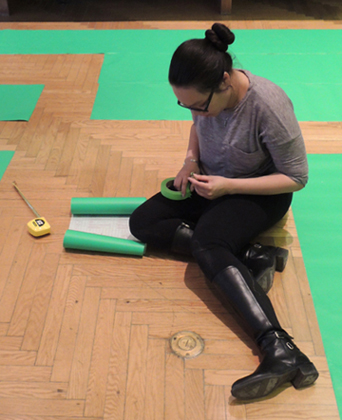 They also used permanent marker to label the backs of all the pieces and match them to a diagram of the maze.
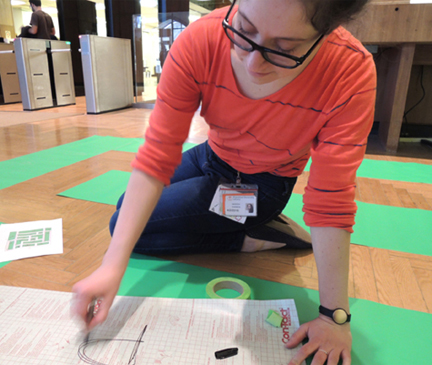 The morning of the event, we’ll be able to glance at the diagram, check the backs of the pieces, and peel and stick the maze quickly (we’ll have a measuring tape on hand to remeasure the pathways too).
 All in all, the maze took about 3 hours to put together. Cue “Eye of the Tiger!”
 Three important things: 1) Don’t forget to mark the start and finish of your maze (we’re using extra pieces of contact paper with “start” and “finish” written on them in permanent marker); 2) At the event, make sure to have the
  The real test, of course, will be at the
 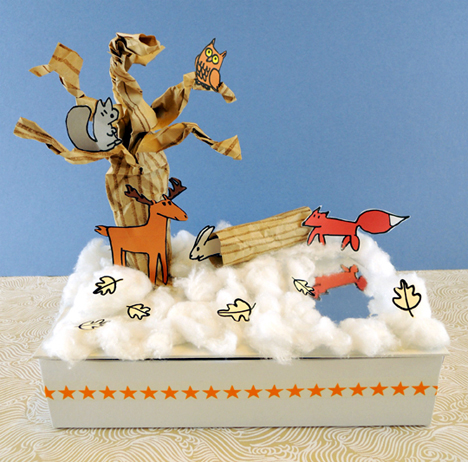 It’s a diorama, a keepsake box, a mini exhibit, AND a lesson in ecology! Open the lid of this winter landscape and you’ll find the creatures that hibernate, burrow underground, and tunnel underneath the snow, complete with an information card!
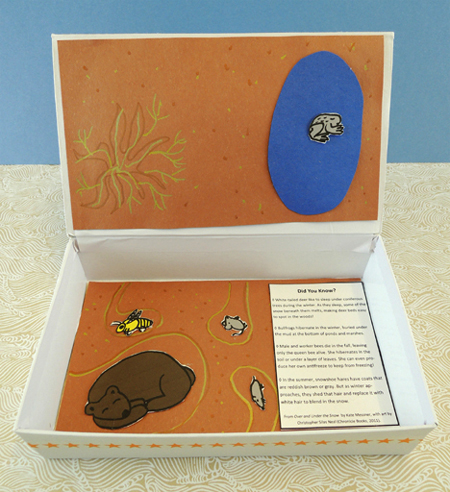 We read Over and Under the Snow, written by Kate Messner, and illustrated by Christopher Silas Neal (Chronicle Books, 2011). A father and child ski over the deep snow in the woods. Even though it’s a world of white, signs of life are everywhere – squirrel, owl, deer, snowshoe hare, and fox. But under the snow is yet another world. Shrews and voles run in tunnels. Bullfrogs burrow in the mud, bears hibernate, and a queen bee sleeps, waiting for the first signs of spring. The book ends with the child in a cozy bed, dreaming of nature. An absolutely beautiful book, with gorgeous, bold illustrations set against snowy white.
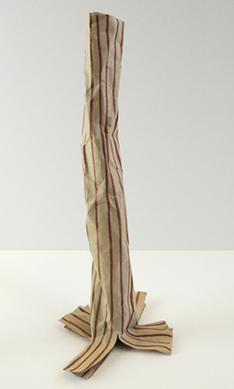
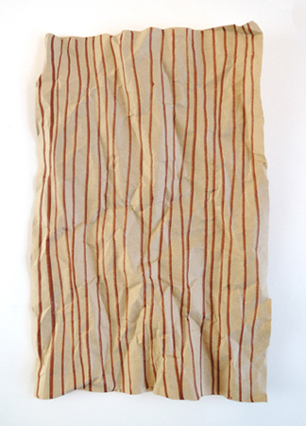 Roll the paper into a tube and secure it with tape. Cut 4 tabs in the bottom of the tube (each tab should be about 1.5″ long). Fold the tabs outwards. Later, you’ll use these tabs to attach the tree to the box lid:
 Cut 5-6 tabs in the opposite end of the tube (these tabs are much longer, about 5″). Fold them out gently, then twist them to create the branches of your tree.
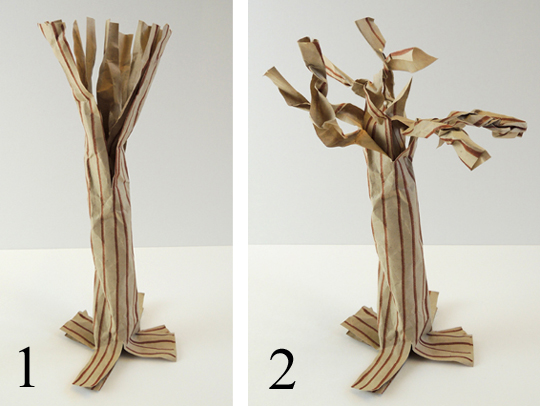 Hot glue (or tape) the tree to the lid of the box. If you’d like to add a log to your landscape, use a brown marker to draw horizontal lines on a 3.75″ x 4.5″ rectangle of brown wrapping paper. Crinkle the paper, then roll the paper into a tube and secure it with tape. The final length of the log should be 3.75″. Set the finished log aside for a moment.
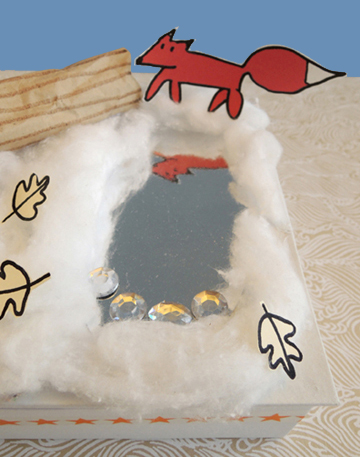 Your winter landscape is complete! Well, maybe not quite complete…
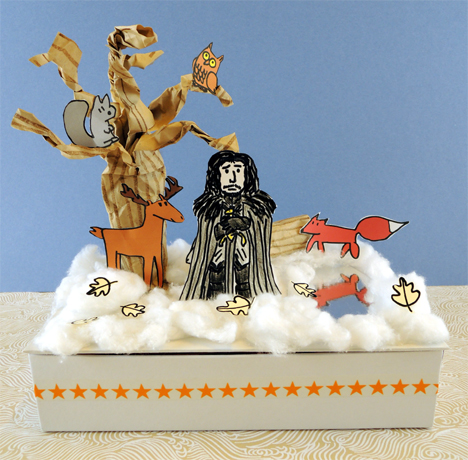 Bet you a