 Our robot project has something very special inside – open its chest door to reveal a burst of birdsong, straight from the heart! And for an extra story time surprise, a life-size robot stopped by for hugs and high fives! Here’s the robot project in action:
We read The Robot and the Bluebird by David Lucas (Farrar Straus Giroux, 2007).
When a robot’s broken heart can’t be mended, he is exiled to a scrap heap. As the days pass, he grows rusted and despondent. One winter day, a bluebird flies into the scrap heap, and the robot invites her to rest in the space where his heart used to be. She does, and the robot is amazed. The bluebird’s wing beats feel like his heart is beating again! Her singing makes him feel like his heart is singing! Unfortunately, the bluebird can’t stay – it’s too cold for her to survive. In fact, she fears she doesn’t have the strength to reach her final destination. So her robot friend carries her through blizzards, fog, and biting winds, until at last they come to a warm place where the sun is shining. There, the exhausted robot freezes in place, his strength finally spent. But the bluebird continues to live in his heart, and so do all the other birds. They circle around him, singing with joy.
I defy you to get through this touching book without choking up! It’s beautifully written and illustrated. What makes it even more special is that this was a special request from a story time regular who will be aging out of the program during our gallery renovations. It’s one of his favorite books. This one’s for you Aaron!
You’ll need:
- 1 large box with a hinged lid (ours was 4.5” X 4.5” x 9” – a large tissue box works)
- 1 small box (ours was 4” x 4” x 4” – basically, anything that fits inside the larger box)
- 1 packing tape core
- A box cutter
- Robot decorating supplies (more on these later!)
- 1 wooden bird whistle
- 1 bubble tea straw
- Scissors, tape and glue for construction
- Markers for decorating
- Hot glue
You definitely need a box with a hinged lid for this project. We went with our standard 4.5″ x 4.5″ x 9″ handy dandy craft box.
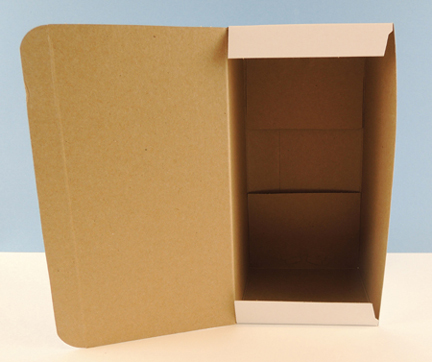 But you can also use a large tissue box. Just use a box cutter to create a hinged lid out of the bottom of the box like so:
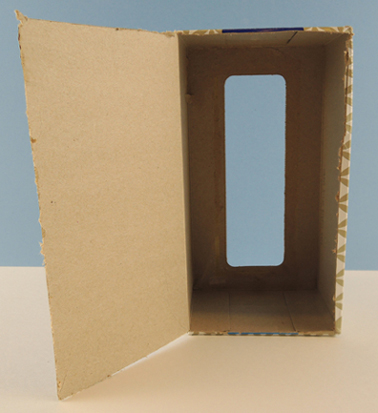 Next, fit a small box inside the large box. The small box is the robot’s chest cavity, so you will need to place it near the center or the large box. We did this by hot gluing a packing tape core to the bottom of the small box, then attaching the whole assembly inside the large box with more hot glue.
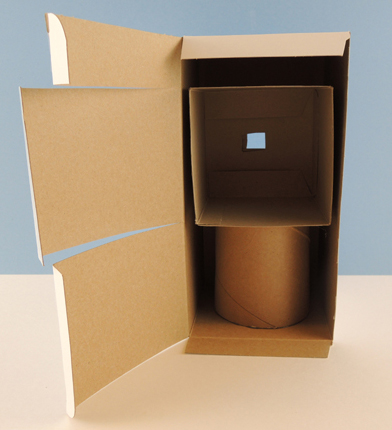 You’ll notice that the lid of the box is cut into 3 sections. These sections eventually fold over to form the front of the robot. Secure the top and bottom sections closed with tape, but leave the middle section open so you can access your bird whistle later.
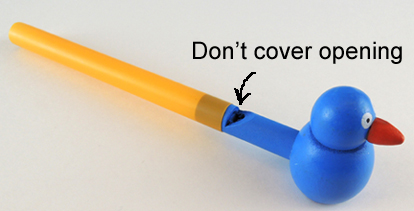
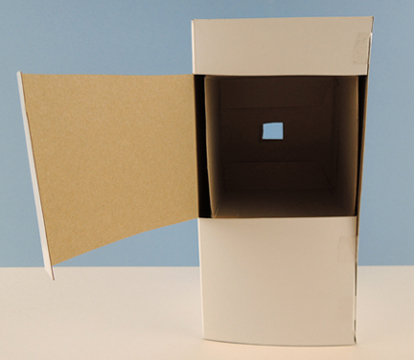 In the above image, you’ll also notice a small square cut in the back of the box. That’s for the mouthpiece of the bird whistle. Use a box cutter to create the square, making sure your cut goes through both the large and the small box. Next, cut a bubble tea straw down to approximately 5″, and slide it onto the mouth piece of a wooden bird whistle (we got ours on Amazon, $8 for 12). Just make sure the little opening in the whistle isn’t covered, or the whistle won’t tweet!
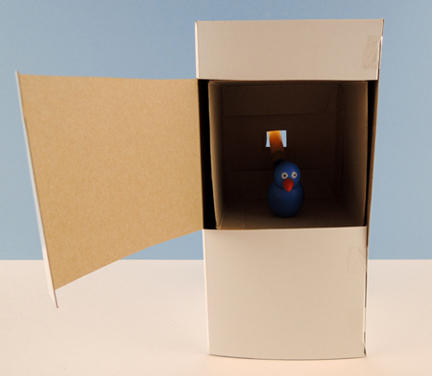
 Thread the straw through the square hole in the back of the box. Now your bird whistle is resting inside the box, and the bubble tea straw is extended out the back.
 Time to decorate the robot! We offered extra boxes for heads, poster board strips for the arms and legs, tin foil, mini aluminum cake tins, mirror board, metallic pastry circles, sparkle stems, tape cores, dot stickers, plastic buttons, textured silver paper, holographic tape, silver paper straws, and foil star stickers. To make your robot’s heart sing, hold it in front of you, open the chest door, and blow on the bubble tea straw.
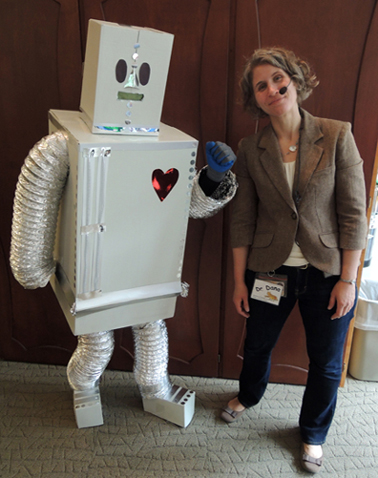
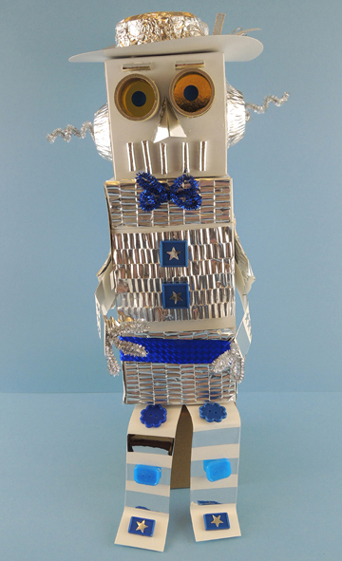 So that’s the project, but there’s ONE thing we did to make this story time extra special. Instead of giving the kids bird whistles while they were making the project, we waited until everyone was finished. Then, a LIFE-SIZED ROBOT came walking into the gallery, carrying a flock of bird whistles for the kids to choose from!
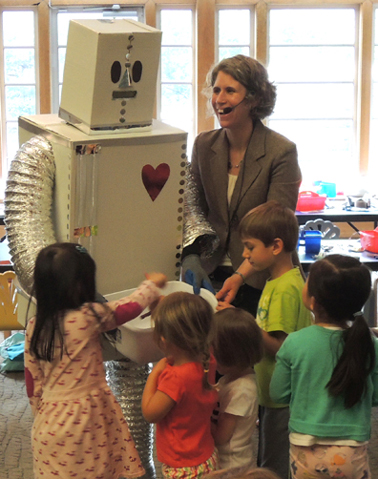 That’s Ian in there, expertly playing the robot (also on his resume – walking a dog, getting a blog tattoo, strewing hearts, channeling his inner Grover, and testing wizard pudding). We put the costume together with a couple boxes. The arms and legs are 8″ flexible foil duct tubing from the Heating & Cooling section of Lowe’s. It took a couple fittings to get the head, torso, arms, legs, and feet to work together. Ian could juuuuust see out of the mouth of the robot, which we covered with a couple layers of yellow tulle.
All in all, Ian was pretty nimble inside the robot costume, even though I did have to help him get around a few obstacles with his box feet. Our puppet theater proved to be a bit of a challenge, but as you can see, Ian recovered beautifully.
Of course, this post would not be complete without a Pop Goes the Page group robot dance…so…without further ado…
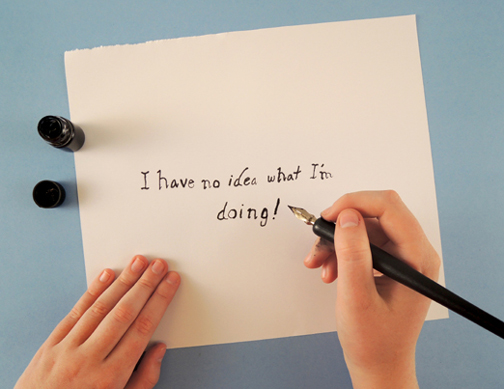 We are truly honored to bring an old friend back to the blog today. Remember Hope, our kid tester? The last time we saw her, she was testing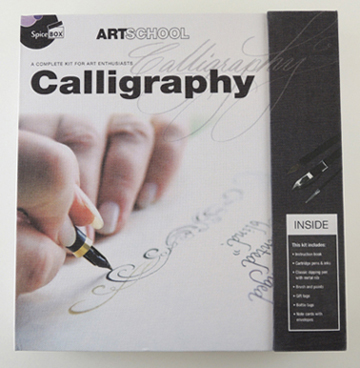
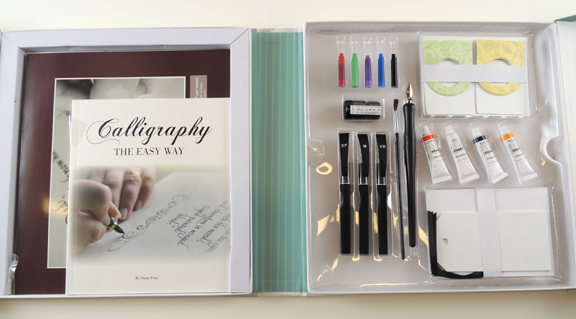 The kit includes: 1 instruction book, practice paper, 3 cartridge pens (xtra fine, medium, and xtra bold), 5 ink cartridges (red, green, purple, blue, and black), 1 classic dipping pen with metal nib, 1 small bottle of black ink, 4 tubes of gouache (red, white, blue, orange), 1 paint brush, 4 gift tags, 4 bottle tags, and 8 note cards with envelopes. After reading the extensive list of supplies included in the kit, I searched the exterior of the box, the interior of the box, the instruction manual, and pretty much everywhere else for a suggested age range for the product…
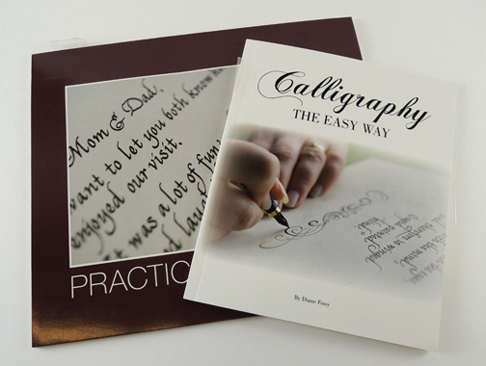 Upon opening the instruction booklet, which was titled Calligraphy the Easy Way by Diane Foisy, I was pleasantly surprised to find a ten page history on calligraphy’s origins, purpose, and more recently, its decline, and those who are attempting to keep the art form alive.
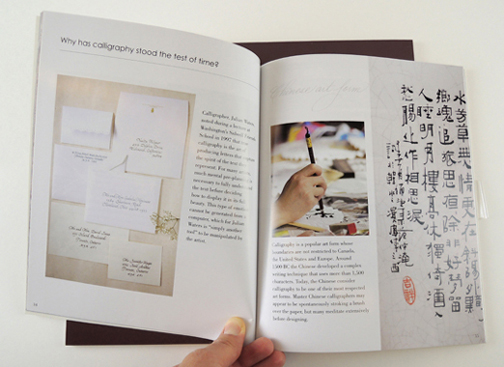 With the ending of that section, in bold letters, it said “History has shown us that calligraphy will prevail.” I’m not sure about you, but to me that sounded a bit sinister, a bit secret society-ish. There was nothing exactly wrong with the statement itself; it just felt a bit chilling for a craft kit instruction booklet.
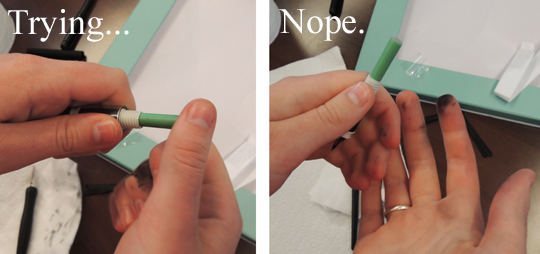 On that page, it also mentioned directions for using a “classic stylus”… nowhere else in the kit is this mentioned. Perhaps it is referring to the “classic dipping pen,” but if so, that was not made clear.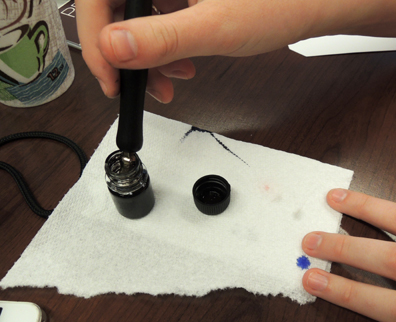
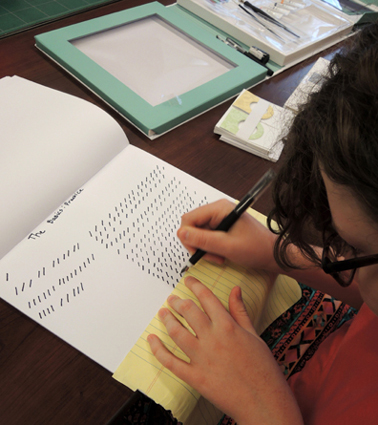 Needless to say, I was not very adept at creating even these simple lines. When I was making these lines on the practice paper provided, the ink went right through the paper. When it did not go through the paper, it bled on the surface of the paper, so it did not make clean lines like those pictured in the booklet.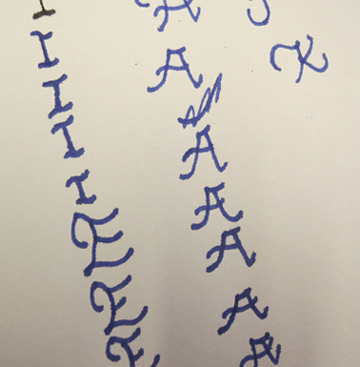
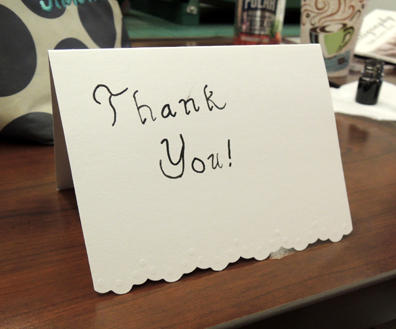 The booklet ended with a brief piece about the history of illumination, a type of medieval calligraphy done mostly by monks, and a few pages of flower templates that the author encouraged you to copy and use in your own designs.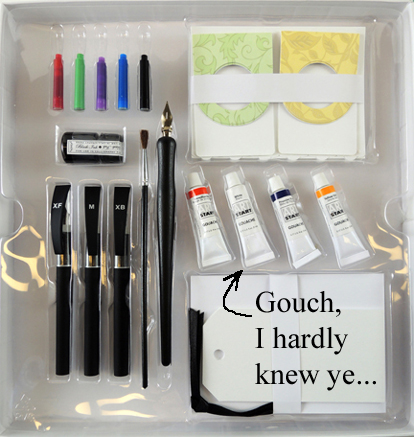
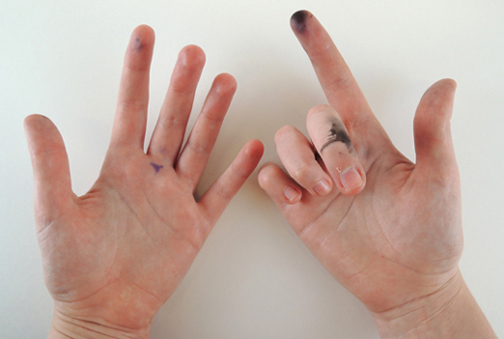 I was so excited to use this product to make something beautiful with calligraphy, but instead I felt inadequate and mocked by the instruction manual. I should’ve been the one mocking the inadequate instruction manual. Since it was called (and I quote) an “instruction book,” I felt that I should have been instructed, not loosely guided by numbers and arrows. On the plus side, I gained a new appreciation for Charles Dickens’ incredibly long novels because he had to write them with one of these pens!
 Solve the riddles, find 3 keys, and discover an ancient temple at
 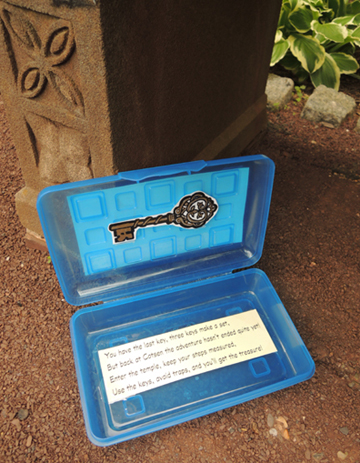 The 3 box locations were quite some distance apart on Princeton University’s campus, so there was a fair amount of excited running. Marissa went with the gang, and managed to get some great action shots.
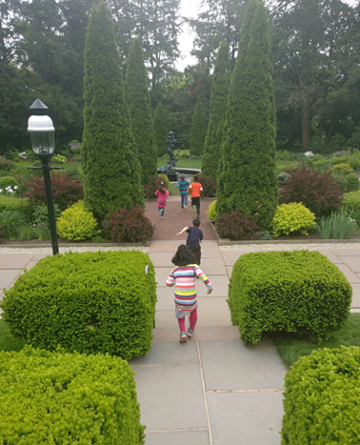 Here’s my favorite. Look at those feet coming completely off the ground!
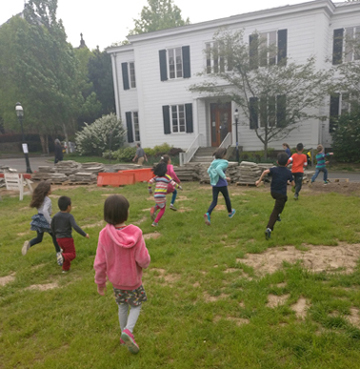 I don’t know about you, but I find rhyming clues really challenging to write. Especially when you want the kids to figure out where to go without being too obvious or clunky. I was, however, pretty happy with this one. Here’s a photo of the location:
 And here’s the clue that led to it:
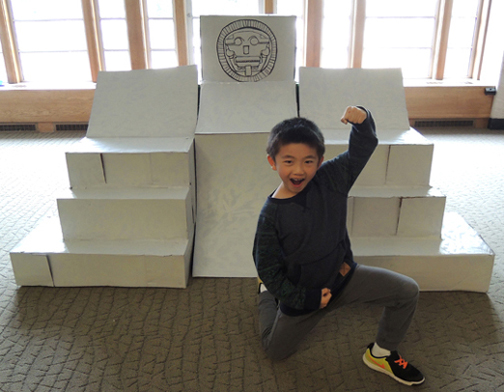
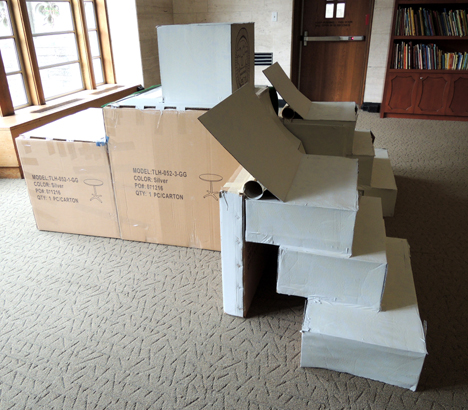
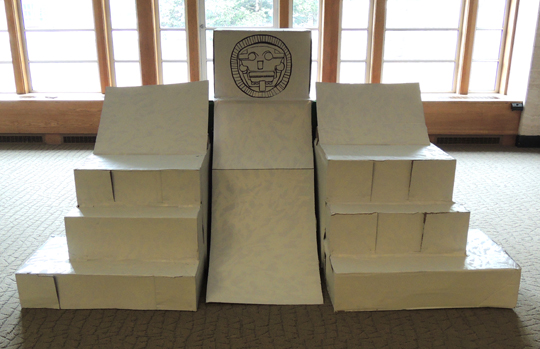 Here’s a shot from the side so you can get an idea of the size and how we constructed it.
 The ramp in the front of the temple lifted to reveal a felt-covered doorway. From there, kids entered a creepy, cob-web covered chamber illuminated with votive LED candles. One at a time, the kids crawled across a floor rigged with bubble wrap to snag a golden treasure box (which we lit from above with an LED light mounted in the top of the treasure vault box).
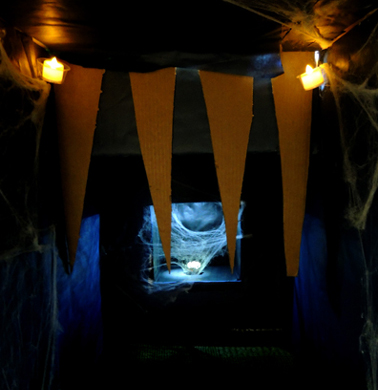
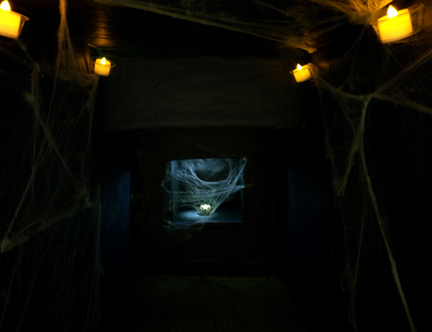 The minute the treasure left the vault, it triggered cardboard spikes dropping from the ceiling! That was me outside the box, manually raising and lowering the spikes from a slit in the ceiling. There was lots of laughing and screaming. Good times!
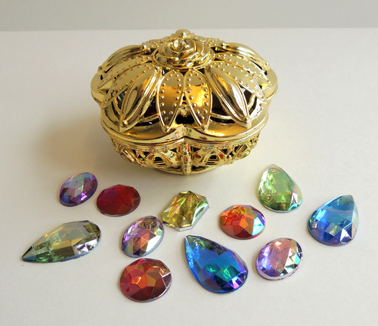
 The characters in the book have a couple run-ins with caiman, so the final touch was an alligator puppet (operated by Marissa) that snapped at the kids as they exited the temple. The hard-earned treasure boxes were plastic jewelry boxes I found at the Dollar Store. They were loaded with plastic gemstones as well. Each kid received a treasure box, and, to make reloading the treasure vault easier, we cut a little trap door in the back of the box.
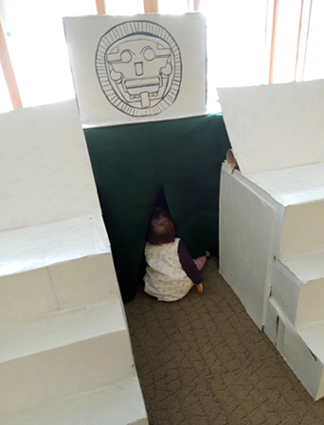
 After everyone had received a treasure box, we opened the temple back up and just let the kids have fun entering and exiting, dodging the spikes. Some of the younger siblings tried too (sans spikes of course). And then there was this little baby who was totally fascinated by the interior of the temple. She hung out for quite a while!
 Addison Cooke and the Treasure of the Incas is a fantastic read-aloud. It’s hilarious, adventurous, faced-paced, with strong strains of Indiana Jones and The Goonies. Definitely looking forward to reading more books in this series!