A Box of Puzzles…and Ducks

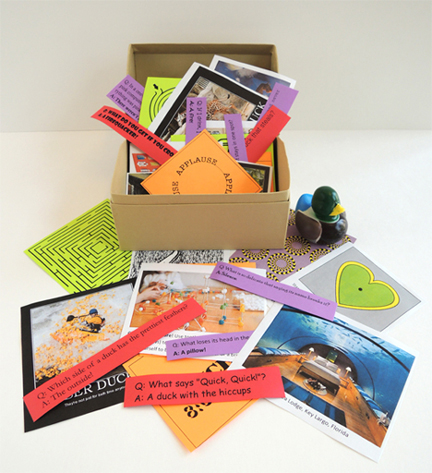
contents of boxInside this box are a number of tantalizing puzzles, mazes, optical illusions, images of unusual hotel rooms, building projects, and…ducks. Can all of these things be some how related? The answer is mostly definitely yes.

This project was part of To Be Continued, our story time program for children ages 6-8. Typically, we do the projects during the program. But unfortunately, the timing on this particular day only gave me five minutes to present the project. To further confound things, it was also the eve of a one month programming hiatus. So I needed something the kids could grab, take home, and discover for themselves. Not unlike the main character in the book!

We read Floors by Patrick Carman (Scholastic, 2011). Ten-year-old Leo Fillmore and his father are the maintenance crew at the Whippet Hotel. But the Whippet isn’t an ordinary hotel. It has a room that’s a giant pinball machine, a roller coaster elevator called the Double Helix, a roof-top duck pond, a Cake Room, a Robot Room, a Pond & Caves room, and a shark head named Daisy. The Whippet is the brainchild of Merganzer D. Whippet, inventor, engineer, architect, and eccentric. Unfortunately, Mr. Whippet has gone missing, the hotel is going haywire, and two mysterious men have been making nefarious inquiries. But things take a turn for the strange when Leo finds a mysterious purple box. Inside is a letter from a lawyer and a clue that can only be from Mr. Whippet. Now Leo, his friend Remi, a duck named Betty, and a talkative robot named Blop have just two days to solve the clues, find more puzzle boxes, explore some of the hotel’s strangest rooms, and save the Whippet.

You’ll need:

  • 1 box
  • Different color printer paper
  • Puzzle box templates (located at the bottom of this post)
  • A piece of curling ribbon
  • Scissors for construction
  • 1 rubber mini-duckie (optional)

Any old box will do, but I decided to splurge and purchase these super-sturdy papier-mâché treasure boxes from Discount School Supply (a set of 12 is $21). My idea was that once kids were done with the activities inside the box, they could decorate the outside with art supplies at home. Here’s what my boxes looked like:

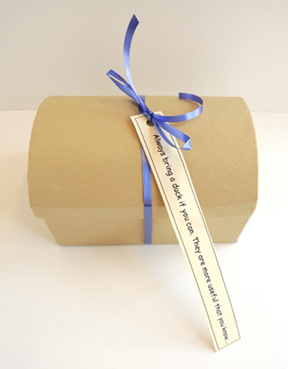
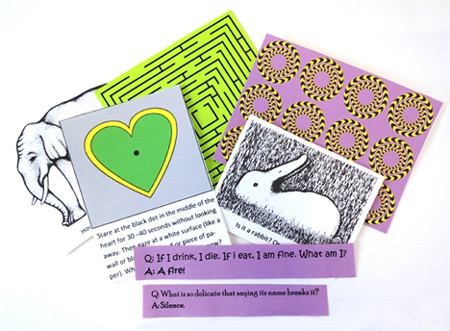
exterior of boxThe tag says “Always bring a duck if you can. They are more useful than you know.” That’s a quote from the book. It’s a very valuable piece of advice given to Leo when he finds the first box. Here’s an image of the full contents of the box:

contents of boxIn the book, Leo and his friend Remi have to follow cryptic clues, solve a number of riddles, and learn that things are not always as they seem. To replicate this experience for the story time kids, I grabbed mazes, optical illusions, and riddles from the internet.

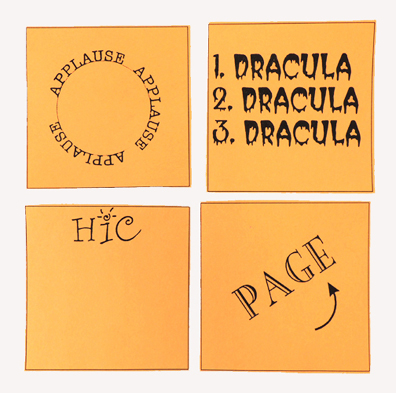
mazes, optical illusions, riddlesI also scanned some Thinklers (i.e. visual riddles) from the book Thinklers! by Kevin Brougher (Missing Piece Press, 2000).

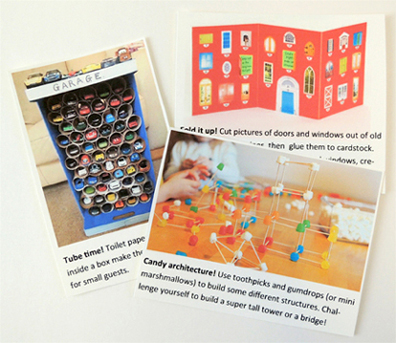
thinklersSince Merganzer engineered the Whippet himself, I included suggestions for a couple building projects involving things like gumdrops, marshmallows, toothpicks, toilet paper tubes, and card stock.

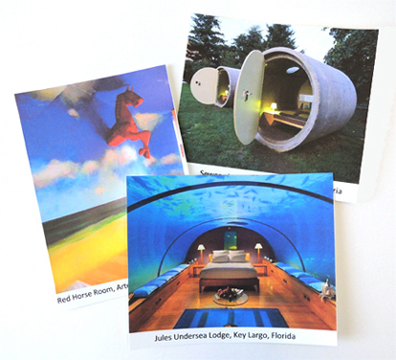
building activitiesThe rooms at the Whippet Hotel are fantastical and amazing. So I did a Google search for unusual real-life hotel rooms. And I found them. Oh yes I did. You must check out the ICEHOTEL in Sweden. Wow.

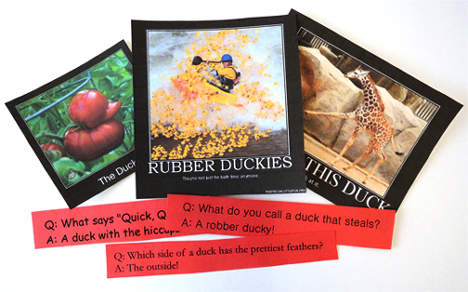
unique hotel roomsMr. Whippet is obsessed with ducks, and Betty the duck saves the day more than once. So I rounded up some duck jokes, duck memes, and other miscellaneous duck items.

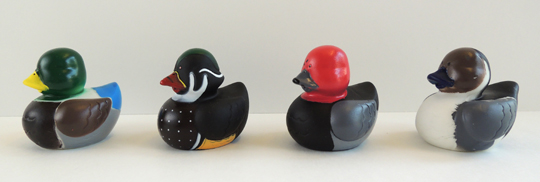
duck memes, jokesI topped everything off with a rubber mini-duck. I found these on Amazon (12 for $6.87).

ducksReady to put together a box? Here are the templates you’ll need to reproduce everything.

The box tag template for the exterior of the box (you’ll need a hole punch too).

The box contents template 1 consists of 3 pages of duck memes, building activities, optical illusions, and images of unique hotel rooms. Since the images are in color, print them on white paper (card stock works great).

The box contents template 2 consists of 4 pages of Thinklers, mazes, riddles and duck jokes. I recommend printing each page on a different color paper. Also, to economize a little, I repeated the duck jokes and riddles twice on a single page.

Have fun! And may the duck be with you, always.

Firefly Lantern

lightning bug lanternsTwinkle twinkle little bug! Light up the night with these glowing firefly bug lanterns. Or at the very least, discover a new way to use those leftover plastic Easter eggs!

We read The Little Squeegy Bug, written by Bill Martin Jr., Michael Sampson, and illustrated by Patrick Corrigan (Winslow Press, 2001). Once there was a little squeegee bug who admired the power and strength of Buzzer the Bumblebee. Hoping to gain his own wings and stinger, the little bug embarks on a quest. His travels lead him to the door of Hauncy the Spider, who weaves a pair of silver wings for him, but refuses the scary stinger. Instead, the wise Spider plucks the brightest star from the sky and hangs it on the squeegee bug’s tail to shine like a beacon for everyone. A firefly is born!

finished lanternsYou’ll need:

  • 1 clear plastic favor box (more on this below!)
  • A box cutter
  • 2 craft ties
  • A selection of metallic dot stickers
  • A selection of foil star stickers
  • 1 balloon stick or wooden dowel
  • 2 sparkle stems (optional)
  • 1 star template, printed on 8.5″ x 11″ white card stock
  • 2 squares of mirror board or poster board (approximately 5.25″ x 5.25″)
  • 1 plastic egg
  • A thumbtack, large screw, and screwdriver for making holes in the egg
  • A 4.75″ piece of twisteez wire
  • 3 pieces pipe cleaner (each approximately 6″ in length)
  • A rectangle of silver wrapping paper (approximately 2.25″ x 2.5″)
  • A selection of eye stickers (optional)
  • A permanent black marker
  • 1 LED votive
  • Scissors and tape for construction

Lantern first, then firefly! The clear plastic box is the most important part of this project. I bought 4″ x 4″ x 4.5″ clear party favor boxes with gold cardboard bases from Nashville Wraps (a dozen cost about $10). I’ve seen similar boxes on Amazon (24 boxes for $15.00 plus $8.50 shipping) and quick check at Oriental Trading Company revealed 24 large clear favor boxes (4″ x 4″ x 4″) for $7.99. The ones from Oriental Trading Company don’t come with a base, which means you’ll have to rig one out of cardboard or poster board.

My boxes came with bases, and I actually used them as the “lid” for the firefly lantern. In the below image, you can see the regular box on the right, and the box with the modified base “lid” on the left.

box and box with lidTo make the lid, remove the base from the box, flip it over, and use a box cutter make two small slits. If you don’t have a box with a base, cut one out of cardboard or poster board, then add the slits.

lid with slitsSlide the ends of a 6″ piece of craft tie upwards through the slits, then twist together them together form a “lantern ring.”

lantern ringTape the clear plastic lid of your lantern closed, then tape the lantern lid on top. Make sure both lids are taped tightly and securely. Don’t, however, tape the bottom of the box closed. You’ll need to be able to add and remove your firefly from the lantern later.

box with lidNext, we decorated each box with metallic dot stickers, foil star stickers, and a 20″ piece of wired metallic star garland (in silver or gold).

decorated boxAttach a craft tie to the lantern ring, then wrap the other end around a balloon stick (or wooden dowel). You can secure the craft tie to the stick with tape, but we decided to wrap sparkle stems around either side of the craft tie. Because it never hurts to have some extra bling, amiright?

lantern attached to balloon stickFinally, cut and trace the stars from the template onto mirror board (or poster board), and tape the stars back-to-back on the craft tie. You could also skip the mirror board and poster board and simply use markers to decorate the stars on the template.

finished lanternSet the lantern aside, it’s time for the firefly! I did not come up with the idea for this amazing little bug. Katie spotted it on Pinterest. I immediately pinned it with a oh-so-solemn vow to make it someday. Here it it, slightly modified from the original.

lightning bugBefore we begin, a quick word about the plastic eggs. Test the LED in them first! We discovered that, with our particular set of eggs, the green ones looked best (yellow was way too light, blue was way too dark). Once you have your egg, drill 8 holes into it – 2 holes in the top of the egg for the antennae, and 6 holes on the underside for legs.

holes in eggsThe original instructions said to make the holes with a thumbtack. But we found that it was really difficult to slide pipe cleaners through thumbtack holes. So we used thumbtacks to make the initial holes, and then enlarged them using a big screw and a screwdriver.

the turn of the screwI also tried using a nail. Totally didn’t work. Use a big screw and a screwdriver. And prep all the eggs in advance of course. Once the holes are made, open the egg and thread a 4.75″ piece of Twisteez wire through the antennae holes. Curl the ends. Next, thread three, 6″ pieces of pipe cleaner through the leg holes. Curl the ends into little feet.

antennae and legsCut wings out of silver paper (we used silver holographic wrapping paper from Party City) and tape them to the top of the egg. IMPORTANT! Attach the wings below where your egg opens and closes. Otherwise, they’ll just get in the way when you are opening and closing the egg to access the LED votive.

wingsUse a black permanant marker to add eyes and a smile (or use dot stickers for the eyes like we did).

bug smileFinally, insert a LED votive into the egg (remember, the “flame” should be pointing at the bug’s rear end). Admittedly, LED votives can get a little pricey if you’re buying for a classroom or story time crowd. Sometimes you can snag them cheap  from discount retailers like Marshall’s and T.J. Maxx. More often, I use 40% off coupons from Michaels Craft store.

Your firefly is illuminated. Grab your lantern, open the bottom of the box, and gently place the firefly inside. Close the box and you’re good to go! I closed all the shades in the gallery and turned off the overhead lights. We went on a lantern walk around the gallery and then settled down to admire our lanterns. For a few minutes at our wild and crazy story time was calm, hushed and very, very peaceful. Ahhhhh…

glowing lanternsIf you don’t like the concept of fireflies trapped in lanterns, just do the firefly project as a standalone. It makes for a friendly, fantastic, and flickering friend!

beautiful bugsMore bug projects you say? This post is one of my all time favorites. And who can resist these sweet little honey bees?

Across the Puddle

woo hooPrepare to embark on an epic journey through a variety of obstacles. Weave in and out of topsy-turvey turtles, dodge two plump pigs, avoid the chomping alligator, and face off with a vacuum cleaner elephant. It’s the world’s biggest puddle…can your little boat make it?

We read The Puddle by David McPhail (Farrar Straus Giroux, 1998). One rainy day, a little boy decides to sail his toy boat. He finds a truly enormous puddle, but unfortunately, a frog hijacks his boat. The boy can’t chase after the frog – he’s promised his mother he’ll stay out of puddles. The frog crashes the boat into a turtle just as an alligator shows up and offers assistance. The alligator retrieves the boat, but it’s a wee bit crushed. In the meantime, a pig arrives for a swim and is being quite messy about it when an elephant appears and drinks the entire puddle. This prompts all the animals to yell at her to put the water back. So she does. Quite forcefully. By this time, the sun comes out, the puddle dries up, and the boy heads home for a hot bath. What a day!

You’ll need:

  • 1 small box (I used a 4” x 4” x 4” box – a small tissue box works too)
  • 2 rectangles of (mine were 3″ x 12″)
  • A section of color masking tape
  • 2 toilet paper tubes
  • A selection of construction paper
  • A selection of multicultural construction paper
  • A selection of patterned paper
  • 1 wooden dowel
  • 3 foam beads
  • 1 sails template, printed on white 8.5″ x 11″ paper
  • Hole punch
  • 1 piece of string or yarn (approximately 27″)
  • 1 puddle obstacle course (more on this later!)
  • Scissors, tape, and stapler for construction
  • Markers for decorating
  • Hot glue

boat with passengersWe’ll begin with the boat! The first steps are exactly the same as this Noah’s Ark balancing game. Cut the lid and tabs off your box (if you are using a tissue box, cut the entire top off). Your box should now be about 3″ tall. Set it aside for a moment. Next, use a marker to draw horizontal lines on 2 rectangles of tag board. This creates the “boards” of your ship. For a bit of color, run a piece of color masking along the top of each rectangle (or just use markers).

sailboat step 1Place both rectangles on top of one another, staple the short ends together, and slide them over the box. Secure them in place with tape or hot glue. This step is really important! If the sides of the boat aren’t attached to the box, the sides will pop off when you yank the boat’s pull string later.

sides of boatNext, wrap a 4″ piece of color masking tape around the top of a wooden dowel, then snip the tape with scissors to create a triangular flag.

sailboat flag stepsPush 3 foam beads on the opposite end of the dowel, then hot glue the foam beads to the bottom of the boat. This is your ship’s mast.

hot glued mastColor and cut the sails from the template, then tape them to the front and back of the mast (we made the sails short so they wouldn’t pull the dowel over, feel free to discard the template and make your own sails if you like). Finally, punch a hole in the front of the boat and knot a piece string through it. Here’s the finished boat with the flag, the sails, and the pull string in place:

finished boatWe made 2 crew members (a person and a frog) using multicultural, construction, and patterned paper. Here’s Marissa’s self portrait, with a froggie friend:

marissa and frogNow for the obstacle course! We snagged 2 huge pieces of cardboard from the recycle bin, and painted them light blue. Interestingly, the paint warped the edges of the cardboard upward, creating “waves.” While the paint was drying, we crafted some animal obstacles. The turtles are tissue paper boxes with green poster board shells, arms, legs, tails and heads.

turtlesThe pigs are large oatmeal containers wrapped with pink construction paper.

pigsThe alligator is the lid of a copy paper box covered in green poster board, with paper cup eyes and poster board teeth.

alligatorThe elephant’s face and nose was constructed out of light blue poster board, and a vacuum hose was inserted in the trunk.

vacuum elephantAfter placing all the obstacles on the cardboard, I used blue masking tape to make directional arrows. I decided not to glue any of the obstacles down (I’d rather have kids send them flying than trip over them).

directional arrowsTo run the course, kids had to navigate their boat through the turtles, ride over some waves, and avoid the pigs (which were rolling all over the place as kids walked on the warped cardboard). Next came chomping alligator (which consisted of Marissa moving the box lid up and down and saying “Chomp! Chomp!” – we’re super high tech here.) Here’s a boat on course:

on courseRight before the finish line, the boats had to pass by the vacuum elephant. That was my job. I would make the elephant suck a toilet paper tube character right out of the boat, and then the kids had to pull it off the end of the vacuum nozzle! Fun!

captured personIMPORTANT! Some kids are afraid of vacuums. I asked vacuum-averse kids to turn their name tag stickers upside down. That was my signal to turn off the vacuum while they completed the obstacle course. It worked great!