Once upon a time a very wise woman, and her equally wise son, had a vision. They wanted to uplift, inspire, and make a difference in the lives of people of color. After careful research and consideration, the son decided that early literacy would be the best way to transform the futures of children of color for the better, helping them reach their truest potential and rejoice in a love of learning and the power of their intellects.
And so, the fantastic non-profit organization Our Kids Read was created by Jahmal Lake, in honor of his mother, Dr. Obiagele Lake. Our Kids Read has a two-fold mission: 1) To place free books into the hands of children and schools; and 2) To offer a remote “Reading Buddy” program to build literacy confidence through mentoring and companionship.

To date, Our Kids Read has placed hundreds of thousands of free books into the hands of children, participated in numerous free book festivals, and reached young readers ages 4-12 in Atlanta, Seattle, Los Angeles, Long Island, Washington, D.C., and Baltimore. In the fall of 2024, it built its first “Read in Color” Little Free Library at an elementary school. Last month, they exponentially expanded that concept by collaborating with Scholastic Books to open an entire Free Book Store in Baltimore, Maryland! Their reading buddy program is thriving with volunteer mentors from Verizon, Microsoft, Nike, and Sephora.

We were delighted and honored to catch up with Jahmal and talk inspirations and aspirations…
Hi Jahmal! Tell us a little about yourself!
I’m a child of the 80s who only recently found my life’s work, my true passion. I spent most of my career as a senior IT leader at American Express Bank, Booz Allen and U.S. Treasury, now I’m running a non-profit that’s taking aim at the country’s literacy crisis! I joined this fight in my 40s and sometimes wish I’d realized earlier that this was my calling but then I think of all of the lessons I learned during the first 40 years of my life that I’m applying as I build this organization and it all makes sense.
You uplift kids through literacy – what were some of your favorite books growing up?
Growing up I was for sure a sci-fi and horror nerd. Stephen King was my absolute favorite author, I remember reading It and Christine when I was eleven or 12 and I could visualize the characters in the story. I can’t pick just one genre or one author though, Madelein L’Engle, Toni Morrison, Ray Bradbury, Douglas Adams (oh wow, can’t forget So Long and Thanks for All the Fish!) and if I’m honest even some steamy romance as a pre-teen. There was never a pattern to what I read. I’d check out 20-30 books every week from the Tompkins County Public Library in Ithaca (my mother was a student at Cornell University for my elementary and middle school). I would just wander around the library with my favorite librarian (Gary) and he’d point out books to me and I’d read the first few pages to see if I liked it, then I’d throw it in my backpack. It was a marvelous childhood. I was an only child and these books kept me company. I NEVER felt lonely, my active (perhaps overactive) imagination took care of that.
Please share how your amazing non-profit was founded.
The non-profit was technically founded in 2019 but didn’t begin operations until 2021 when we got our 501c3. And this was really my mothers vision that she put on my shoulders when she passed a few years ago. We found out in May of 2020 that my mom had mesothelioma and by June of the same year she was no longer with us. In that last month she made me promise to move the dream of Our Kids Read forward in a major way and use at least $50,000 of my inheritance to kickstart the organization’s operations. So that’s exactly what I did. We applied for and were granted our 501(c)(3) status in November of 2021 and received major book grants from the NY Public Library and Scholastic shortly thereafter, over $1M worth of books between the two. We have given away over 120,000 children’s books since we started.
You began your work in 2020, it’s now 2024. What is the most valuable thing you’ve learned in four years?
The most valuable thing I’ve learned in the past 4 years is that childhood illiteracy is a solvable problem. I think as someone approaching the problem from the outside, it’s almost given me an advantage that practitioners who are deep in this space might not have. I’m questioning some fundamental assumptions about how we teach children to read, the biggest of which is that teaching a child to read is solely the school’s responsibility. It’s absolutely not. Children learn language at such an early age that by the time they get to pre-K at 5 years old or Kindergarten at 6 years old, you’ve already missed out on 4 critical years of language development. I believe that we as a society need to embrace technology to create an AI that is FREE that parents can use to teach their children how to read in the home, before they even get to school. A friend said to me recently, “if slaves could learn how to read in the dark, we can use AI to teach toddlers to read on a tablet.” Truer words.
Also in the past four years, what has been your proudest moment? Or your most significant experience?
I think my proudest moment was seeing the opening of the Baltimore Literacy hub recently and seeing the news story on CBS and thinking “wow mom, this is happening!” I honestly am not the guy to sit back and give myself credit for anything. Which I know is not good. If you never take time to appreciate the small wins it becomes a seemingly endless grind. But it’s something I struggle with. I’m always thinking about what I could have done better or what is outstanding, things that still need to get done. But when I saw the CBS new story and the anchor said something like “Jahmal Lake recalled how much he enjoyed reading as a kid” I have to admit, I might have teared up a little. So great to see this dream coming to fruition.
Please tell us about your national Free Book Festivals.
The Free Book Festivals are really just a hook to get students enrolled in our free evening Reading Buddies program. For the Festivals, we bring around 1,000 free books to an elementary school or community center, along with West African drummers and storytellers, to get students excited about story and reading. The storytellers act out the stories accompanied by rhythms that match the story. At the end of the performance we let each of the students in attendance pick out 3 free books and give then a flyer to sign up for our Reading Buddies program. We typically get 20% of the students to receive the flyer ultimately enrolled in the reading program. Not the greatest conversion percentage, but I’ll take it! At this rate we will be able to get over 1 million students enrolled by the year 2030.
What are your biggest goals for the future of Our Kids Read?
The biggest goals for the future of Our Kids Read is becoming a household name and making childhood illiteracy like polio, a thing of the past. We know it’s possible and as technologists we aim to leverage AI to make sure it happens in our lifetime.
Images courtesy of Our Kids Read
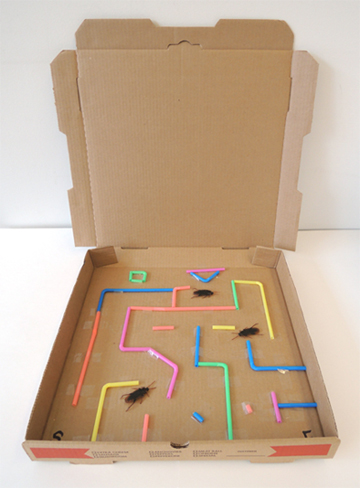 Let’s face facts: most kids (and even some adults!) find gross things funny. They like fart jokes, quips about underwear, burps, bugs, and just saying the word “poop” can send the conversation into a 15 minute spiral. Well, kids…this post is for you. We did a round up of story time projects that involve a wee bit of gross humor. May it bring you giggles and joy!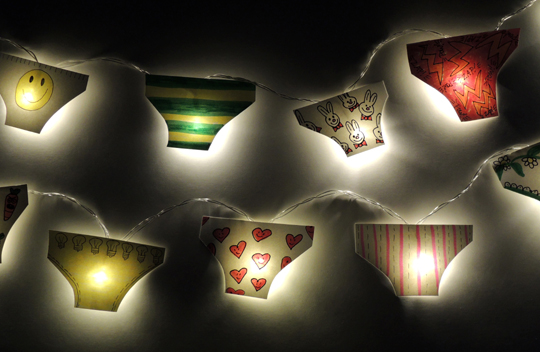
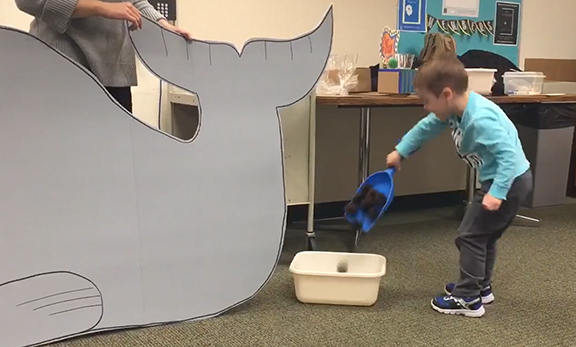 While this book, I Won a What?, was ultimately about taking care of a pet whale, if you watch the video in the post, you’ll see that whale care includes taking them on walk, bathing them, and yes…scooping up pom pom poop.
 It’s the party to end all parties, old sport! To celebrate the 100th anniversary of the publication of “The Great Gatsby” this April,
 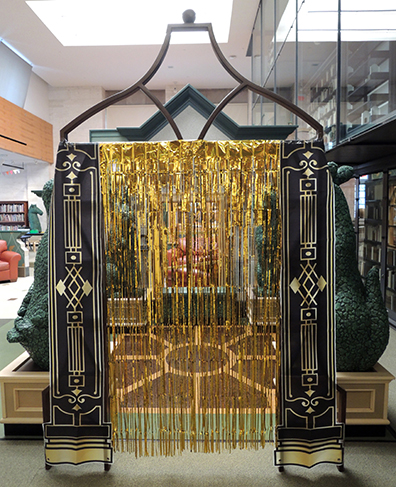 As some of you may have already guessed, the gold tinsel almost stole the entire show. Kids ran through it, swatted it, wore it as hair, and sat quietly with it tickling their faces. They also pulled it out in handfuls and threw it all over the gallery. It was a total mess after the event, and we’re still finding strands of tinsel in the library, but it was worth it!
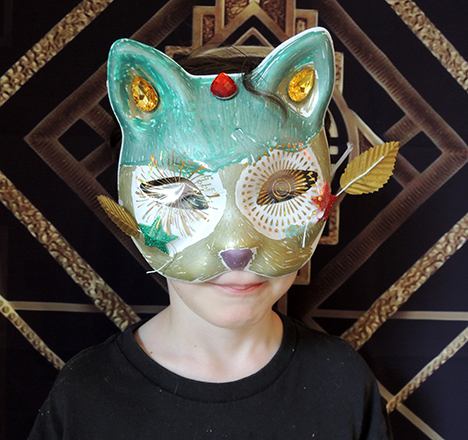 We also offered a smaller, more focused art activity elsewhere in the gallery – coloring sheets that featured the work of British artist Louis Wain, who was popular during the Gatsby era! Wain became famous for his drawings of cats depicted with human-like appearance and behavior, and we pulled images from our special collections to share with the community.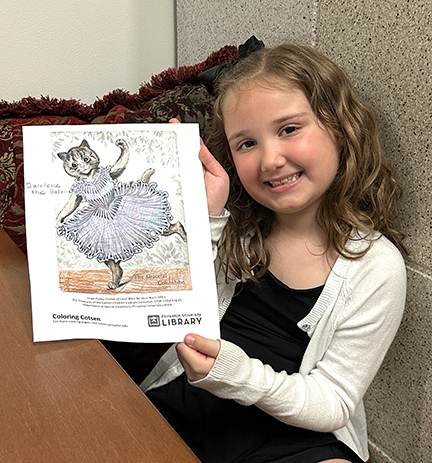
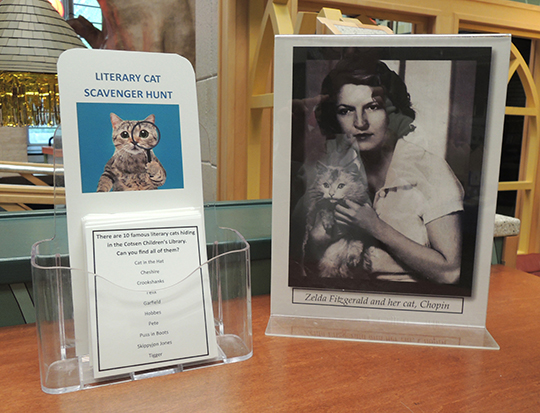
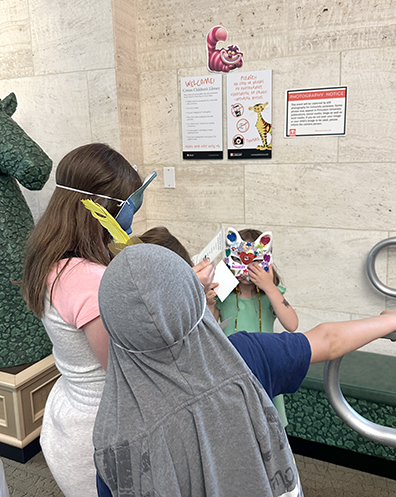 Speaking of familiar cats, we thought it would be fun to ask library staff to submit portraits for a “Match the Librarian to Their Cat” game. Hint: staff wore their cat’s colors, and even hilariously replicated their poses and expressions.
 Our Great Catsby event was also a cat food drive to benefit