Baby New Year

baby new year readsBaby New Year is here, and we thought we would celebrate with a baby story time post!

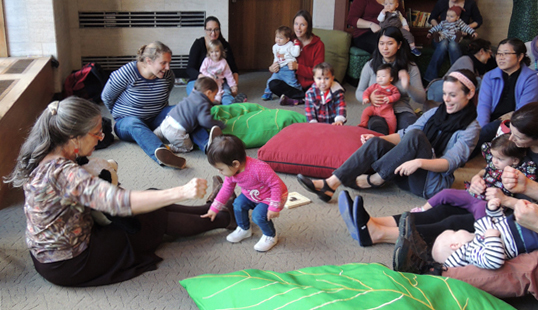
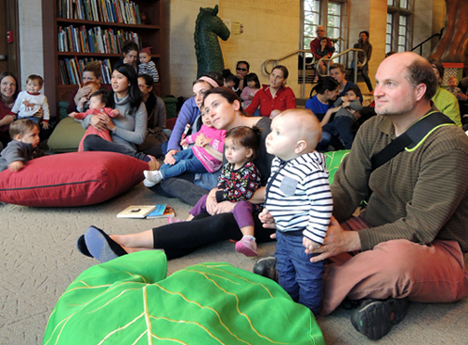
We invited the talented Peggy Salwen to our library to lead a story time bonanza for children ages 2-24 months. Peggy has been a librarian for over 40 years, and is currently a Senior Children’s Librarian at the New York Public Library. Legendary for her baby skills, massive stock of songs, and playful props, Peggy expertly led a very large crowd of babies and caretakers through books, songs, and movement activities. After the program, I sat down to chat with Peggy about the tricks of her trade.
baby new yearYou obviously brought books with you today, but you also brought puppets, props, and a big stuffed bear. Tell us about your props!

I use a lot of puppets and props with babies.  When I read Peek a Moo, I have little puppets that go with every one of the characters. I have a cow puppet, and then pig, a mouse, and an owl. Some are finger puppets, some are hand puppets.
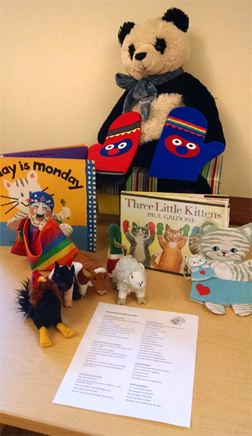
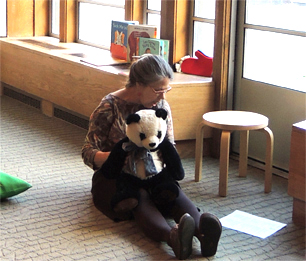
puppets and propsMy Peek-A-Boo mittens I always use with babies. The mittens are in a box and, while I’m sure it’s a bit obnoxious for the parents, I repeatedly use the box during story time. Repetition is so important for babies, and they love it when I take the top off of the box, take Mr. Peek and Mr. Boo out of the box, and then put them back in the box. The babies just get so excited because they know what’s going to happen. It’s all ritual, and ritual is a big thing. I’ve had Poppy [a big stuffed panda bear] for a long time. He’s my “baby.” I use him to demonstrate for parents what they are supposed to do with their babies.
poppyYou brought a number of flap books to story time today. They were great! I could see the kids anticipating what was going to happen next…

Yes! I don’t love the flap books as much in the library’s collections, but I really like the flap books for baby story time.

What’s the hardest thing about baby story times?

Getting the adults to stop talking and to participate, I think.

How do you get parents to stop talking and participate?

By concisely saying “This is story time. Put your phones away. Don’t talk to your neighbor. This is the one time we ask you to take 20 minutes and be with your baby.” Baby story time is really for the adults, it’s not so much for the babies! It’s for adults to learn how to do things and to show their children that they want to do these things. It’s for them to see how much fun it can be to be with their babies. You are a baby’s first teacher. I think that’s the key. You’re there to teach them how to enjoy life, how to learn. That’s what I believe is most important.
baby story timeWhat’s your advice for someone who’s brand new, who’s facing his/her very first baby story time?

Sing a lot of songs. Say a lot of rhymes. It’s more about the songs and the rhymes than it is about the books! Do fewer books and more songs and rhymes. Being a librarian, you think you have to do the book thing. Yes, reading the books is important, but for baby story time, songs and bouncy rhymes are more important.  I learned in a workshop that lyrics to songs are like syllables of words, so your child learns the syllables of words when you sing. So singing is a great way to learn language too!


Peggy’s Favorite Story Time Books

Leo Loves Baby Time by Anna McQuinn
The Baby Goes Beep by Rebecca O’Connell
Brown Bear, Brown Bear, What Do You See? By Bill Martin
Peek-a-Moo! By Marie Torres Cimarusti
Peek-a-Baby by Karen Katz
Where is Baby’s Belly Button? By Karen Katz
Tuck Me In! by Dean Hacohen and Sherry Scharschmidt
Head, Shoulders, Knees and Toes by Annie Kubler
If You’re Happy and You Know It by Annie Kubler
Baa Baa Black Sheep by Annie Kubler

Songs & Rhymes
“Open Shut Them”
“This is Me”
“These Are Baby’s Fingers”
“Little Red Wagon”
“Tommy Thumbs”
“We’re Going to the Moon”
“Tick Tock, Tick Tock”
“Mother and Father and Uncle John”
“Banana Cheer”
“Head, Shoulders, Knees and Toes”
“The Noble Duke of York”
Flannel of the Future

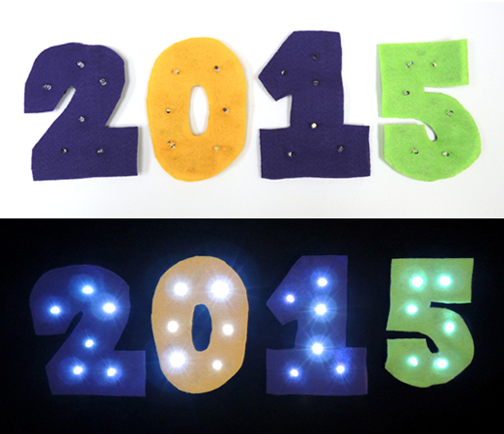
flannel board 2015Some of you may recall this post, in which I visited my friends at scienceSeeds and reported on all the cool science toys they are currently playing with. There was one toy, however, that I didn’t include because I wanted to do a special post on it later.

The time has come for that post.

Get ready to usher your story time flannel board into 2015…may I introduce…the brilliant…the amazing…the mesmerizing…conductive thread! Yes, this thread conducts electricity, which means that your flannel can be rigged with lights!

You’ll need:

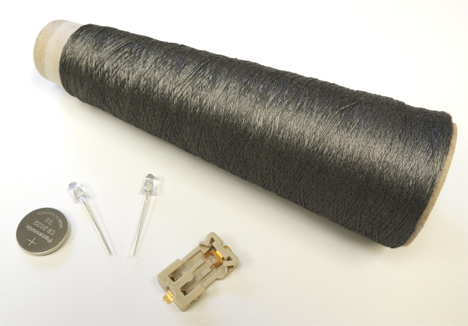
  • 1-2 pieces of felt (i.e. flannel)
  • 1 sewing needle
  • A length of conductive thread
  • 1 coin cell battery holder
  • LEDs (3mm or 5mm size are recommended)
  • 1 coin cell battery
  • Scissors
  • Hot glue (optional)

The good news is that all the electrical components listed above will cost you less than $10. A 30 foot bobbin of the thread is $2.95, and the LEDs are between 20¢-50¢ each. A battery holder is about $1.95, and the coin cell batteries, which can be purchased just about any retail store, are between $1-3 dollars (the one you see in the image below is size CR 2032). scienceSeeds buys most of their supplies from SparkFun Electronics, an online company.

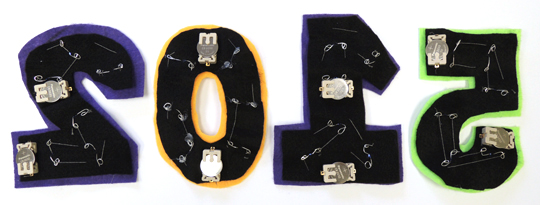
electrical suppliesSince we were using lots of LEDs, Lindsay, our scienceSeeds flannel artist, decided to do 2 layers of flannel. The black “background” layer held the thread and the batteries, and a colorful top layer hid the stitching. The results were colorful, tidy, and sturdy. Here’s what the back of our flannel numbers looks like:

rigged upFirst, use the conductive thread to sew a coin cell battery holder to a piece of felt. It’s important that the battery holder is tightly connected to the felt. Lindsay recommends hot gluing the battery holder to the felt first, and then stitching the holder’s connections to the felt with the thread.

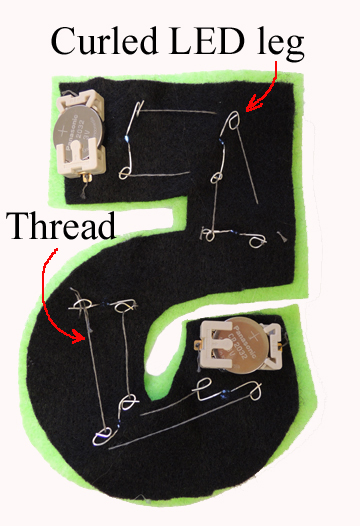
Next, push the legs of an LED through the felt. Curl the legs into circles using a small pair of scissors, jewelry pliers, or needle nose pliers.Then stitch the legs to the felt with the thread.

curled leg and threadBecause you’re making a circuit, it’s essential to connect negative to negative and positive to positive. Therefore, the same thread that is connected to the negative post of the battery holder needs to be connected to the negative LED leg. Likewise, the same thread that is connected to the positive post of the battery holder needs to be connected to the positive LED leg.

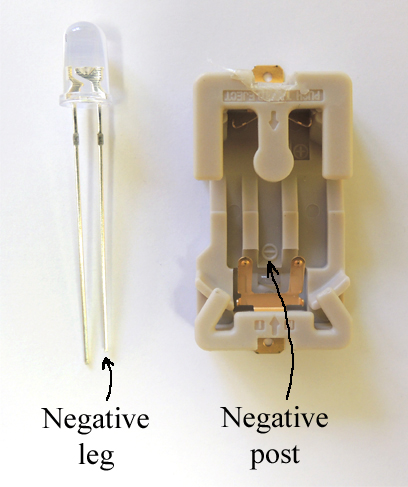
Worried you won’t be able to rig things up correctly? Worry no more. The battery holder’s negative post is clearly marked, and the negative leg of an LED is always the shorter of the two.

led leg and holderYou can just connect one LED, or you connect a train of them. One important thing to note: if you’re using just one LED, the battery tends to heat up (as opposed to multiple LEDs in a strand, which share the power load). If you’re using just one LED, you might consider adding a resistor (i.e. an electrical component that limits the flow of a current through a circuit). Many LEDs already come with resistors.

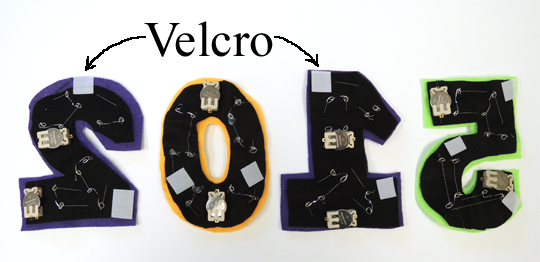
When everything is connected, slip a coin cell battery into the battery holder. Your LEDs will activate, and your flannel board will glow! We discovered that the weight of our LEDs, battery holders, and coin batteries made our flannel numbers drop off the flannel board (Viva Las Vegas!). But the problem was quickly solved with a bit of Velcro.

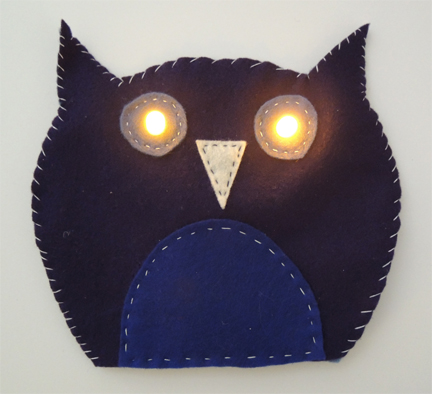
velcroYou could also move beyond flannel boards! Here are a few projects from the scienceSeeds workshop. A handsome owl puppet with glowing eyes…

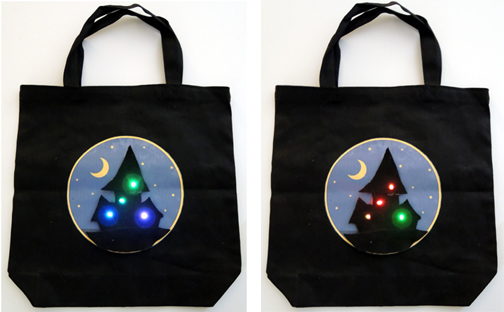
owlA Halloween treat bag with color-changing LEDs! Oooo!

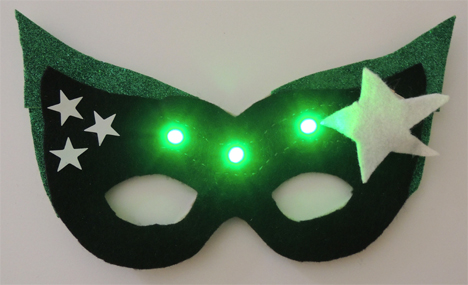
bagA truly marvelous super hero mask.

maskIn addition to conducting electricity, the thread can also be used decoratively. You can see it here, adding some silver highlights to the mask.

thread on maskOK…you have the tools and the know-how. Cue up Pachelbel’s Canon in D, go forth, and illuminate!


Many thanks to scienceSeeds for rigging up the fantastic 2015 flannel!

The Famous Bucket

famous bucketPrior to 2007, if you had asked a young reader to name a famous bucket, I’ll wager most would have replied “Charlie.” But that was before a new bucket arrived on the scene. A fire-engine red bucket, wielded by an acrobatic young lady with a blonde ponytail. I speak, of course, of Kate Wetherall. Katie is one of the fantastic characters in The Mysterious Benedict Society, written by Trenton Lee Stuart (Little, Brown, 2007).

Intrigued by a curiously-worded advertisement in a local paper, orphan Reynie Muldoon spends a most unusual afternoon taking a series of strange tests. Later, he joins three other children (Sticky Washington, Constance Contraire and Kate Wetherall) who also passed the tests in unique ways. The children are invited to join a secret mission to stop Ledroptha Curtain, a criminal mastermind. The book is filled with puzzles, riddles, and action, but what I love the best is the friendship that forms between the children as their strengths (and weaknesses) are put to the test.

In the books (there are 3 in the series, plus a prequel), Kate always carries a red bucket stocked with a number of useful supplies. So when To Be Continued, our story time program for 6-8 year-olds finished the book, I just knew we had to something with Kate’s bucket! So I designed this game.

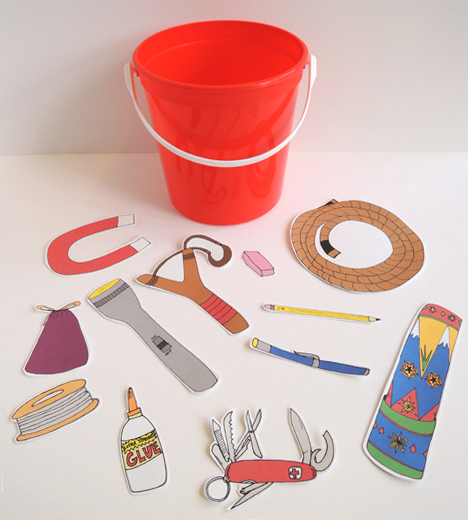
bucket gameAll you’ll need is 1 red bucket, a bucket game template printed on white card stock, and a copy of the bucket game scenarios. You’ll need markers to color in the template (or you can just go with the full color version), and scissors. I also gave kids a list of the bucket’s contents.

A quick word about the bucket. The 6.5″ bucket in the above photo can be purchased from Lowe’s for $2.35. However, since I required close to 20 buckets for my program, I needed something cheaper. I found a 4.5″ treat pail at Party City for 99¢. Nice! I also spotted 8.5″ paper bags at Party City for 79¢. Yes, a bag is technically not a bucket, but it’s a budget-friendly option nonetheless.

buckets and bagTo play the game, read a scenario aloud. Ask the kids to select the bucket items they would use to solve the scenario. Once everyone’s selections are made, go around the room and ask them to display which tools they selected, and how they would use them to solve the scenario. As you can imagine, there were some pretty innovative answers!

I’m a big fan of the Mysterious Benedict Society books, and in 2010 I was delighted to interview the author. If you’d like to listen to (or read) my interview with Trenton Lee Stewart, just click here.

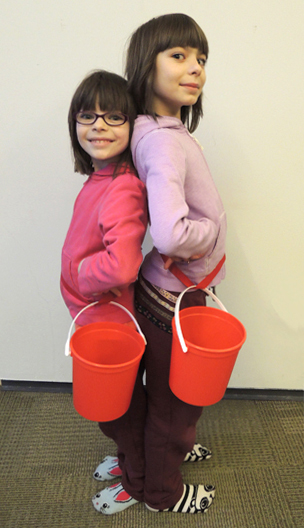
Also, I don’t know if you noticed the amazing footwear on the two models at the top of the post (who also happen to be huge fans of the books). If not, scroll back up and prepare for some serious cuteness!