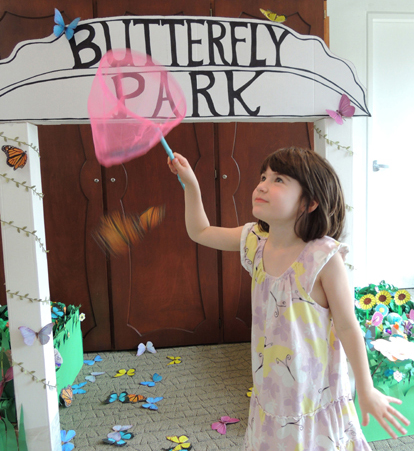
 Bring your net and your sense of wonderment – there are butterflies in the park! We crafted a beautiful community garden, then waited for the butterflies to arrive. Swooping, diving, floating, and fluttering, how many butterflies can you catch for your own little garden?
We read Butterfly Park by Elly MacKay (Running Press, 2015). A little girl moves from the country to the city, trading the sounds of birds and crickets for horns and trains. Her new house is right next to Butterfly Park – except that there are no trees, no flowers, and no butterflies in the park. Well, there is one butterfly, but it flies away. Undaunted, the little girl knocks on doors, recruiting neighborhood children to find butterflies to live in the park. Eventually, their search leads them to an important clue – flowers! Soon, the whole neighborhood is in Butterfly Park, planning, digging, and planting. Not only do butterflies come to live at the park, the little girl realizes that she’s found a home too.
You’ll need:
- 1 large tissue box
- 1 golf pencil
- Green pipe cleaners, sparkle stems, and/or drinking straws
- A selection of tissue paper
- A selection of crepe paper streamers
- A flower coloring template, printed on 8.5″ x 11″ card stock
- Green color masking tape
- Green construction paper
- Butterfly catching game (more on this later!)
- Scissors and tape for construction
- Markers for decorating
This story time project had three parts: 1) Making a little garden; 2) Putting all the little gardens together to make one big butterfly park; and 3) Catching butterflies in the park to take home in your little garden. We’ll begin with the little garden!
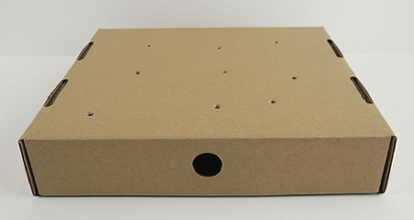
 We used 9.5″ x 11″ cardboard trays rescued from the recycling bin. Flip the tray over and use a golf pencil to punch holes in the top (the golf pencils worked great with 3-5 year-olds and were much less scary than using scissors to poke holes).
 If you don’t have a tray, a large tissue box works too. Cut the top off the tissue box. Then, cut the entire box down to 2.5″. Flip it over, and use a golf pencil to punch holes in the top:
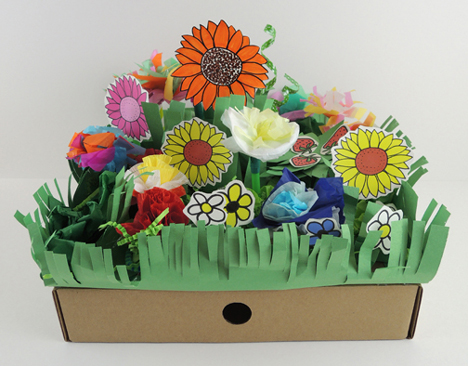
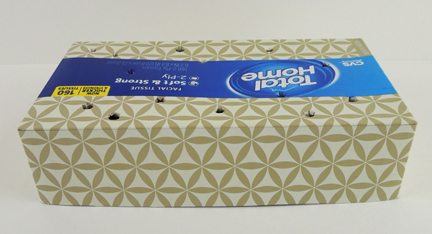 To plant your garden, cut a pipe cleaner, sparkle stem, and/or drinking straw in half. Attach a flower to one end, then poke the other end through a hole in the box. Secure the stem to the underside of the box with tape (or leave them loose so you can “pick” them!).
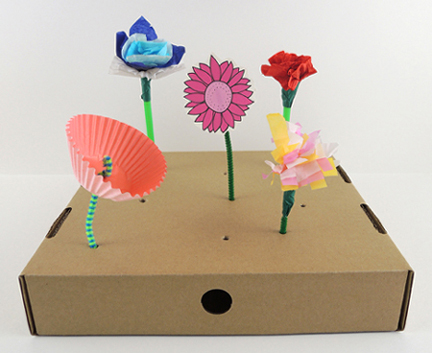 As you can see above, we offered tissue paper and baking cups for the flowers. You can also use the flowers from the template, and the kids can color them in. We brought out green construction paper grass fringes, green paper crinkles, and craft ties as well.
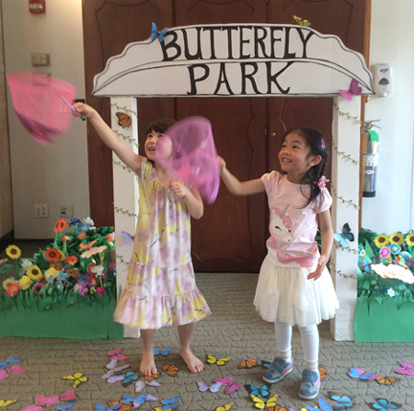
When the decorating was done, the kids brought their little gardens to the BIG garden. The big garden consisted of a sign and 4 corner “hedges” we festooned with flowers. Kids placed their little gardens between the hedges, forming a perimeter in full bloom.
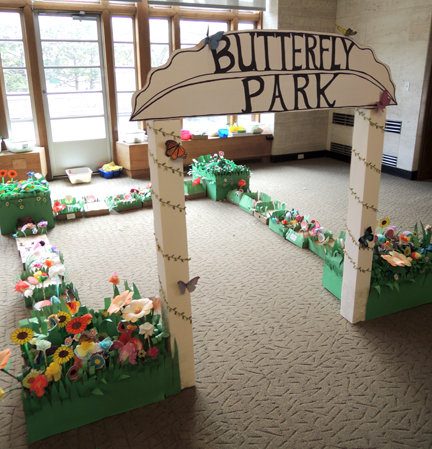
The hedges are recycled cardboard boxes. The sign is made of 3 recycled scroll boxes (2 as posts, one as the cross beam) and a piece of white cardboard. This garden is Marissa’s handiwork, right down to the beautiful hand-lettering on the sign. And check out her flower arranging skills!
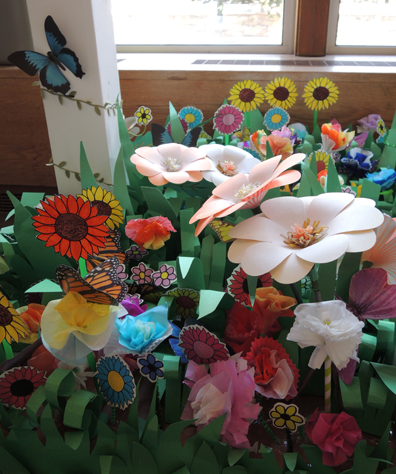
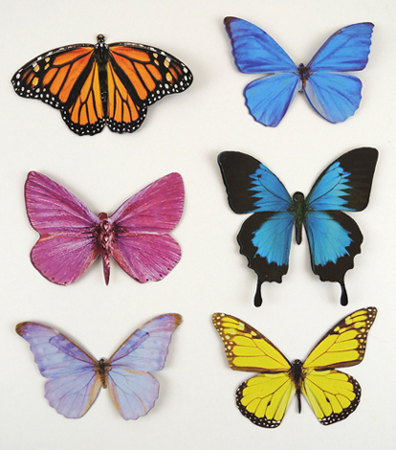
The flowering garden is waiting, now for the butterflies! I found mine at Oriental Trading Company. Specifically, they’re from the the “Butterfly Hanging Door Curtain.” One curtain costs $6.50, and you get about 60 butterflies per curtain. The butterflies are sturdy tagboard, look realistic, and they’re printed double sided.
 Four at a time, kids stepped into Butterfly Park wielding toy nets (I found mine in the $1 section of Target). Then Marissa and Joani strewed butterflies down upon them. Well, sometimes there was a little more dropping into nets than strewing…
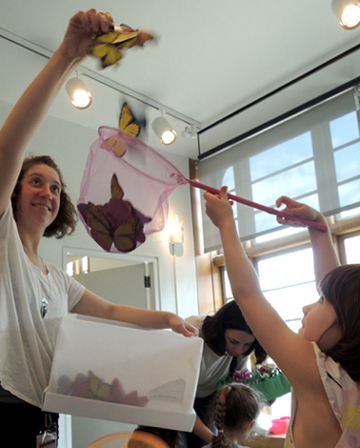 Once kids had caught some butterflies, they gently tucked them into their gardens to take home. Did they have fun? Yes they did! Some kids even stayed 20 minutes after story time ended, just to get in on some more butterfly catching fun!
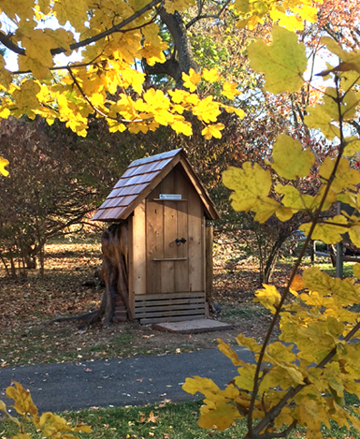 It might look an elvish cottage, but this structure houses a mighty amount of knowledge! May I introduce you to the Little Free Library in Princeton’s Marquand Park?
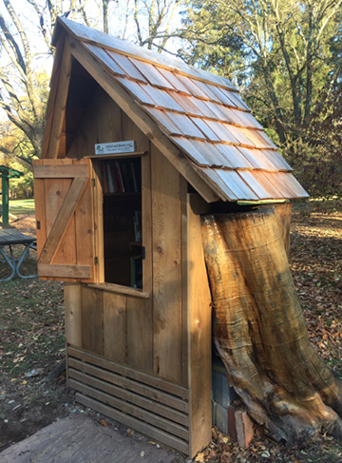 Robert Wells, founder and steward of the Marquand Park library, first spotted a Little Free Library while visiting the Outer Banks. Returning to Princeton, he realized that the park’s hollow stump, with its interesting curves, would be a perfect library location. He commissioned cabinet maker Gui Nelesson of Lost inStudio to build it, and a new Little Free Library was born! Here’s a shot of the back:
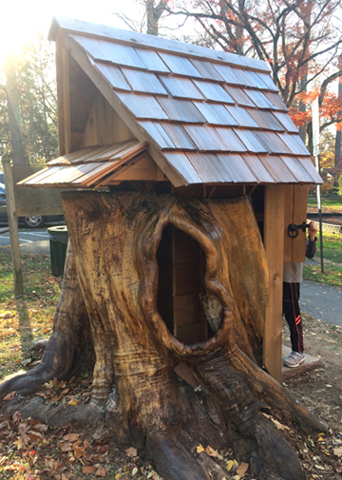 The size of this library is also unusual. Most Little Free Libraries are smaller than a copy paper box, and mounted on a post. The Marquand library can hold 300 books! It’s dedicated to children’s books, and even includes a interior bench for little readers to get comfortable.
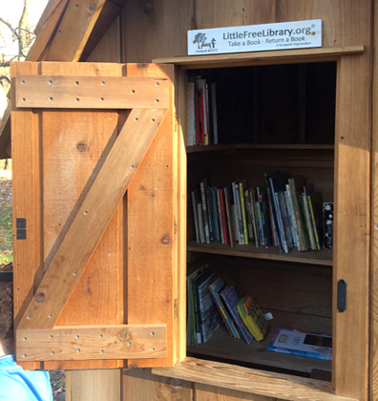 In case you’re wondering, you enter and exit the library through the window. The shutter gently swings shut to keep the books dry and protected. Not far away is a big sand play area, a playground, swings, picnic benches, walking paths, and lots of big open spaces to run around. And trees! Gorgeous trees!
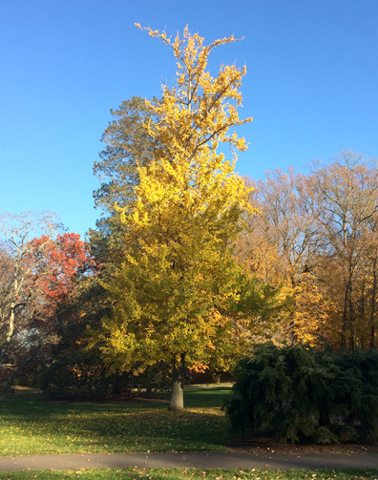 Marquand Park is located on Lovers Lane in Princeton, New Jersey. Please come by for a visit – and perhaps you’d consider exchanging one of your gently used children’s book at a very special Little Free Library?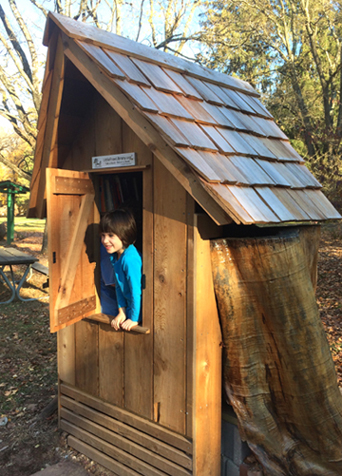
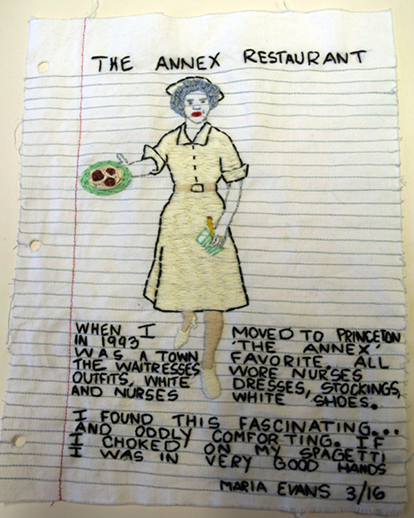
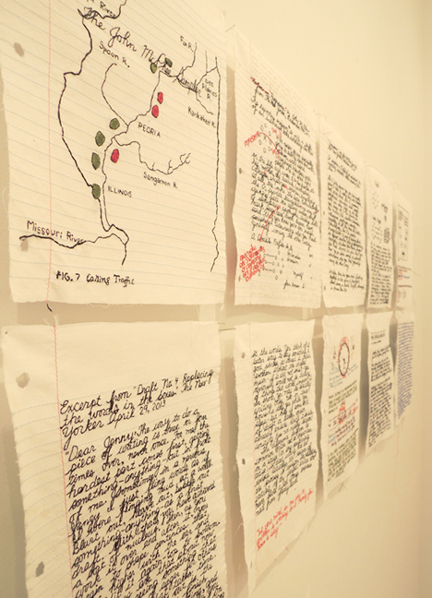 Look closely and you’ll see that these are not handwritten pages of notes. They’re hand-stitched pages of fabric. The intricacy of the stitching, the re-imagining of lined paper as cloth, and the time it takes to produce a single page make viewing these pieces truly amazing. Also amazing is the touching and mindfully deliberate recording of life – both the extraordinary and the ordinary – through slow and careful stitchery.
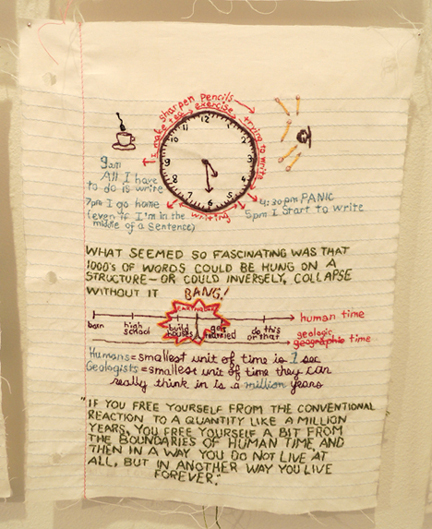 These pages are the works of
 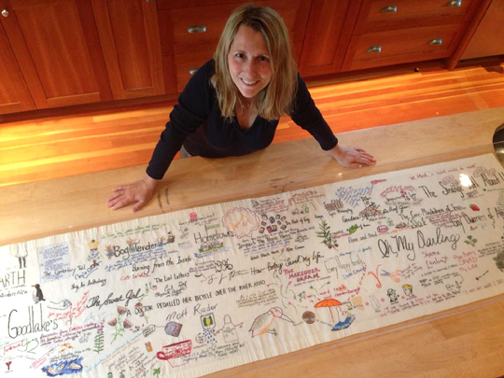 Please tell us a little about yourself!
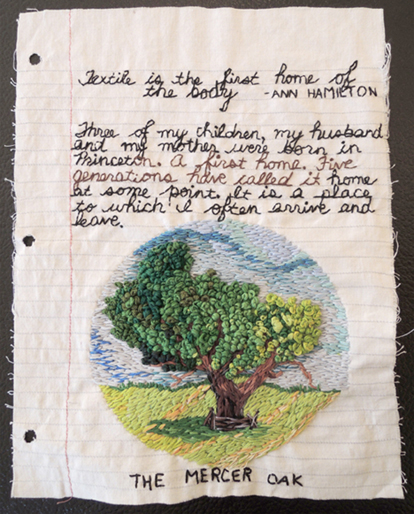 Can you describe the process behind creating a single sheet?
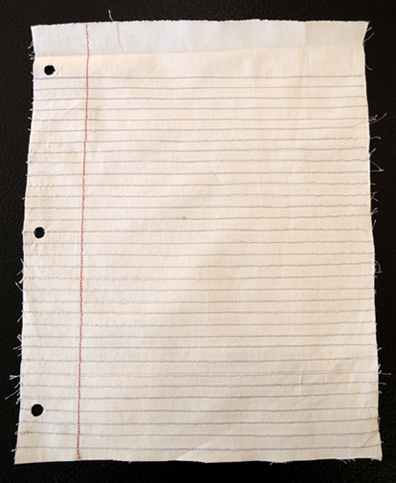 Is it difficult to achieve flow when hand-stitching? I imagine it’s quite a bit slower than writing, painting, or sculpting…
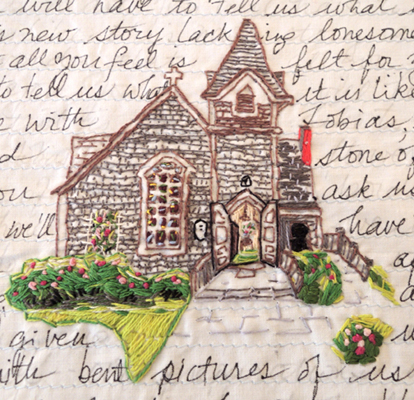 In your mind, what is the relationship between the written word and the stitched word? Are they the same? Vastly different?
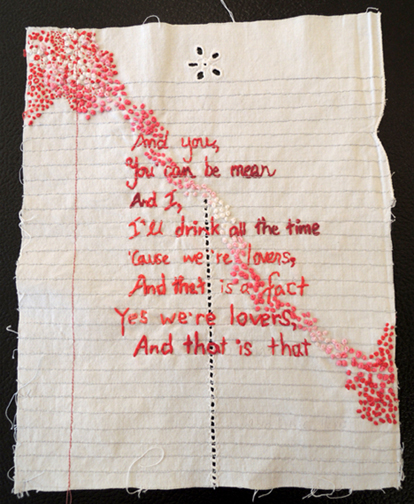 Please tell us about your community art project involving fabric paper.