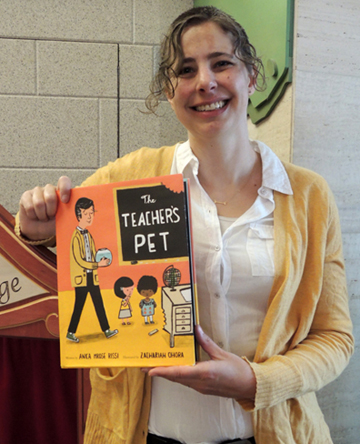
 School is in session, and it appears your teacher has a new pet…that could potentially eat him. Wouldn’t you rather have a sweet little hamster? We were delighted to have author Anica Mrose Rissi visit our story time to read her book, The Teacher’s Pet. There’s an interview with Nica at the end of today’s post, AND! We’re giving away 6 signed copies of the book to YOU, our blog readers!
We read The Teacher’s Pet, written by Anica Mrose Rissi, and illustrated by Zachariah OHora (Disney Hyperion, 2017). Everyone is excited when the class tadpoles hatch. Mr. Stricter, the teacher, allows the class one tadpole to keep as a pet. Except “Bruno” isn’t a tadpole. He’s a hippo who proceeds to grow at an alarming rate and run amok. Bruno eats schools supplies, breaks desks, and snores during silent reading. But Mr. Stricter won’t hear a word against his beloved pet. Until Bruno swallows him whole. The clever class rescues Mr. Stricter, but Bruno needs to retire to a place with more room. Perhaps Mr. Stricter would like a hamster?
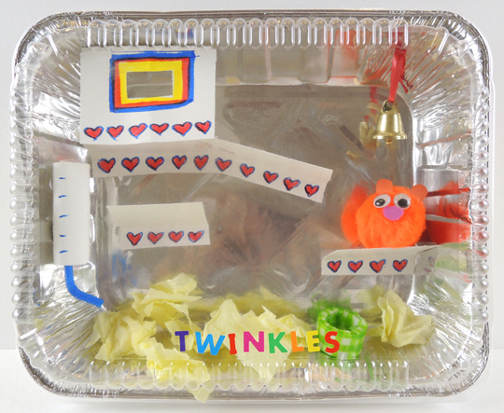
We made hamster cages, complete with a jumbo pom-pom hamster. Thanks to the wonder of magnets, your hamster can scurry around the cage, motor up ramps, and ring a little bell!
You’ll need:
- 1 aluminum food container with plastic lid (more on this below)
- Poster board
- Yellow crepe paper streamer
- Construction paper
- 1 wine cork
- 2 button magnets
- 2 wiggle eyes
- 1 jumbo pom-pom
- 1 bell
- Scissors and tape for construction
- Markers for decorating
- Hot glue
The key to this project is the container you use for the hamster’s cage. We found 10.5″ x 12.5″ aluminum food containers with plastic lids at our local dollar store that totally did the trick. Definitely opt for a larger container so you have room to attach the cage elements. Also, make sure the bottom of the aluminum container is somewhat smooth. Some are heavily ribbed, which makes it hard to keep the hamster/magnet connection going. The cage elements are simple:
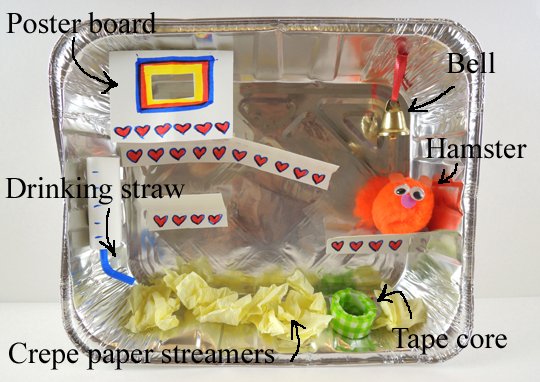 We made a water bottle out of a roll of construction paper and a snippet of drinking straw. The ramps and the little hamster house are poster board. The sawdust shavings are crumpled pieces of yellow crepe paper streamers (the clear winner out of testing a bunch of different types of paper). The food bowl is a tape core wrapped with patterned tape. And the bell is hanging from a little piece of curling ribbon.
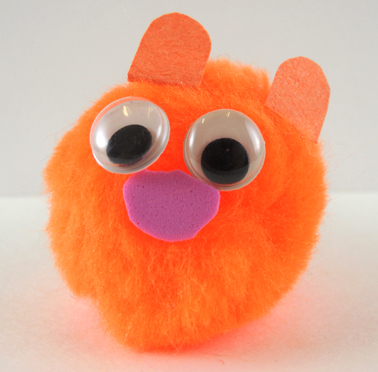
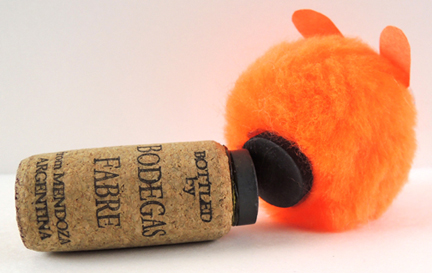
The hamster is a jumbo pom-pom with wiggle eyes, construction paper ears, and a little self-adhesive foam nose (even though construction paper works for the nose too). Hot glue button magnets to the back of the pom-pom and one end of a wine cork and you have your hamster magnet wand, ready to go!
 We also found some alphabet letter stickers in the art cabinet. So we encouraged kids to spell their hamster’s name on the clear plastic lid of the aluminum container. Our hamster was named Twinkles, but there was also a Sparky, Bob, Ricky, and…I can’t quite pronounce this one…
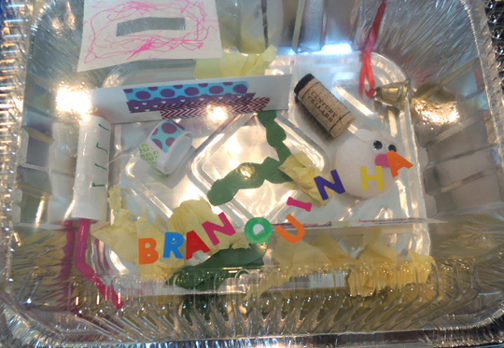 To operate your hamster, place the cork wand behind the cage, connect it with the magnet glued to the pom-pom hamster, then drag the wand to lead the hamster through all of his/her activities!
The Teacher’s Pet is fantastic and fun, and the fun multiplied exponentially when the Anica Mrose Rissi arrived to read it to us herself (whilst also sporting an awesome Mr. Stricter sweater). Many readers know Anica from her charming Anna, Banana series, but she recently released her first YA novel, Always Forever Maybe.
 Please tell us a little about yourself!
I grew up on an island off the coast of Maine, where I read a lot of books and loved a lot of pets. After college, I moved to New York City, where I worked as a book editor for more than thirteen years. Now I tell and collect stories, make up songs on my violin, and take long walks with my dog, Arugula, here in Princeton, where I’ve lived for the past three years.
Besides my picture books, chapter books, young adult novels, and essays, I also write lyrics for (and play fiddle in!) the electro-country band Owen Lake and the Tragic Loves. Princeton-area friends can see us play at two free, family-friendly shows this fall: We’ll be part of the Unruly Sounds Festival at Hinds Plaza on September 29, and we’ll be playing a record release show at Princeton Public Library on November 10, to celebrate our new album, The Best of Your Lies.
Thanks for coming to our library! What do you enjoy most about reading to kids?
Thanks for having me! Talking with kids about writing and reading is one of my favorite parts of being an author. I’m lucky to do a lot of school visits, at which the kids always ask fun and interesting questions. The best thing about reading stories to kids and talking with them about my creative process is that young kids are all creators too. I don’t know a single child who isn’t also an artist or storyteller (or both!), so the conversation is really one amongst peers. I can inspire and encourage them, but they inspire me with their creativity and imaginations too.
You’re best known for your Anna, Banana series, but The Teacher’s Pet was your first picture book. What inspired it?
The Teacher’s Pet is the story of a teacher who is so enamored of the new class pet, he can’t see all the trouble it’s causing. I wrote it because I wanted to play with the pun suggested by the title and tell a story about a teacher whose obvious favorite is an actual pet. And I was drawn to the challenge of writing it as a picture book—a medium with so much room for humor, yet space for so few words.
As for character inspiration…Mr. Stricter is perhaps the most autobiographical character I’ve written. I am not an elementary-school teacher, and I’ve never (yet) been swallowed whole (or sneezed back out!) by a creature like Bruno, but I am wildly in love with my own adorable but not always entirely well-behaved pet (the aforementioned pup, Arugula).
A fun fact about picture-book creation: Picture book authors and illustrators almost always work separately, and even though I wrote this book, I didn’t know that Bruno, the class pet, would turn out to be a [species redacted] until I saw the first round of Zachariah OHora’s hilarious artwork. When the early sketches for the story arrived in my inbox, I laughed with surprise. I never would have guessed that a tadpole would grow into a [!!!!!]. (Though I knew, of course, that Bruno would not be a regular frog.) It’s so much fun to write a story like this and get to see the extra layers—and humor—that the visual story created by the illustrator adds to the text.
This summer, you released your first YA book, Always Forever Maybe. I know you’re continuing the Anna, Banana series, releasing another picture book, and working on another YA novel. Sometimes, do you feel like you’re writing on different planets?
I feel lucky to get to write many kinds of stories for different audiences, and my brain likes to keep busy. I’m happiest when I’m working on several projects at once (though it’s best when each project is in a different stage of creation—I can’t, for example, write two first drafts simultaneously). But no, they don’t feel like different planets to me. Each story has a way it wants to be told, and when I’m writing a draft, I’m focused on figuring out the best way to tell it. That process feels both similar from book to book and wildly different. But I’m exploring similar themes across categories, genres, and age levels—almost everything I write, from picture books for kids to essays for adults, touches on ideas about friendship, animals, and love.
Describe writing in 6 words.
Fun terrible surprising exciting wonderful drudgery :)
If you’d like to meet Anica, she’s going to be at the Princeton Public Library’s Children’s Book Festival this Saturday, September 22nd from 11am to 4pm. Go say hi!
We also have 6 copies of The Teacher’s Pet to give away, signed by Anica AND the illustrator, Zachariah OHora (who will be at the book festival too)! Just e-mail cotsenevents@princeton.edu with your name, and the name of your favorite pet growing up. We’ll put all the names in a hat and draw 6 winners at random on Tuesday, September 25th. Good luck!
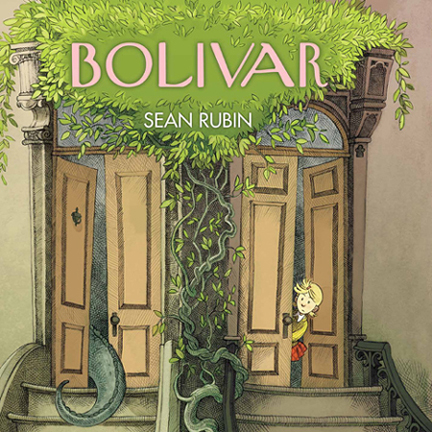 Interesting fact about Sean Rubin. In high school, he showed his artwork to Brian Jacques and landed himself a Redwall illustration gig. Another interesting fact? Sean is a self-taught artist who majored in Art and Archeology at Princeton University. One final fact. Sean is obviously, wildly and without-a-doubt talented, and I am delighted to announce his debut children’s book/graphic novel, Bolivar (Archaia, 2017).
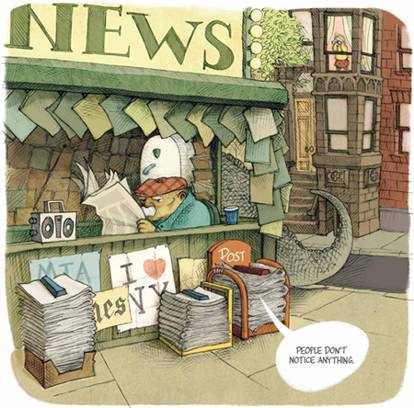 There is one person, however, who does notice Bolivar – a little girl named Sybil who is doggedly determined to obtain photographic evidence of her prehistoric neighbor.
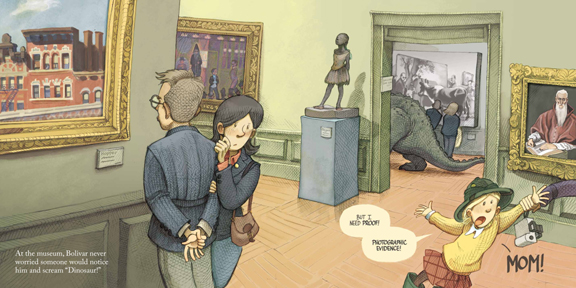 Is Bolivar is a picture book with chapters? A graphic novel with picture book narration? Whatever it is, it totally works, manifesting itself as the perfect book for young readers transitioning into reading on their own while also exploring the joys of the comic book format.
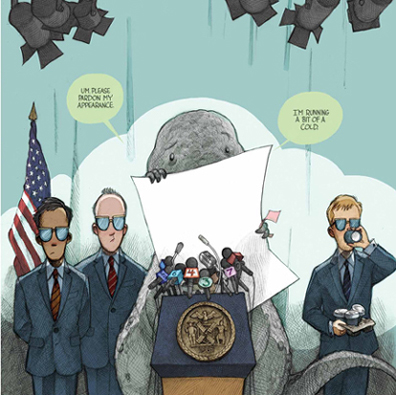 I thought that was a funny idea, so I started writing a book about it. However, I soon realized that if there was a dinosaur in New York City, no one would actually notice it… at least not for a while.
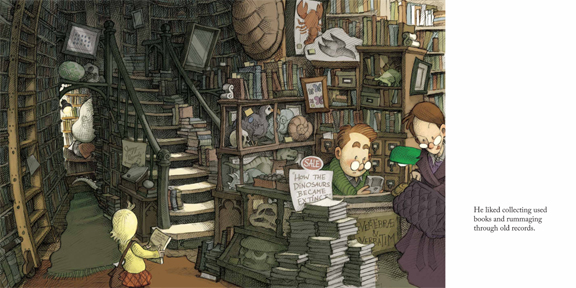 In her
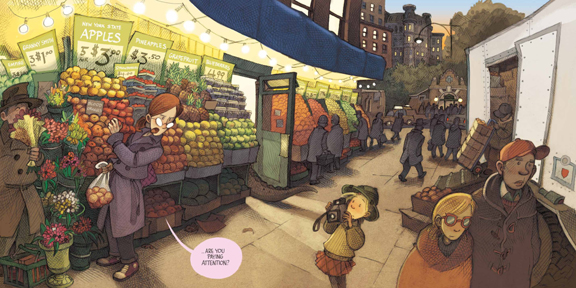
 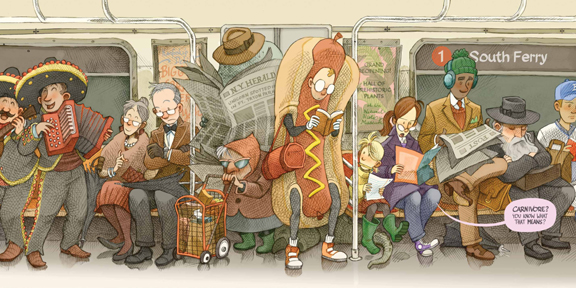 I was born in Brooklyn, and I spent most of my childhood there and on Long Island, which is right next door. After I finished college, I wound up back in the city, this time on Manhattan’s Upper West Side. I love New York. Being a New Yorker is an important part of my self-identity, and there’s no telling how many hours I’ve spent exploring the city, usually on foot.
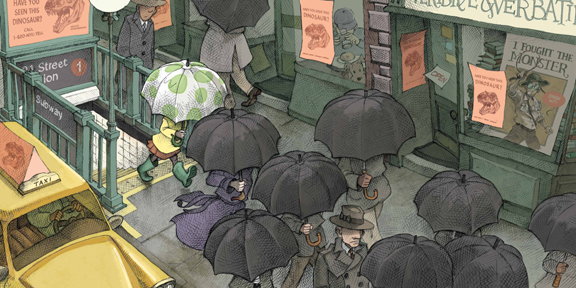 Although I started writing and drawing the book when I lived in New York, much of Bolivar was completed after I moved to Virginia in 2015. As a result, when I sat down to draw, I used a lot of photography and old observational drawings for references. Soon, I realized that I wasn’t drawing Manhattan as it is today. The city is always changing, people come and go, stores open and close, and buildings are built and torn down—so who’s to say which version of New York is the most authentic or accurate?
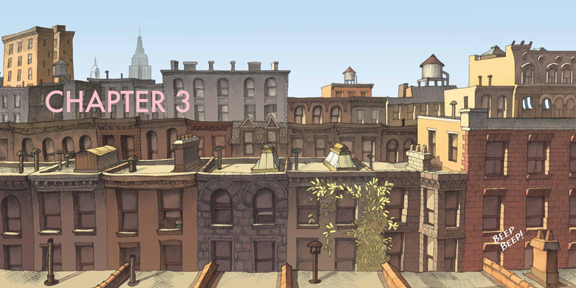 My references began mixing with my memories, especially my memories of New York when I was a kid. In the end, I think most of the book is actually drawn from these memories. As most of the book is also from a kid’s point of view, I think this actually helped me empathize with Sybil’s perspective.
 Betsy also mentioned that this is “a strange kind of graphic novel/picture book/bedtime novel hybrid,” which might cause some people to have trouble classifying it. How did this hybridization come together?
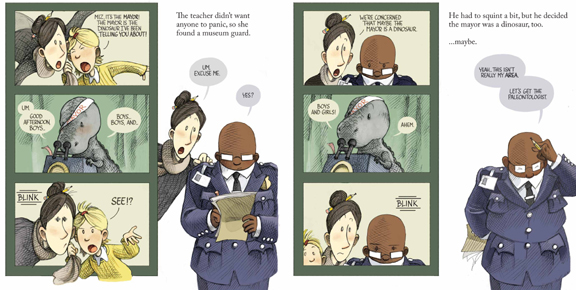 Personally and creatively, the book really took off when I began listening to what the characters had to say. It’s incredible for me to remember that, in the first draft of this book, Sybil was in one scene and said maybe three lines, and her mother didn’t speak at all. I think Bolivar is still mostly a picture book, it’s just a picture book with five chapters, and the characters have succeeded in talking over the author on nearly every page.
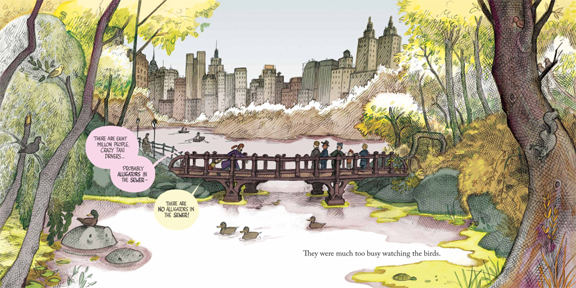 The biggest blessing, and curse, of bouncing between narrative text and panels with dialog balloons involves pacing. In many ways, the panels force you to pick up the pace of your reading. At the same time, they slow down how quickly you’re turning pages. I think the reader will spend more time on a two-page spread that contains a number of panels, and less time on a two-page spread with one, large, open illustration. Ironically, the panel spreads feel faster and the open spreads feel slower. I had to take that into account when establishing the flow of the story.
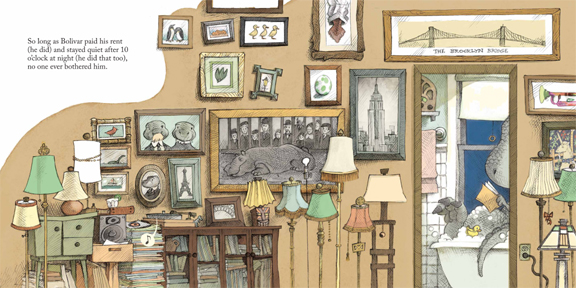 Of course we both have a connection to Princeton University, so I should probably mention that there are number of Princeton references, too. My favorite of these is definitely the Tigers football helmet in the classroom toward the end of the book.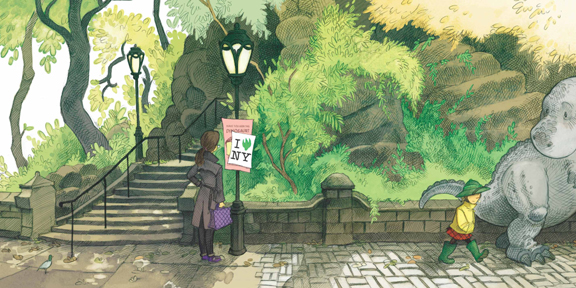
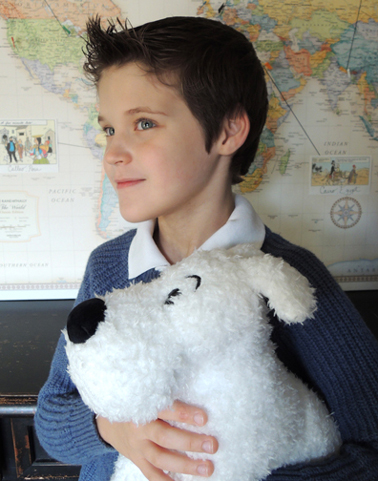
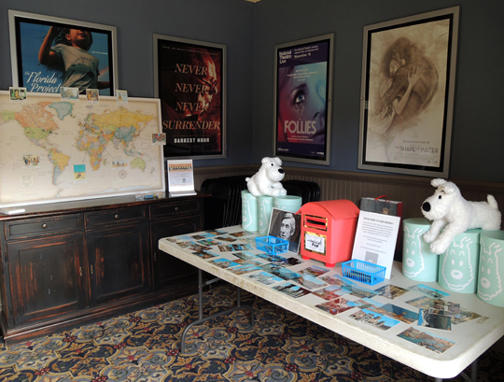
 Families entering the theater were greeted by a table covered with postcards (I found a pack of 92 vintage postcards at the thrift store for for $4 woot!) and a big world map.
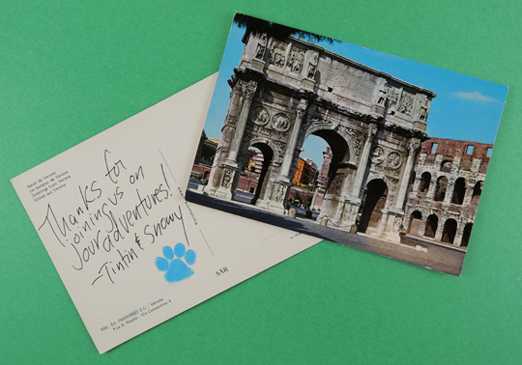
 Kids were invited to select a postcard and write their name and address on it. Then, they put the postcard in the red mailbox for a chance to win a stuffed animal of Snowy, Tintin’s faithful canine companion. Katie modeled the mailbox after the ones she saw in Brussels (birthplace of Tintin!). Isn’t it awesome? It has pom-pom feet!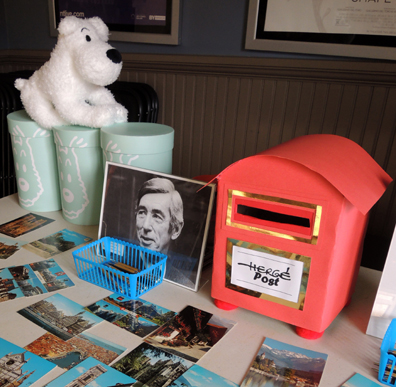
 Next to the postcard table was a big map (50″ x 32″) mounted on foam board:
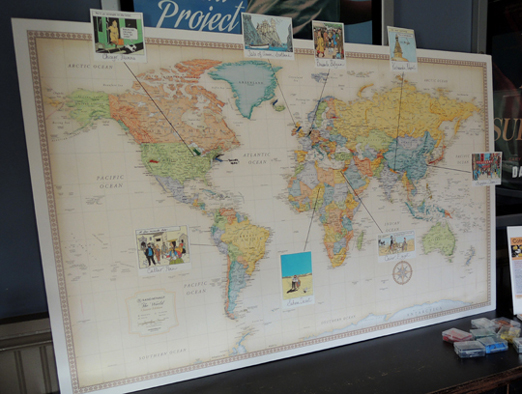 Katie selected some cool Tintin location images from the various volumes and attached them to the map. A line and a flag showed the actual location on the map.
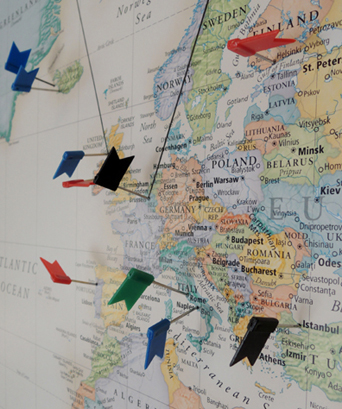
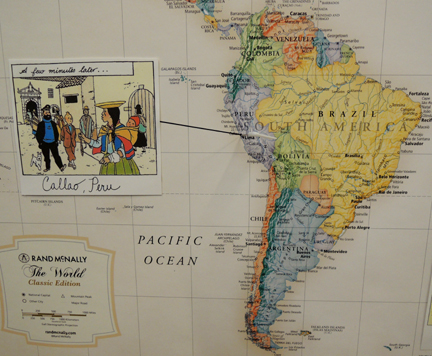 During the event, kids were invited to add pushpin flags on locations they had traveled to. As it turns out, our crowd was pretty well traveled! Iceland, Australia, India, Thailand, Costa Rica, China, Hawaii, South Korea, Europe…
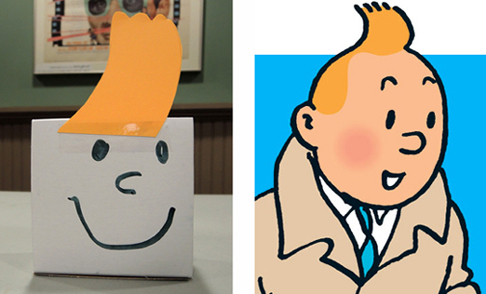
 Around the corner from the postcard and map table were 2 additional activities: A Tintin head band with the iconic hair flip, and a pull-along box Snowy. The box Snowy was a 2″ x 4″ x 4″
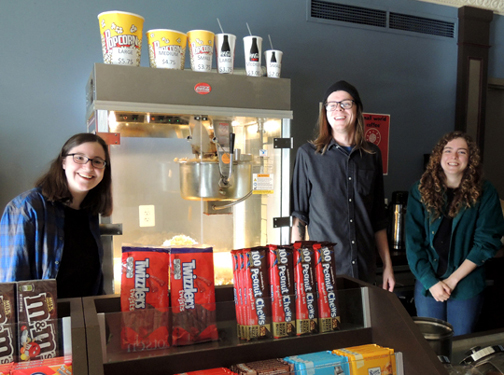
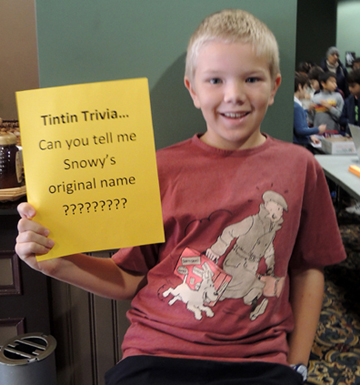
 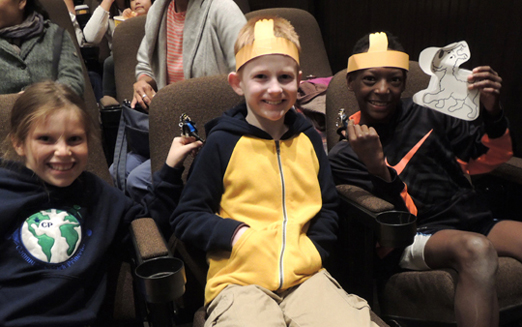 Notice the little Captain Haddock key chains they’re holding up? Those were part of a trivia contest we were running. Our Tintin expert had a couple key chains on hand to give to kids who correctly guessed Snowy’s original name in the comics (which were first published in French).
 In honor of Snowy, we also had a very, very special performance. A live dog show provided by
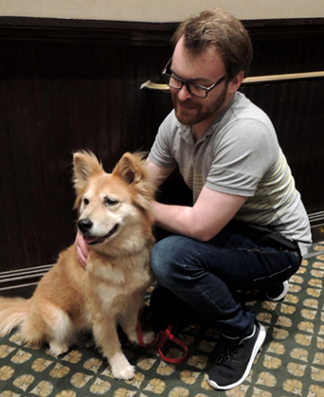
 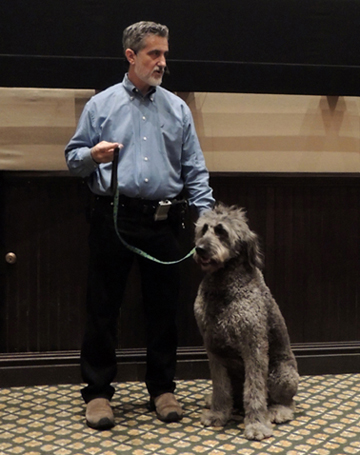 Bill Berloni is a Tony-Award winner with decades of experience training animals. In fact, he trained the very first Sandy for the original production of Annie. He and his apprentice, Andy, brought 3 dogs – Marti, who plays Sandy in Annie (and this was the Sandy from the 2014 movie!), Nessa, who plays Toto in The Wizard of Oz, and Bowdie, who plays Winn-Dixie in Because of Winn-Dixie. Above is Bowdie. Below is Marti, waiting with Andy to go on stage:
 And here’s Nessa, the cutest, most enthusiastic Toto ever, racing down the aisle:
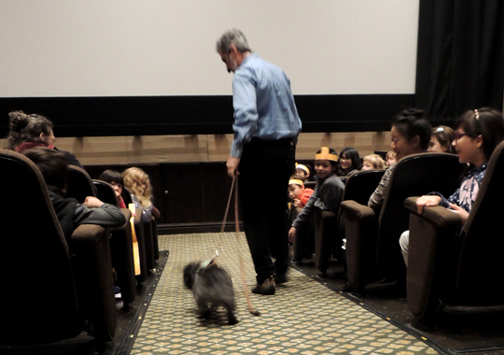 Bill shared a little of his history, his training techniques, and the rescue stories of each of the dogs. There were plenty of demonstrations too, both on and off the leash. The thing that shone through the most however? How happy the dogs are, how much they love working with Bill, and what a tremendous advocate he is for rescue animals. He’s truly amazing. He’s also an author! After the event, he gave me a copy of his heart-warming book, Broadway Tails: Heartfelt Stories of Rescue Dogs Who Became Showbiz Superstars (Lyons Press, 2008), which has a foreword by Bernadette Peters.