Cheshire Cat Grin

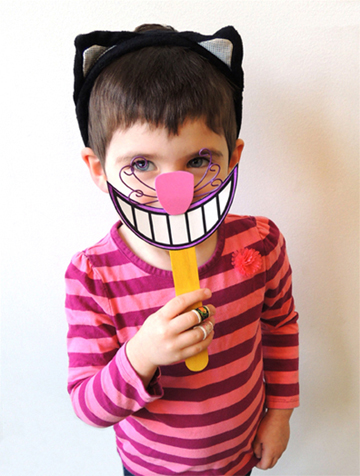
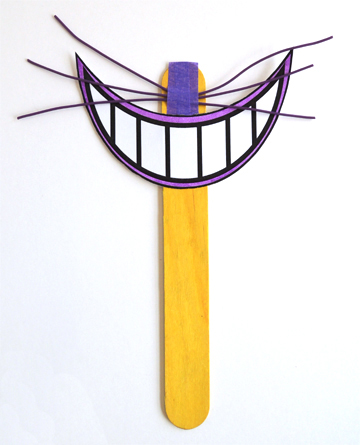
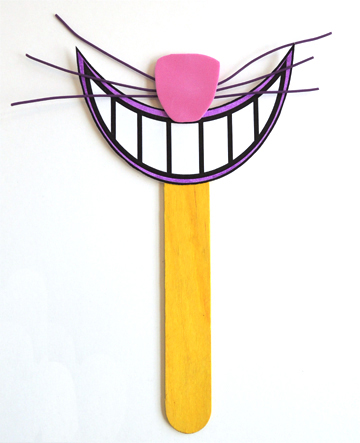
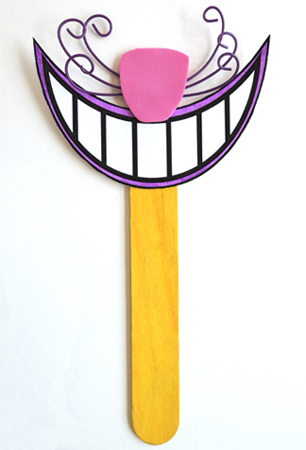
cheshire cat grinSomething to smile about! I designed this Cheshire Cat project for an Alice in Wonderland program. It’s quick, easy, and the results are frabjous!

You’ll need:

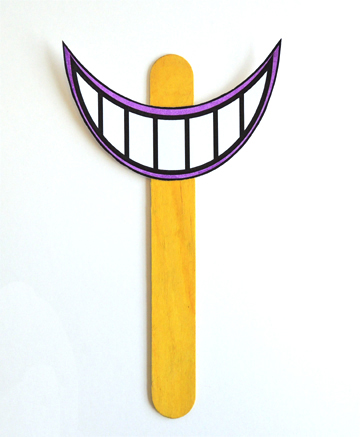
First, select a grin from the template and use markers to color it. Glue (or tape, or hot glue) the smile to a jumbo craft stick. Make sure to leave about 1″ of space at the top of the stick for your whiskers and nose.

grin step 1Pinch the centers of the twisteez wires together, then secure them to the stick with masking tape. If you can’t find twisteez wires, use very thin strips of card stock for whiskers. I wouldn’t recommend using pipe cleaners. The ends can get rather sharp when you cut them, and that’s not good for a project that is held close to the eyes.

grin step 2Shape a square of self-adhesive foam into a cat nose, then peel and stick on top of the masking tape. You can also use regular foam and adhere the nose with hot glue.

grin step 3Trim and curl the whiskers (or leave them straight), and you’re done!

grin step 4Hold the project to your face to become a cat with a grin, or hold it away from you to demonstrate a grin without a cat!

Baby New Year

baby new year readsBaby New Year is here, and we thought we would celebrate with a baby story time post!

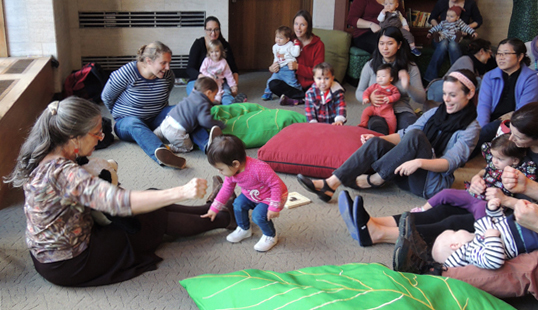
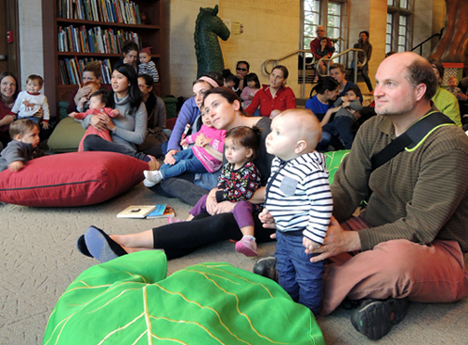
We invited the talented Peggy Salwen to our library to lead a story time bonanza for children ages 2-24 months. Peggy has been a librarian for over 40 years, and is currently a Senior Children’s Librarian at the New York Public Library. Legendary for her baby skills, massive stock of songs, and playful props, Peggy expertly led a very large crowd of babies and caretakers through books, songs, and movement activities. After the program, I sat down to chat with Peggy about the tricks of her trade.

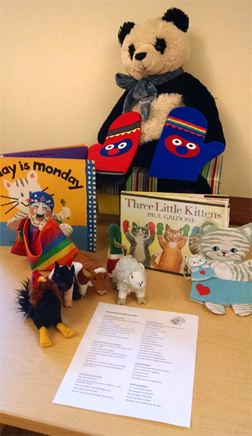
baby new yearYou obviously brought books with you today, but you also brought puppets, props, and a big stuffed bear. Tell us about your props!

I use a lot of puppets and props with babies.  When I read Peek a Moo, I have little puppets that go with every one of the characters. I have a cow puppet, and then pig, a mouse, and an owl. Some are finger puppets, some are hand puppets.

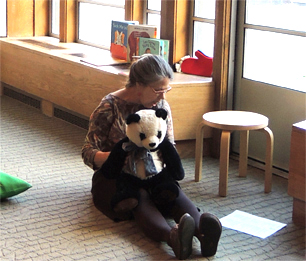
puppets and propsMy Peek-A-Boo mittens I always use with babies. The mittens are in a box and, while I’m sure it’s a bit obnoxious for the parents, I repeatedly use the box during story time. Repetition is so important for babies, and they love it when I take the top off of the box, take Mr. Peek and Mr. Boo out of the box, and then put them back in the box. The babies just get so excited because they know what’s going to happen. It’s all ritual, and ritual is a big thing. I’ve had Poppy [a big stuffed panda bear] for a long time. He’s my “baby.” I use him to demonstrate for parents what they are supposed to do with their babies.

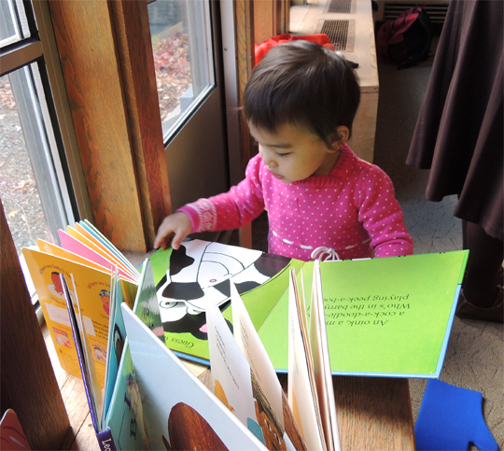
poppyYou brought a number of flap books to story time today. They were great! I could see the kids anticipating what was going to happen next…

Yes! I don’t love the flap books as much in the library’s collections, but I really like the flap books for baby story time.

What’s the hardest thing about baby story times?

Getting the adults to stop talking and to participate, I think.

How do you get parents to stop talking and participate?

By concisely saying “This is story time. Put your phones away. Don’t talk to your neighbor. This is the one time we ask you to take 20 minutes and be with your baby.” Baby story time is really for the adults, it’s not so much for the babies! It’s for adults to learn how to do things and to show their children that they want to do these things. It’s for them to see how much fun it can be to be with their babies. You are a baby’s first teacher. I think that’s the key. You’re there to teach them how to enjoy life, how to learn. That’s what I believe is most important.

baby story timeWhat’s your advice for someone who’s brand new, who’s facing his/her very first baby story time?

Sing a lot of songs. Say a lot of rhymes. It’s more about the songs and the rhymes than it is about the books! Do fewer books and more songs and rhymes. Being a librarian, you think you have to do the book thing. Yes, reading the books is important, but for baby story time, songs and bouncy rhymes are more important.  I learned in a workshop that lyrics to songs are like syllables of words, so your child learns the syllables of words when you sing. So singing is a great way to learn language too!


Peggy’s Favorite Story Time Books

Leo Loves Baby Time by Anna McQuinn
The Baby Goes Beep by Rebecca O’Connell
Brown Bear, Brown Bear, What Do You See? By Bill Martin
Peek-a-Moo! By Marie Torres Cimarusti
Peek-a-Baby by Karen Katz
Where is Baby’s Belly Button? By Karen Katz
Tuck Me In! by Dean Hacohen and Sherry Scharschmidt
Head, Shoulders, Knees and Toes by Annie Kubler
If You’re Happy and You Know It by Annie Kubler
Baa Baa Black Sheep by Annie Kubler

Songs & Rhymes
“Open Shut Them”
“This is Me”
“These Are Baby’s Fingers”
“Little Red Wagon”
“Tommy Thumbs”
“We’re Going to the Moon”
“Tick Tock, Tick Tock”
“Mother and Father and Uncle John”
“Banana Cheer”
“Head, Shoulders, Knees and Toes”
“The Noble Duke of York”

Teaching the Untouchable

vellumIn 2014, College & Research Library News published an article I wrote about teaching children using rare books and special collections materials. I’ve posted it here as well!


The Cotsen Children’s Library at Princeton University is a Rare Books and Special Collections Library devoted to children’s literature. It has an extensive and engaging collection, and part of our mission is education and outreach to children. Rare books and children…can the two mix?

The answer is yes, absolutely. For seven years, I’ve had tremendous success bringing collections education to New Jersey schools. This outreach initiative, which I call Cotsen in the Classroom, consists of six staff-lead programs that are available, free of charge, to K-5 classrooms in public schools, private schools, and home schools. To date, over 14,000 children have participated in the programs.

Each Cotsen in the Classroom program is set at a particular grade level and is based on items from our special collections. Beatrix and Peter, the kindergarten program, features the natural history drawings, family photos, and picture letters of Beatrix Potter (for more Potter fun, take a look at this post). Kamishibai, the first-grade program, includes historic photos, story cards, and performances of kamishibai, a type of street theater popular in Japan from 1930-1950 (you can read more about kamishibai in this post). Mr. Andersen, the second-grade program, follows the life story of Hans Christian Anderson, using a number of his personal paper cuts and century-spanning illustrations for The Ugly Duckling.

Colonial Classroom, the third-grade program, features a day in a Colonial American classroom, complete with horn books, copy books, primers, and writing blanks. Illuminate Me, the fourth-grade program, demonstrates the process of creating illuminated manuscripts and discusses the world-changing invention of the Gutenberg press, and the advent of the printed book (manuscript fans, click here). You Are Here, the fifth-grade program, exhibits 18th-century geographical objects from London, England, and discusses how, over the century, they reflected changes in education and social structure in Europe. To see the full program descriptions, click here.

display boardsSince the programs travel out of Cotsen and into local schools, I don’t use actual collections materials. Instead, I teach with enlarged high-resolution photos mounted on foam board, reproductions of historical items, and objects that have been purchased (or specially constructed) for the programs. Students work with (and take home) full-color reproductions of collections items, as well. The visual material is reinforced by a lively lecture, hands-on activities, and a succession of question and answer opportunities designed to keep the students engaged during the 45-minute presentation.

Are the programs successful? Do students gain an appreciation for the collections material? Do they retain the information in the programs? Do they enjoy the programs? The answer to all of these questions is yes.

The entire programming year for Cotsen in the Classroom (which runs for 38 – 40 weeks during the academic year) consistently books within 48 hours of the opening registration date. I’ve observed students exclaiming over a 15-century illuminated manuscript, avidly searching for the publication year on a 1776 copy book, and racing each other to locate New Holland on a paper globe from 1830. Students often recognize me when I return to their schools and eagerly share what they enjoyed the previous year. Teachers repeatedly relay stories of students making further connections to, and initiating personal projects on, topics inspired by the Cotsen in the Classroom programs.

manuscript workThere are also the thank-you cards I receive from classrooms. While some are obviously form letters dictated by the teacher, others recall key pieces of the presentations, make personal connections to the material, or accurately replicate, through their illustrations, the collections material presented in the programs.

It’s definitely possible to bring special collections to school children, including those who visit your library on tours. Whether designing a new program or adjusting a current one, I offer the following recommendations for developing successful programs for your young patrons.

Allow hands-on whenever possible. Rare materials are, by their nature, not things to be handled frequently or casually. Therefore, I use reproductions of collections items. A large poster to pass around the classroom, a reproduction of a period object, even a contemporary version of a historical object can all be used to great effect. For children, being allowed to touch an object creates an instant connection to it, and promotes absorption and retention of the information. It doesn’t have to be elaborate. Whisper sticks, for example, were a form of punishment in Colonial schools. Pupils caught whispering were forced to clamp sticks in their mouths. I use wooden Popsicle sticks, purchased in bulk from a school supply company, to replicate this experience.

Adjust for your audience. The younger the children, the more activities, transitions, and visual changes you will need. The Beatrix Potter kindergarten program, for example, starts as a group sitting theater- style on the floor, then quickly moves back to tables/desks for some natural history sketches, then returns to the floor for the remainder of the program. In between these transitions, there are plenty of visuals. The fifth-grade program, in contrast, takes place almost entirely at the students’ desks, with the visuals presented at the front of the classroom and a collaborative group activity at the end of the program.

Leave time at the end for Q & A. Answering questions is my favorite part of these programs, and a good way to assess if the audience was interested and engaged. I build in at least 5 minutes at the end of each program to answer questions. One fourth-grade class kept me busy answering questions for 30 minutes! I’ve fielded a wide range of questions about these programs – questions about the content, questions about the Cotsen library and rare books, questions about my work and expertise, and questions about how the programs were researched and designed.

Send materials home. Every student who participates in Cotsen in the Classroom takes home a full-color reproduction of a collections item. “We get to keep this? Really? Cool!” is the refrain I often hear as I pass materials out. Sending materials home allows students to connect with what they learned, and share it with their families. One parent (who also happened to be the principal of the school) stopped me in the hall to tell me how excited his five-year-old son had been to show him the Beatrix Potter sketchbook he’d brought home from class that week.

Ask your audience to analyze your program. During the first three years of the Cotsen in the Classroom initiative, I gave every classroom teacher an evaluation form. On this anonymous form, he or she was asked to rate the program on a scale of 1 – 5. I also left space on the form for teacher comments, student comments, and general suggestions. I used the invaluable feedback I received on these forms to improve the presentations, clarify content, and assess whether the program was accomplishing its educational goals.

model pressTeaching the untouchable can absolutely be done through quality reproductions, replicas of historical objects, and a presentation designed to engage, enlighten, and empower young learners. It’s also incredibly rewarding. A kindergartener eagerly asking a question, a fifth-grader gazing thoughtfully at an 18-century map cabinet, a first-grader creating a kamishibai title card, a third-grader who wants to find books on the subject I just presented – after seven years of teaching these programs, I never tire of watching students making connections to the special collections material. I also enjoy their expressions of appreciation for my visit. “That was so cool.” “I never knew that!” “That was the best presentation ever!” “Can you teach us something else?”

But my favorite compliment of all time was one that was not expressed directly to me. As I left the classroom, I overheard a fourth-grade boy whisper to his friend, “I thought that was going to be boring but it totally wasn’t!”

Success!


Teaching the Untouchable: Rare Books Education in Elementary School Classrooms was originally published in College & Research Library News, November 2014 (Vol. 75. No. 10). Full text version, click here. Pdf version, click here.