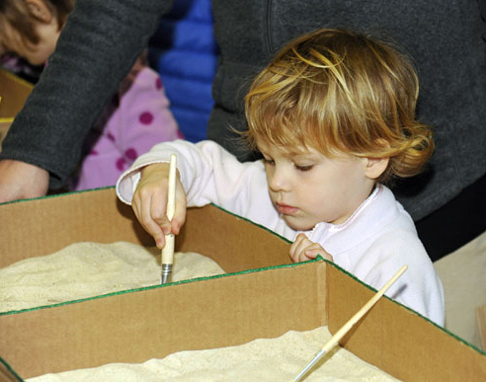
 While archaeology can’t always be fedoras, bullwhips, and jaunty theme music, it is a fascinating field of study. Plus, you get to dig really, really big holes! In 2013, my library had a large-scale Journey to the Centre of the Earth event, and archeology seemed just the thing to include. But we needed to be realistic about what we could do. I mean, we couldn’t set up a dig site on the event floor…or could we?
Today, I’m going to share how Katie and I built a portable archeological dig site. It has it all – grids, brushes, artifacts, scientific sketches, field notes, and a clipboard activity that got kids thinking about how all the artifacts were connected. The dig was hosted by the Historical Society of Princeton, who put their own fantastic twist on things (I’ll share what that is at the end of the post!).
Katie and I created the dig in the pre-blog days, so you’ll have to excuse me if there aren’t as many detailed process photos!
Our dig consisted of 4 different “sites.” Each site was a group of 6 corrugated cardboard boxes and a clipboard. I ordered the boxes from Uline (model S-16746). They are 15″ x 15″ x 3″. Originally, the boxes had attached lids, but we cut those off. We connected the boxes with tons of hot glue, then ran brown packing tape around the outside as well.
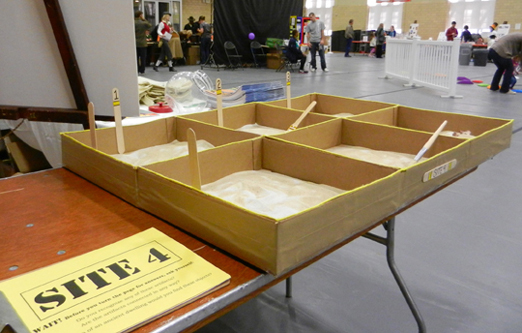 Archeologists use string to divide their sites into grids. We replicated this by hot gluing yarn along the tops of the boxes. We color-coordinated the sites as well. Site 4, for example, had yellow yarn, yellow stripes on the markers, and a yellow cover sheet on the clipboard. The other site colors were green, orange and red.
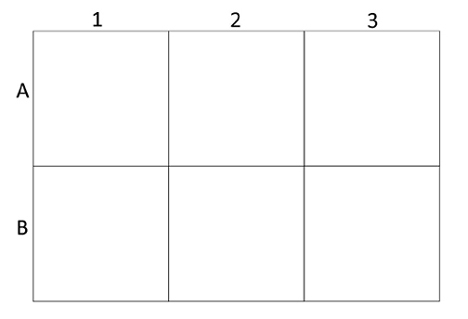
Since the artifacts would later be matched to a site map, we hot glued wooden craft sticks markers around the grid as well. Here’s how each site was marked:
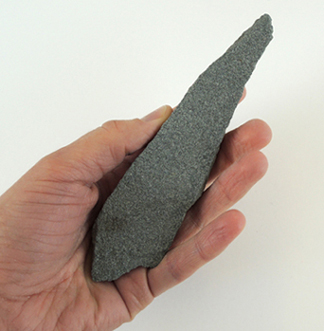
 The next step was to find artifacts to put in the boxes. We had a lot of fun with this! Among other things, we used old metal jewelry, non-plastic beads, and owl pellet bones. We used air dry clay to make cups, plates, bowls, and spoons (a couple of which we intentionally shattered and used as shards). A library contractor donated some small deer antlers, and I snagged a “stone knife” from a broken piece of paving tile.
 Each of the 4 sites had its own theme: 1) Fire Pit; 2) Pantry; 3) Treasury; and 4) Armory. We sorted the artifacts under the different themes, and then arranged them in the appropriate boxes. Because we needed the artifacts to match the site map, we hot glued them inside the boxes. And we really, really hot glued them. We even had an emergency hot glue gun at the event in case an over-eager archeologist yanked an artifact out of the box.
Next came the dirt! Except, for sanitation reasons, we used playground sand purchased from Lowe’s. Specifically, we mixed white and yellow playground sand together to give it more texture.
To keep the mess at a minimum, we added 1″ of sand to the boxes. It was just enough to cover most of the objects, but still left a few sticking out in a tantalizing way. Each individual box got 4 cups of sand, which meant each site used 24 cups of sand. In the end, we used 50lbs of sand for the whole dig site. For obvious reasons, we transported the prepped boxes to the event and THEN filled them with sand.
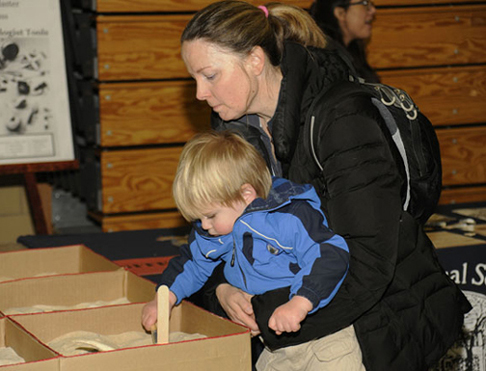
At the event, young archeologists used paintbrushes to uncover the artifacts. They were natural bristle brushes with wooden handles in assorted sizes (the widest being 2″). There were at least 4 brushes per site so multiple kids could work at once.
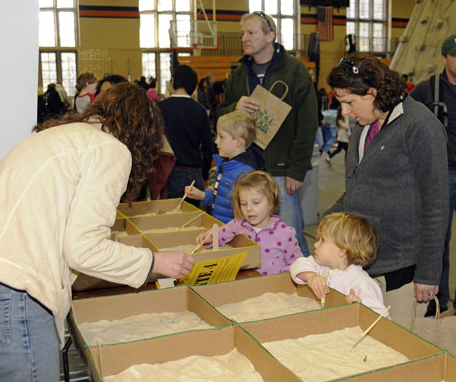 Remember the clip boards by each site? The clipboards contained a site map of where all the objects were buried. But before kids looked at the map, we asked them to think about what they had just uncovered. So the cover sheets for the clipboards looked like this:
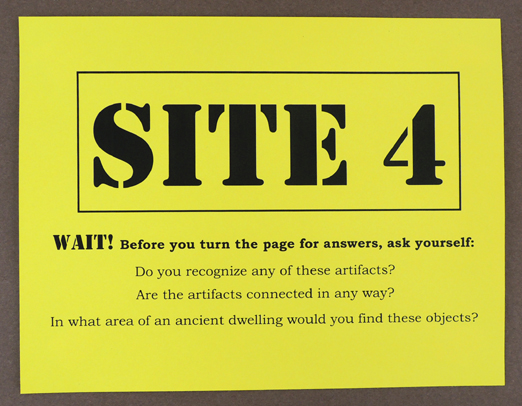
Kids would talk about what the artifacts looked like (“That looks like a spoon!”), how some artifacts were located close together (“I saw a plate and a spoon together…”), and then make guesses as to what dwelling the artifacts were used for (“I think someone was eating here. A kitchen maybe?”).
Flip up the cover sheet, and there was the site map with the artifacts. If kids hadn’t found an artifact, they could use the grid markers to locate it. The map also had the title of the site, so kids could confirm their hunches as to how the artifacts were connected. If they excavated all the sites, they would also see how those were related (the Pantry was located next to the Fire Pit, the Armory was located next to the Treasury).
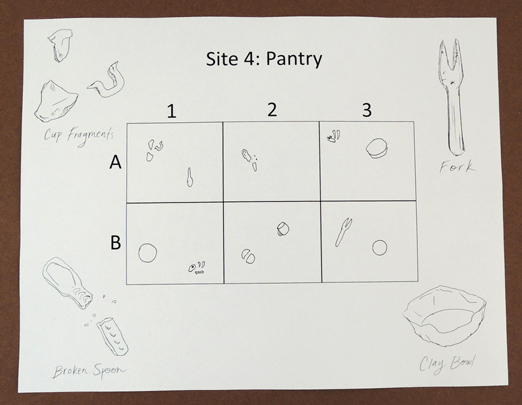 Bordering each site map were cool “field sketches” identifying some of the objects on the site. These were drawn by the awesome Aliisa Lee.
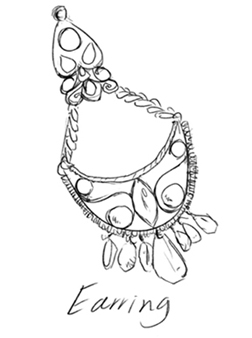 Aliisa even added cool little notes to some of the sketches…
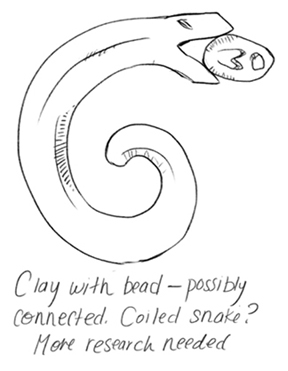 You might have noticed that we didn’t label everything on the site map. That was intentional. Many of the objects were obvious (beads, spoons, a bracelet), but we left a few mysteries to show that, sometimes, you don’t get all the answers right away. It might take a little more research and consultation with your colleagues.
I mentioned that the Historical Society of Princeton added their own special twist to the archeology activity. YES! They displayed, and in some cases let kids handle, a multitude of artifacts that had been discovered and excavated from actual dig sites in Princeton! Some of the artifacts included broken dishware, glass piece, the base of a flowerpot, arrowheads, and a stone ax.
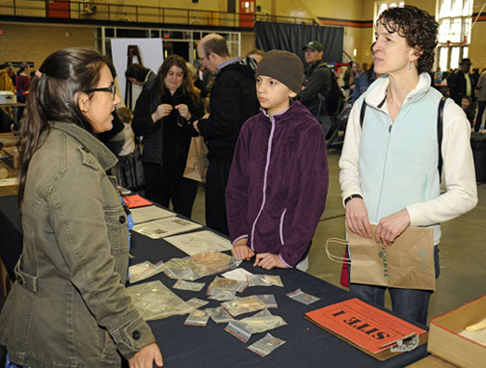 The two Princeton excavation sites were the Houdibras Tavern and the Updike Farmstead (where the Historical Society now houses its headquarters). They had this fantastic photo on display too. Kids at the Houdibras Tavern dig in 1969. It was the PERFECT archeology and history connection. So cool.
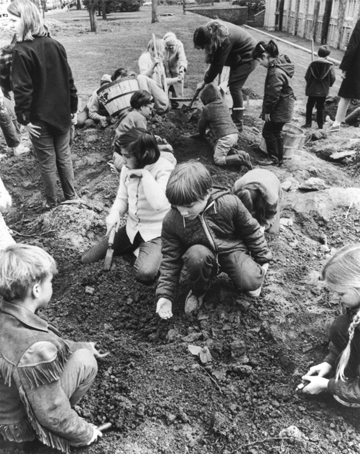
Photographer Warren E. Kruse of the Trenton Times, from the Collection of the Historical Society of Princeton
And there you have it! An archeological dig site to spark the imaginations of budding young archeologists (with their dedicated research assistants offering a boost when needed).
 If you’d like to see the event map, here it ’tis. The front of the map lists all the activities. The back features book quotes or informational blurbs tying the activities back to the books, Lewis Carroll, or Victorian England. Like all of our programs, the event was open to the public and free of charge.
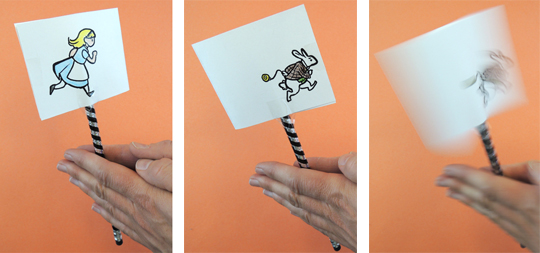
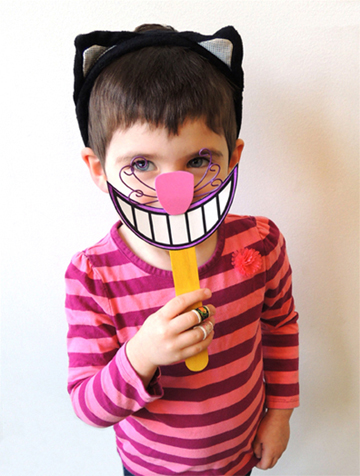 Or this really cool Victorian visual toy called a thaumatrope. At the very bottom of the thaumatrope post, you can also see Marissa and I channeling our inner 80s – and I don’t mean 1880s folks.
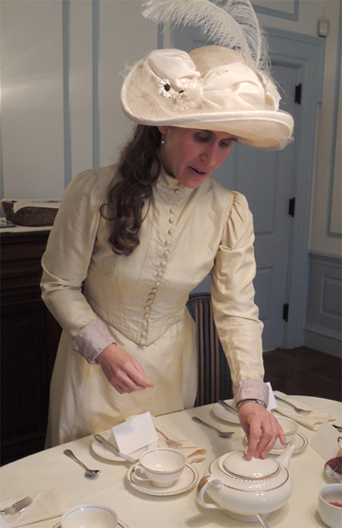
 And what about tea? 2016 was the 150th anniversary of the publication of Alice’s Adventures in Wonderland, and we put together an elaborate Victorian tea program, complete with big hats, mini scones, and a generous serving of history.
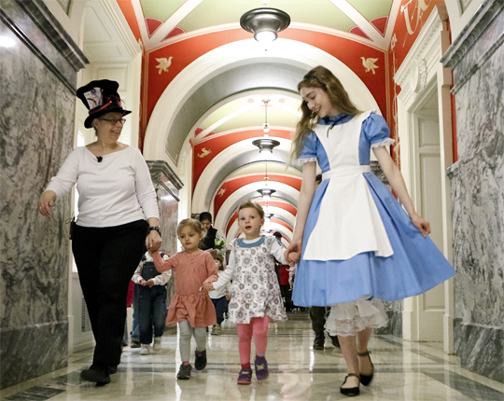
 The Library of Congress went all out for the 150th anniversary as well. In this post, you can see some of their activities, lecturers, and Miss Joani in a replica of Alice’s iconic dress.
 However, the award for the most whimsical Alice connection goes to the Mazza Museum of International Art from Picture Books (which I blogged about here). In their children’s loft, you can follow the White Rabbit down the hole…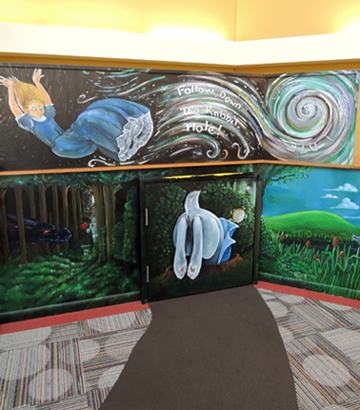
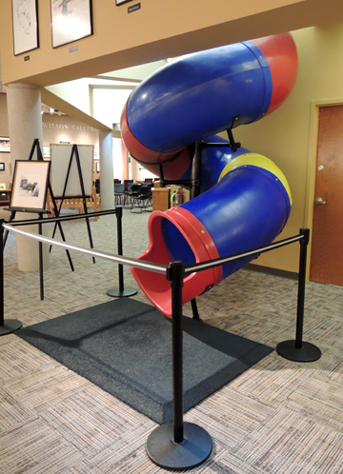 Dang. I want a twisty slide in my place of employment.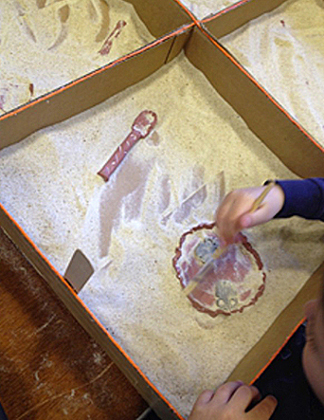
 Navigate your way through a laser maze, steal a bear from a snoring sleeper, and snag some hidden diamonds. Stealthiness, sneakiness, and silence are strongly encouraged at
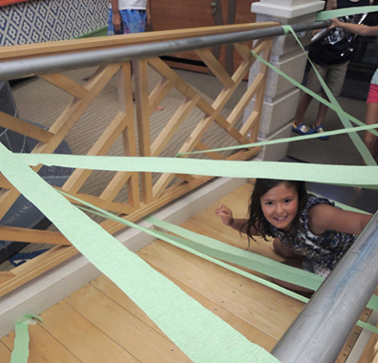
 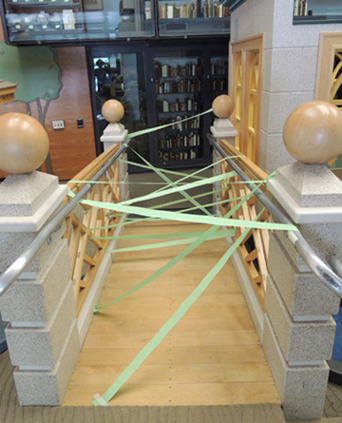 Starting at the bottom of the bridge, kids had to squeeze, crawl, and slide through the course without touching a single “laser beam.” I stood nearby, making “Zzzzzt!” laser noises at key moments.
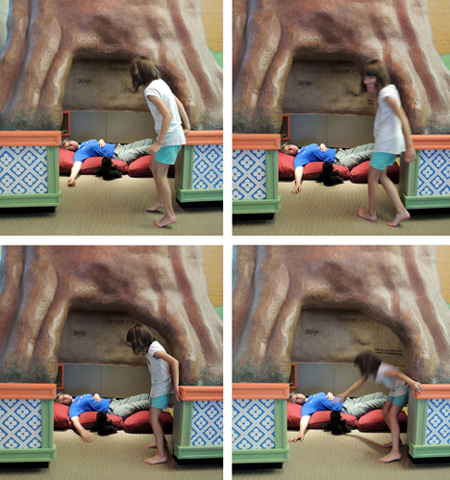
 Story Time Task #2: George’s midterm exam involves stealing a teddy bear from a sleeping toddler. I grabbed a bear puppet, flopped on some pillows, closed my eyes, and started snoring wildly.
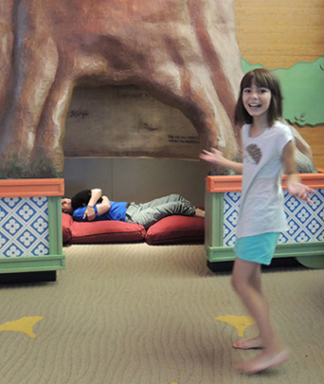
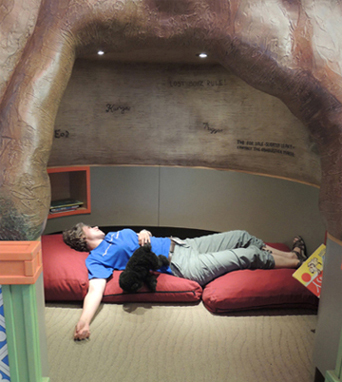 One by one, the kids had to sneak up and grab the bear without me noticing them (and they were quite astonishingly good at this). To increase the challenge, sometimes I would randomly thrash around in my sleep, throw the bear around, or grab it tightly to my chest.
 Story Time Task #3: The diamond hunt. Pilfer Academy is a massive Gothic mansion with arches, spires, and stained-glass windows. I thought it would be fantastic to immerse kids in a similar environment, so we headed over to one of my favorite places, the Chancellor Green Rotunda.
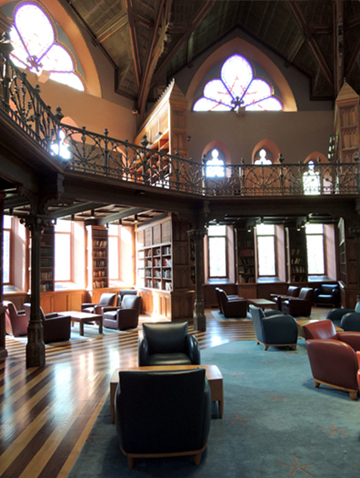 This beautiful room was once the original library for Princeton University. Now it’s a study space for the Andlinger Humanities Center. Here’s a shot of its elegant stained-glass dome.
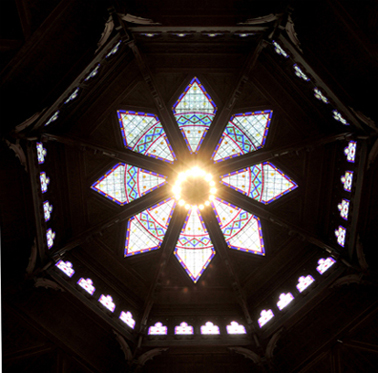 On this particular afternoon, however, the room was full of hidden diamonds!
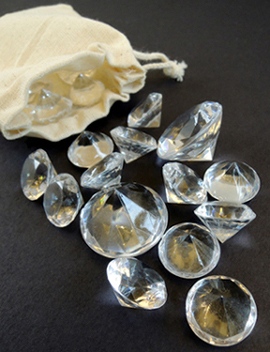 I found these acrylic diamonds in the wedding section of Michaels Craft store. A $5 pack contained over 75 diamonds of assorted sizes (from 0.75″ to 1″). I hid the larger diamonds in various locations in the room.
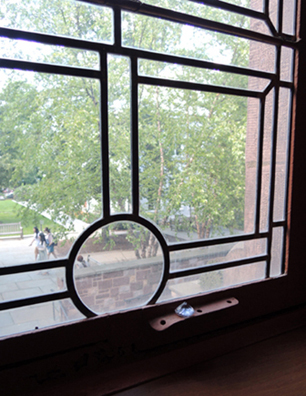 Sometimes I got a little sneaky. Can you spot the diamond in the wood paneling below?
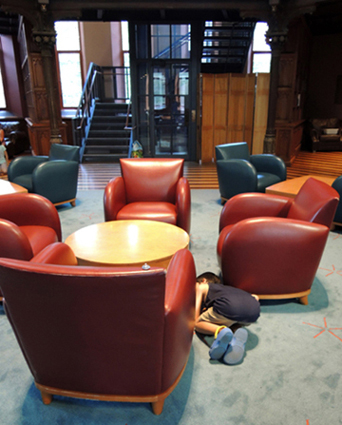
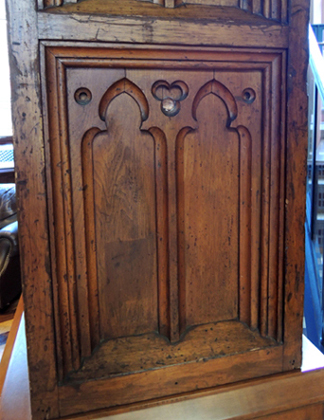 One by one, kids went searching for diamonds in the room. Once you found two diamonds, it was another person’s turn to search. And you had to be completely silent while searching!
 At the end of the program, each kid got to take home a little drawstring bag with some diamonds in it. Score!
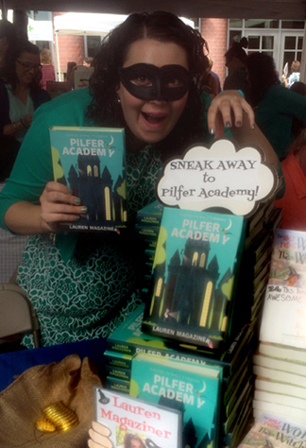 That’s right! Lauren Magaziner herself! Totally rocking a bandit mask, I must say. Thanks for the fantastic book Lauren. We absolutely loved it.