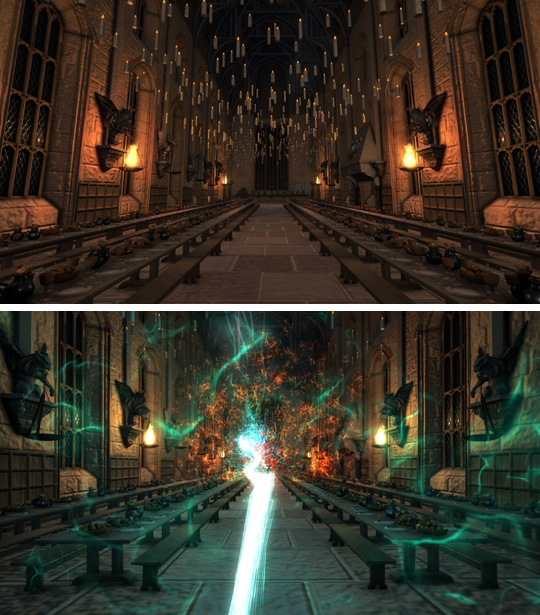
 Are you ready to see something stunning, amazing, and totally, wickedly, cool?
Above are screen shots from the custom Harry Potter game that was featured at our library’s Wand Works event. Set in the Great Hall of Hogwarts, the Spell Simulator allows kids to test 6 spells with their wands. I’ll share the game with you first, and then introduce you to its creator, Princeton University junior José M Rico (who is, incidentally, majoring in Computer Science and co-founder of the gaming company Kapricorn Media).
For starters, we wanted the game to play on a really big screen, have good sound, and have the highest resolution possible. Instead of cobbling something together with our library’s equipment, I did one of the smartest things of my outreach career. I hired NJ Backyard Movies. They brought a huge inflatable screen, big sound speakers, and a terrific projector. Best of all, a tech guy set everything up and stayed during the event to make sure it ran smoothly.
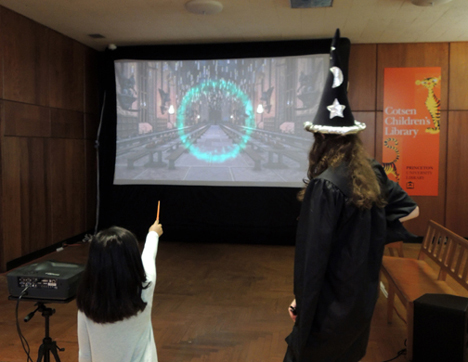 One by one, kids approached the screen, where 6 spells were displayed on a menu – Bombarda, Glacius, Incendio, Lumos Maxima, Priori Incantatem, and Protego. Once chosen, the screen would briefly display the title of the spell, its use, and its linguistic roots. Then the caster would find themselves in the Great Hall. A sparkling circle would appear. With a flick of the wand and a shout, kids would cast the spell.
Discretely to the side of the spell-casting area, and controlling the game with keystrokes, was José. He wouldn’t activate the spell unless the kids spoke the spell and flicked their wands. And he wouldn’t stop the spell until they raised or lowered their wands. This made the game appear to react to the kids’ movements.
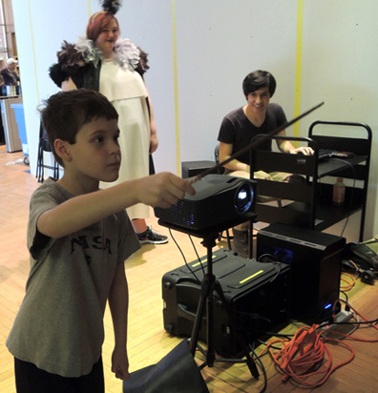 This photo also caught Téa Wimer, our Curator of Muggle Artifacts, taking a break from her exhibit to check out the game. OK. Ready to see the spells? I highly recommend dimming the lights, cranking up the sound, and viewing these full screen.
AMAZING, right? I must admit, I was moved to tears when José first showed me his game. The amount of time, care, and talent he put into it is truly touching. At the event, there were huge smiles, gasps of wonder, delighted laughter, and long, slow drawn out exclamations of “Whoaaaaaa….”
José has very generously modified the game so YOU can play it. Yup. Download a Windows or Mac version of the game, for free, right here.
GAME DESIGNER JOSÉ M RICO
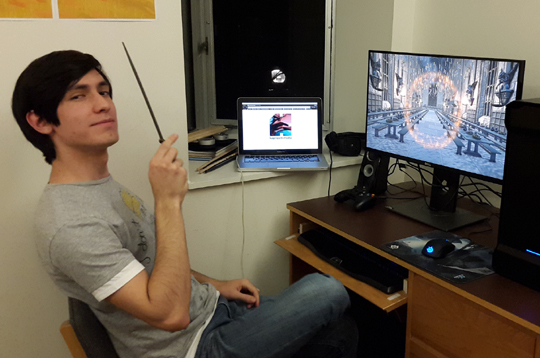
Tell us a little about Kapricorn Media…
Kapricorn Media is a two-man game development team. It consists of Luciano Obregon, the artist and designer and my friend since childhood, and me, the programmer. It was officially named and established by us in May of 2016, though it had inadvertently started in spirit years earlier. Luciano and I have always been searching for something in this world. This has led us on a path of creation, discovery, and uncertainty that involved our early immersions into many LEGO worlds, our wooden sword fights, our hand-drawn mini games, our video game mods, and ultimately our own game development team. Kapricorn Media is our next and most mature step in this constant search.
How would you describe your relationship with the Harry Potter books?
The Harry Potter books opened up a rich universe of magic and adventure. Even though I doubt I was even capable of reading at the time the first book was published, I quickly joined the Harry Potter craze as the movies and the later books started to come out. I spent several days trying to look for the perfectly shaped stick to use as a wand, and then casting spells at my friends and imaginary enemies. I remember Luciano and I made our own Marauder’s Map at some point. I also remember having a framed photo of Luciano and me, only I had cut out a picture of Hermione Granger and pasted it on top of Luciano’s face. I had a huge crush on Hermione.
How did you decide which spells to include in the game?
I started out with a huge list of spells, and a limited amount of time to implement them. Some of them, like Wingardium Leviosa or Accio, would have required me to develop more interactive controls. Some of them weren’t as visually interesting, like Alohomora or Expelliarmus by itself. Ultimately, I chose the ones that I thought were most visually striking and made the caster feel most powerful. I also decided to add Protego and Priori Incantatem to vary the mechanics of the game by introducing an opponent.
Describe the process of building one of the spells…
Each spell had three main components: visual effects, the physical effect of the spell, and sound. I usually implemented them in that order. All visual effects involved some sort of particle system, one or more light sources to integrate the particles with the game scene, and a conduit for the spell, usually a missile or beam. The physical effect of the spell was trickiest for Bombarda, since the explosion triggers an expanding shockwave that knocks back all props in the scene. Finally, the sound design consisted of me shifting through free online sound databases. The explosion sound for Glacius, for example, contains modified audio clips of people dumping out lots of ice cubes.
How long did it take to develop the entire game?
The game probably took me a grand total of 70 to 80 hours to develop.
Which spell is your favorite?
My favorite spell is, by far, Priori Incantatem (which is not technically a spell, but more of an “event”). However, the spell with my favorite sound effects is Glacius.
What was the most creative aspect of this game for you?
The most creative aspect was choosing the appropriate way of presenting and controlling the game environment at the actual event. Even though I experimented with several options, including motion capture through webcams and Nintendo Wii remotes, I ultimately decided to do something extremely simple, yet effective. I was the one controlling the pace of the game behind the scenes. The players would point their wands and cast spells, but it would be me actually pressing the buttons and running the show. As such, the result was more of a visual effects slideshow than an actual interactive game, but I believe it was the best choice for this situation.
What was the most difficult thing to develop?
Even though I developed this game under the name of Kapricorn Media, I was mostly on my own, since Luciano was busy working on his own projects and plans at the moment. Therefore, I had to take over the visual design of the game. I had the good fortune of finding an amazing 3D rendition of the Hogwarts Great Hall by French artist Jeremy Goncalves. This scene grounded the aesthetic of the game and allowed me to take concrete decisions about the scene’s lighting and special effects.
How did event attendees react to your game?
The attendees, both children and parents, were impressed by the power of each spell cast! As the button-presser behind the scenes, I got to watch every single player flick their wand and react at the result. I saw plenty of smiles and surprised faces! There was the occasional skeptic who just shrugged and said “oh, it’s just a screen.” Most players tried one or two spells, though some of them got in line over and over again to try them all. The more attentive and talkative ones approached me and quickly realized that I was, in fact, the one controlling the flow of the game.
Many thanks to artist Jeremy Goncalves for allowing us to use his stunning 3D rendition of the Great Hall.
 Just posted! A webcast with author Kevin Sands, author of the Blackthorn Key Adventures, a series that begins with The Blackthorn Key and follows with its sequel, Mark of the Plague. The third book, The Assassin’s Curse, was released this month.
 Just posted! A webcast with author Christina Diaz Gonzalez, author of Moving Target and its recent sequel, Return Fire.