Furry & Fabulous

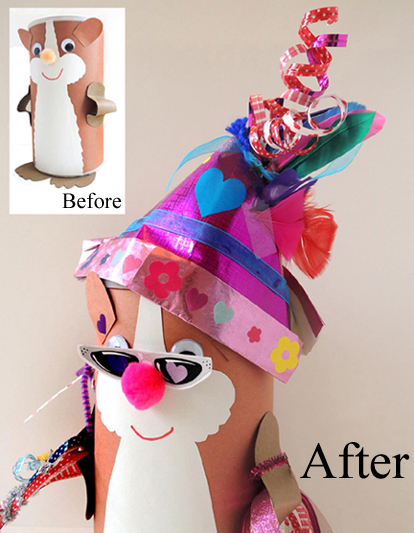
furry and fabulousWhy be a hamster when you can be…a GLAMster! With the proper hat, accessories, and a stunning pair of sunglasses, become a hamster who is sure to get noticed.

We read Glamsters, written by Elizabeth Cody Kimmel and illustrated by Jackie Urbanovic (Disney-Hyperion, 2008). It’s the big annual sale at Hamster World, and Harriet the hamster is worried that she and her sister Patricia won’t get noticed. When Harriet spots a magazine article about “glamsters” lining the bottom of her cage, she thinks she’s found the solution. She transforms herself with “high gloss-and-glo fur volumizer,” a new hat, and funky whisker extensions. Yes, Harriet’s feeling pretty glamorous until Patricia wakes up from a nap, sees Harriet, and screams. Definitely NOT the reaction Harriet was expecting. Patricia helps Harriet get back to normal and, best of all, the two hamsters get noticed by a lovely new owner. Just by being themselves.

You’ll need:

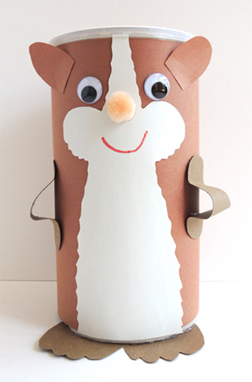
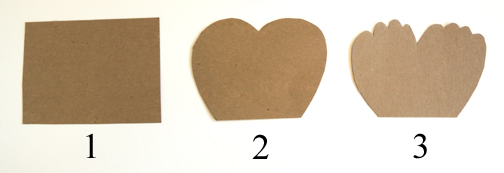
hamsterWe’ll begin with the hamster. Wrap the outside of a large oatmeal container with brown construction paper. Cut the feet from a square of tagboard (or brown poster board). I cut little toes as well.

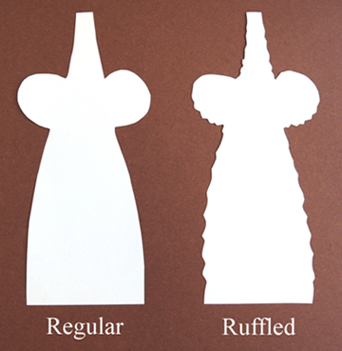
hamster feetHot glue the feet to the bottom of the oatmeal container. Next, cut the hamster’s bib from the template (the bib is the white “fur” that forms the hamster’s tummy, cheeks, and forehead). You can leave the sides of the bib just as they are in the template, or you can use scissors to cut ruffles in the sides to resemble fur.

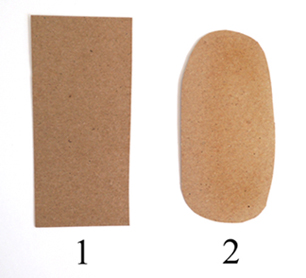
hamster bib rufflesHot glue (or tape) the bib to the front of the oatmeal container. Arms are next! The arms are  2 tagboard rectangles that are rounded at each end.

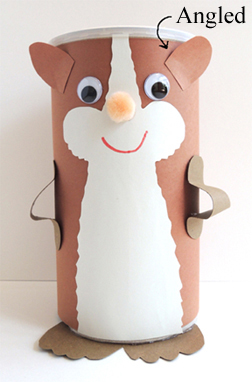
hamster armsAttach the arms to the body with hot glue (or tape). Hot glue on a pom-pom nose and a pair of wiggle eyes. Use markers to add a smile. Finally, use brown construction paper to make a pair of ears, and then hot glue (or tape) them on. You’ll notice that the ears are attached on the front of the container, above the eyes, and at a slight angle. This is so the hamster’s ears won’t interfere with the hat.

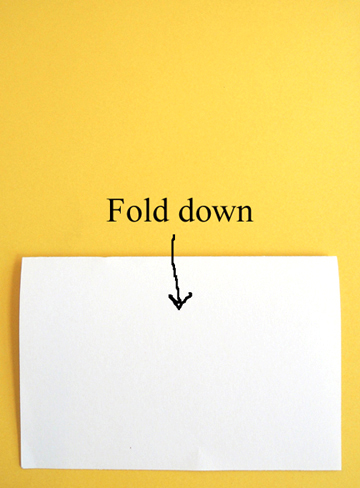
angled ear Your hamster is finished, now for some glamorous accessories! For the hat, I prepped a bunch of simple white origami hats. Start with a 9″ x 12″ sheet of construction paper:

hat step 1

Fold the paper in half downwards

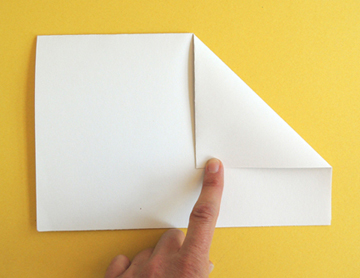
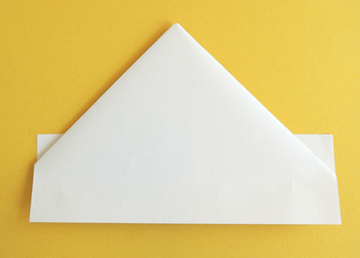
hat step 2Now fold the upper right-hand corner towards the middle of the paper like so:

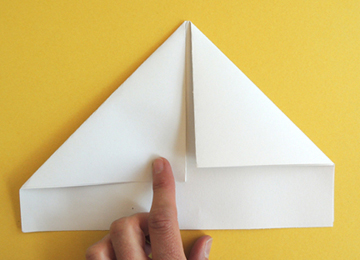
hat step 3Then repeat with the upper left-hand corner.

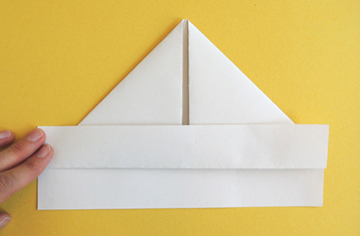
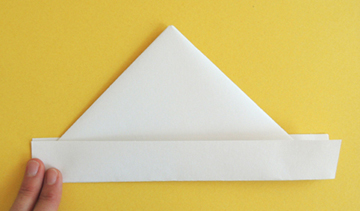
hat step 4Fold one side of the bottom up

hat step 5Then flip the hat over…

hat step 6And fold the remaining side up at the bottom.

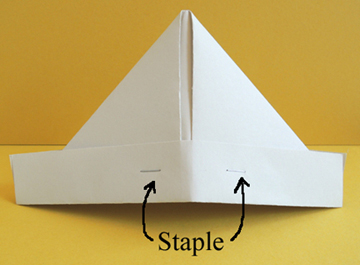
hat step 7Flip the hat back over, open it at the bottom, and secure it with 2 staples.

hat step 8The hat is ready, let the hamster makeover commence! I offered patterned paper, embossed foil paper, sparkle stems, craft-ties, heart stickers, small feathers, and dot stickers, as well as the Bling Bin. I also tested some glitter tape out on this project. I was dubious about its claim to not shed glitter, but it actually wasn’t too bad (see my issue with glitter in the FAQs).

Kids make hats, necklaces, belts, purses, ties, briefcases, etc. The final touch, however, was a pair of sunglasses. Color and cut a pair from the template, and perch them on your hamster’s pom-pom nose. Perfect dahling.

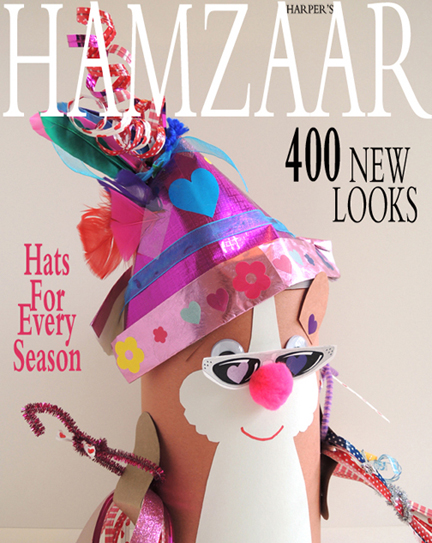
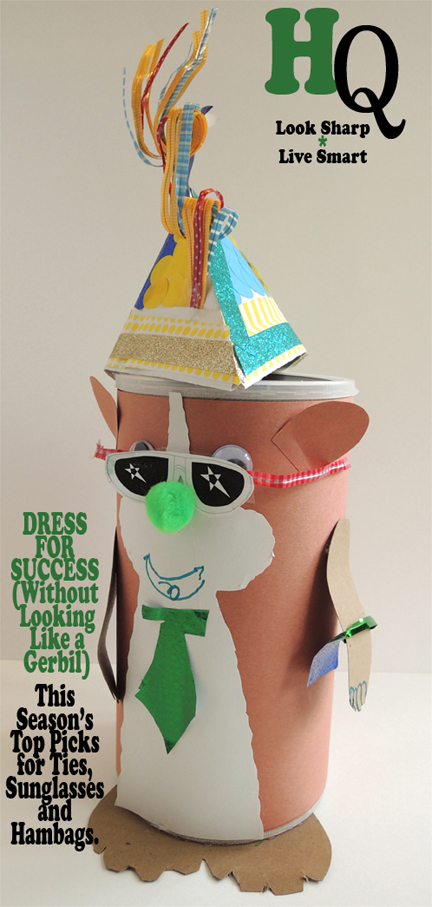
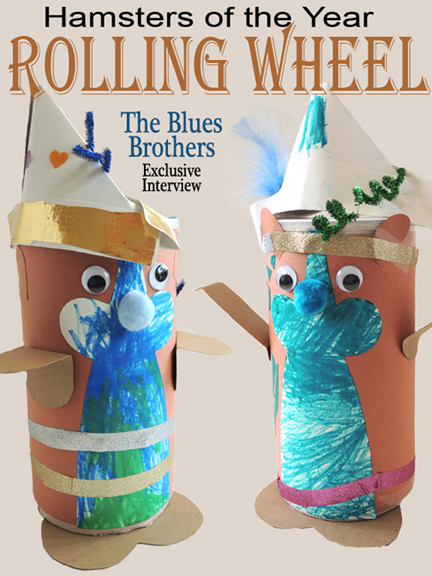
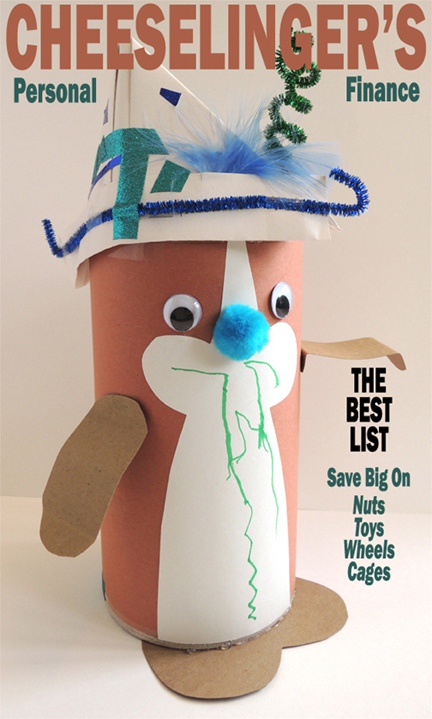
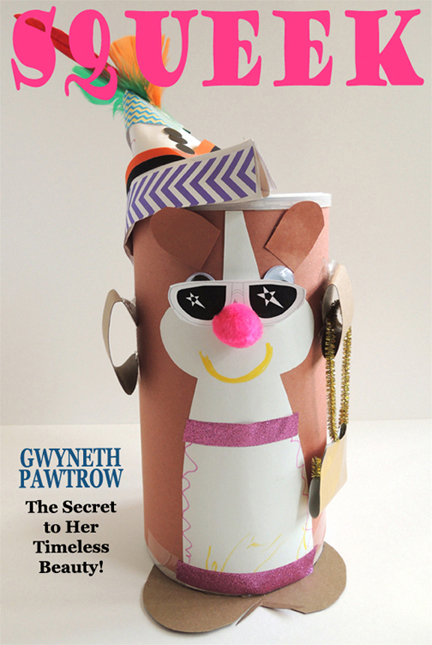
As you can imagine, we had some super glamorous hamsters at story time. I captured a few quick poses in my photo studio, and Katie whipped up some exclusive magazine covers…

Harper's HamzaarHAMQRolling WheelGood HamsterkeepingCheeselingersSqueek


Shadow Play

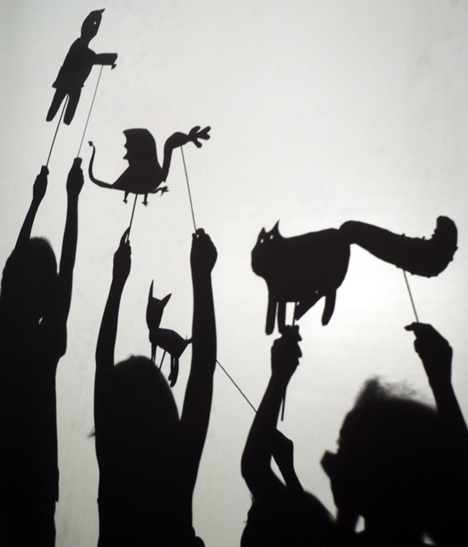
shadow playWe made these fantastic shadow puppets as part of To Be Continued, our chapter book story time for kids ages 6-8. We had just finished reading The Books of Elsewhere: The Shadows by Jacqueline West (Dial, 2010).

Olive Dunwoody and her parents have just moved into an old house. And the house doesn’t like it. The house’s previous owner, Mrs. McMartin, was involved in witchcraft, and not very nice witchcraft at that. The house wants Mrs. McMartin, and the rest of her dark family, back. Olive soon discovers that she can enter the house’s enchanted paintings. She also discovers a trio of talking cats (who totally rock), a be-spelled boy named Morton, and the nefarious plans of Aldous McMartin, the evil patriarch of the ancient McMartin family. Can Olive and her friends fight off the shadows? This book is spooky, exciting, funny, and kept the kids in the group on the edges of their seats (or pillows, rather).

You’ll need:

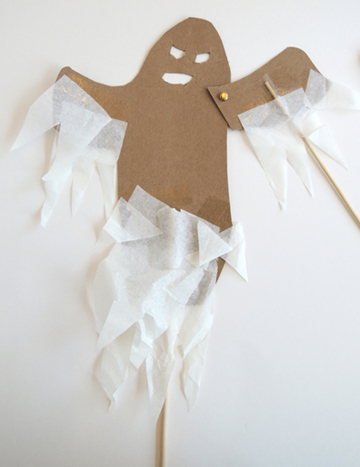
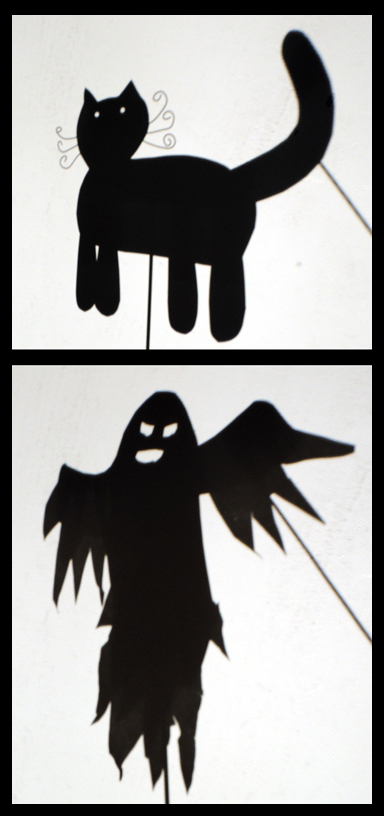
I made two example puppets – a cat (because the cats are such fantastic characters in the book), and a ghost. But the kids could make anything they wanted. We had cats, ghosts, dragons, zombies, and some sort of monster with a detachable brain. Oh yeah.

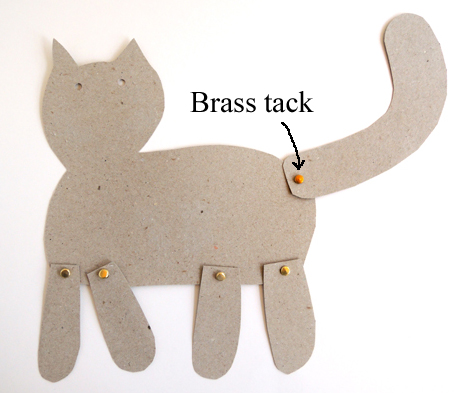
The kids started by using markers to sketch their puppets on a sheet of tagboard. They cut the entire figure out first, and then made specific cuts on the portions they wanted to manipulate later (such as cutting the tail off and reattaching it with a brass fastener).

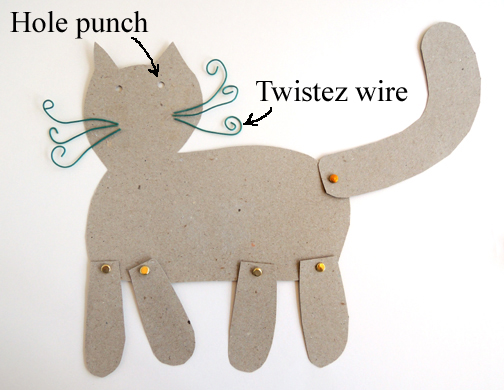
cat with brass tacksWe used the hole punch to make eyes (you can use scissors to cut eyes and mouth holes too). I had some tissue paper, twisteez wire, pipe cleaners, and cellophane handy to add some texture to the shadows as well.

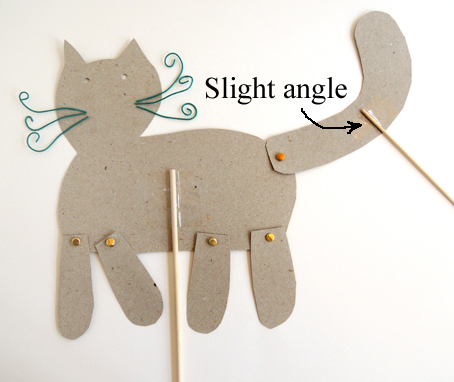
cat with whiskersWhen it came time to put the sticks on the puppets, we used a wooden dowel as the central stick and a lighter bamboo skewer for the moveable part. We attached the sticks with tape.

One hint about the stick placement. It’s best to attach the stick that manipulates a part of the puppet (like an arm or tail) at a slight angle. This will give it a better range of motion.

cat with sticksHere’s my ghost puppet. I made one arm moveable, cut out the eyes and the mouth with scissors, and added tissue paper drapery.

ghost puppetFor the grand show, I lowered all the shades, turned off the lights, and fired up the overhead projector (you can read more about the joys of overhead projectors here). I pointed the projector at wall and…magic!

finished puppetsNeedless to say, we had a total blast playing with our shadow puppets. The program ran for less than an hour, but it would have been interesting to keep it going for a few more – experimenting with different types of puppets, textures, and launching into spontaneous narratives. There are some interesting multicultural angles to shadow puppetry as well. Hmmm…maybe a more extensive weekend workshop is in order?
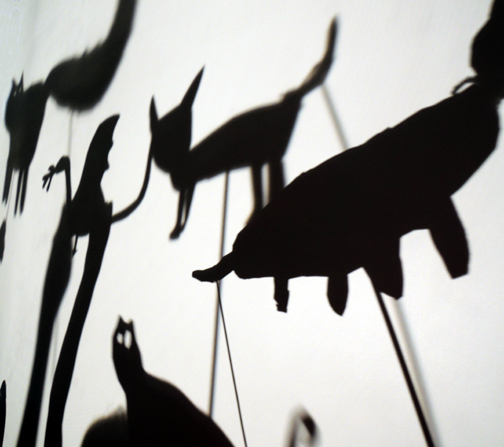
more shadows

Wish Fish

wish fishA goldfish is a lovely pet…unless, of course, you had your heart set on a pony. But what if the fish could talk and grant you a wish?

We read The Birthday Fish by Dan Yaccarino (Henry Holt and Co., 2005). More than anything else, Cynthia wants a pony for her birthday. Every year, she wishes for a birthday pony, and every year, she gets something else. This year, as Cynthia blows out her candles she wishes for a pony called Marigold. She gets a goldfish. Upset, Cynthia is about to pour the fish down the drain when it speaks! The birthday fish will grant her wish, but first she must take it to the lake and set it free. So Cynthia loads the fishbowl in her toy stroller and departs for the lake. During the journey, they meet and overcome many obstacles (bumpy roads, hungry cats, hot sun, etc.). At last, they arrive at the lake and…Cynthia decides she’d rather keep her new friend. She names him Marigold.

You’ll need:

  • 2 large clear plastic plates (mine were 10″ in diameter)
  • 1 small tissue box
  • A couple cups of uncooked rice (or aquarium gravel)
  • fish and castle template printed on a piece of 8.5″ x 11″ white card stock
  • 2 small paperclips (mine were 1.25″)
  • 1 large paperclip (mine was 2″)
  • Green construction paper
  • Fish decorating supplies (I used orange & yellow construction paper, cello sheets, crepe paper streamers, embossed foil paper, and patterned paper
  • A 5″ piece of clear clear elastic beading cord
  • Scissors, tape, glue stick and stapler for construction
  • Markers for decorating

We’ll begin with your fabulous fishbowl! Place 2 clear plastic plates rim-to-rim like this:

rim to rim plates Then tape the lower half of the plates together. Don’t tape the entire thing because you still need to put things inside your fishbowl!

taped-plates-3Now for the base. Cut a small tissue box in half. Recycle the bottom half. You now have a 2.5″ base with an opening at the top.

tissue box cut downIf there is any plastic around the opening of the tissue box, remove it. Then, on both sides of the box, cut from the opening to the edge of the box. Then cut diagonally downward into the sides of the box. This leaves your base looking like this:

cut baseDrop your fishbowl into the base. You might have to do a little cutting and adjusting to get the fishbowl to sit upright snugly. Secure the fishbowl to the base with tape. Pour some uncooked rice in the opening at the top of the plates. This is the “sand” for your fishbowl.

rice in baseNow for some fish-friendly decor! Both the castle and the aquatic plant are anchored in the rice by paper clip “stakes.” We’ll start with the castle. Color and cut the castle from the template. Make sure you keep it in once piece (later, you’ll fold it so it can be viewed from both sides of the fishbowl).

Flip the castle over and tape two small paperclips to one side. You’ll notice that I taped just the very tops of the paperclips to the castle. This is so there would be plenty of paperclip  to stick into the rice. Fold the castle in half and tape it closed.

castle tapedTo make the aquatic plant, cut 3 curvy plant pieces out of green construction paper. Make sure they don’t exceed 6″ in height (otherwise, they start to tip over in the fishbowl). Staple the 3 pieces together, then tape a large paperclip to the bottom.

stapled and taped plantOpen the top of your fishbowl and gently push the castle and aquatic plant paperclip stakes into the rice. I recommend placing the castle all the way to the right, and the plant all the way to the left to make room in the middle for your dangling fish.

And now…the fish! Cut and color the fish from the template. Like the castle, the fish is double-sided. So leave it all in one piece.

Flip the fish over to the blank side and decorate. I offered construction paper, cello squares, crepe paper streamers, embossed foil paper, and patterned paper in hues of orange and yellow. When you’re done decorating, tape a piece of elastic beading cord to one side of the fish:

fish with taped cordThen fold your fish over and tape it closed (to make my fish plump, I taped it shut using tape loops). Next, dangle your fish in the fishbowl, adjust for height, and tape the free end of the cord to the outside of the bowl. Tape the top half of the fishbowl closed. Done!

wish fishIf you have a little extra time, I suggest playing “Pin the Tail on the Goldfish” before taping your fishbowls completely closed. I whipped up a simple game poster and made some construction paper fish tails. A white bandana served as our blindfold (and kids who didn’t like things over their eyes had the option of simply closing their eyes).

pin the tail on the fishThe prize for playing – regardless of where the tail was pinned – was a lovely little sea shell for your fishbowl. The shells were dropped in and THEN we taped the fishbowls securely closed. There was some spilled rice, but a quick vacuuming took care of that.

Still hankering for a pony? Perhaps you should check out this post.