 In the world of crafting, just about anything can be adjusted, changed, or redone according to your budget, staffing, and audience. In fact, adaptation is one of the things I love about developing craft projects for kids. Today, I’m going to show you how I took a simple project and made it even simpler and less expensive for a large-scale event. I’ll throw in a couple hints about running large-scale event tables to boot.
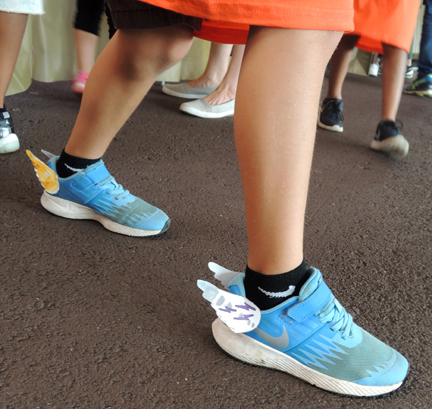
Our event table had a Lightning Thief theme. So for our project, we went with these winged sneakers made out of stiffened felt, glitter glue, glue dots, and paperclips (you’ll find the original instructions here):
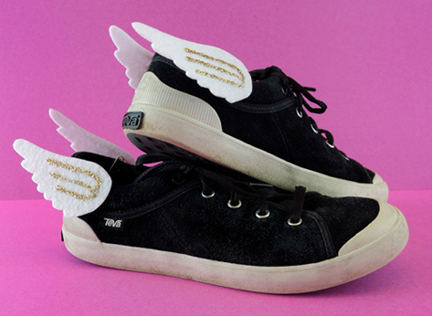 The project was already easy to assemble, but since we needed to produce 200 pairs of wings, the art supplies were a problem. We made 4 cost-saving changes:
- We made the wings out of card stock instead of stiffened felt
- We replaced the glitter glue with metallic markers
- We used tape instead of glue dots
- We scavenged paper clips from various office stashes, rather than buying new ones
Oh, and I adapted the original project template to include more pairs of wings. Instead of 4 pairs of wings per sheet, there are 6 (the adjusted template is here). I turned a couple copy paper box lids into trays housing small, medium, and large wings.
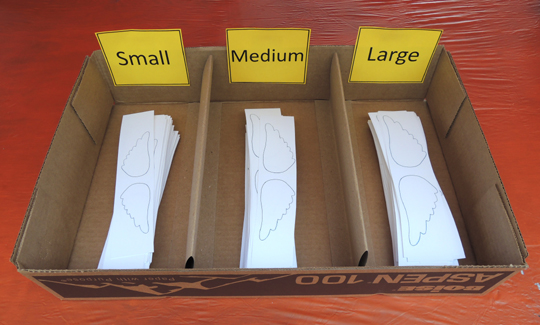 Notice how we just did a rough cut of the wings (meaning we left each pair on a single strip of paper instead of cutting them out individually)? This is event pointer #1: Prep Up to a Point. Rather than cutting out 200 pairs of wings before the event, we let 200 event participants cut the wings themselves. This definitely saved us prep time, and spared us some wicked hand cramps. Another event pointer? Present the Project.
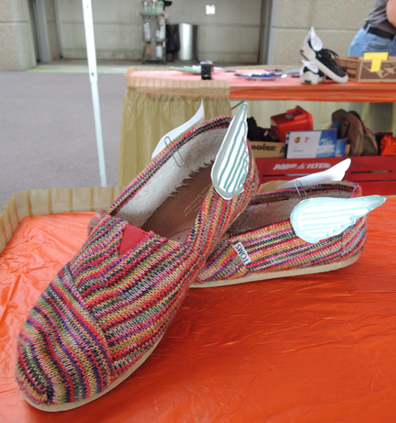 Always have an example of the finished project on the table, so matter how simple it is. That way, you can show kids (and their grown-ups) exactly what they’re aiming to create. If you’re lucky, they’ll be able to get started the project just by looking at the finished version (which will also save you having to explain it 200 times). Next event pointer: Set Up a Self-Cleaning Table.
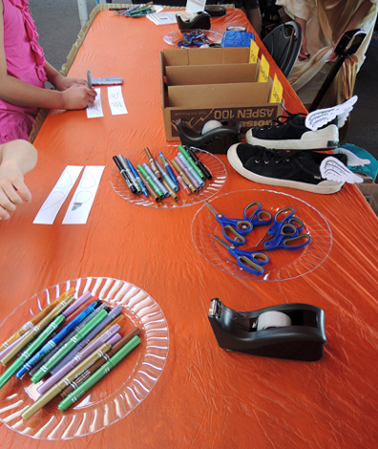 Event tables get crowded quickly, and supplies fly everywhere. However, I find that when supplies are on paper or plastic plates, the plates actually encourage people to return the supplies to their proper places. I don’t know what is it – the plates are wide and flat? They’re super obvious? Impossible to toss something at and miss? Whatever the reason, with plates I spend 75% less time cleaning up the table. And that’s huge when you’re staffing a table for 4 or 5 hours. Pointer #4: Table Skirts are a Good Thing.
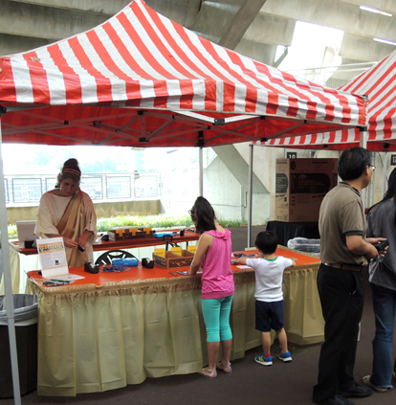 Table skirts are an inexpensive way to make your event table look more finished. They also hide all the unattractive supply boxes you need to stash under your table, as well as your purse or backpack. OK. My final event pointer. Costumes are Awesome.
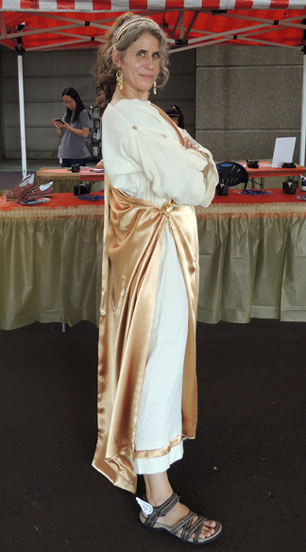
You want your table to get attention and a fair amount of traffic, right? Well, there’s no better way to get it – and show your team spirit – then wearing a costume. The above outfit is recycled from an event I did in 2011. Katie’s costume was borrowed from the Lewis Center for the Arts’ costume shop. But we totally could have rigged something up with sheets too.
Your costumes don’t have to be fancy – even a color-coordinated t-shirt will do. But I will say the more you dress up, the bigger an audience you draw (as well as event photographers! We’ve definitely ended up in local papers, blogs, and Facebook because of our costumes).
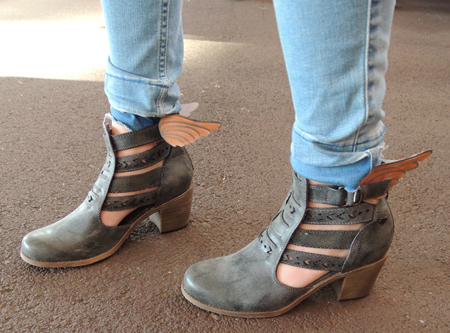
How did our adapted project go over? Really well! Check out these truly amazing shoes…
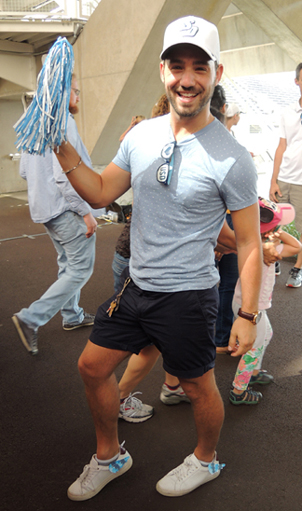
Adults were encouraged to make wings too! I absolutely LOVE this guy. Even if was rooting for USD at a Princeton Tigers football game.
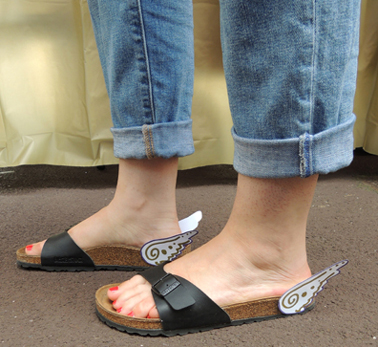
 And speaking of adaptation, people made a couple project adjustments of their own at the event! A lack of straps on the backs of one’s sandals? Quickly remedied with tape:
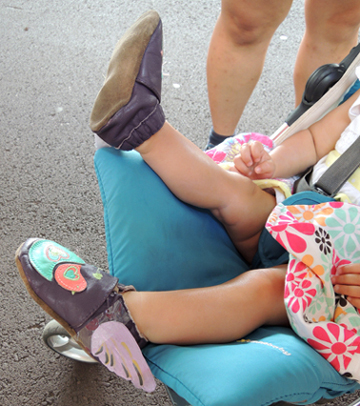
 Not into the paper clip part of the project? Tape, once again to the rescue:
 Some skipped the shoe part and simply taped the wings to the backs of their shirts!
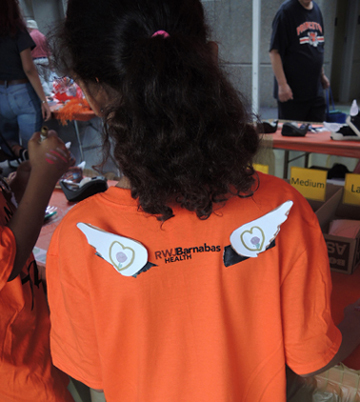 Do you see how the wings are attached to the back of the shirt with black masking tape? That’s another project modification we came up with. Kids without socks (or kids who might be bothered by the paper clips rubbing their feet) were offered masking tape to cover the section of paperclip inside their shoes. It worked great, and it gave the wings a little extra reinforcement too.
Thus, to summarize my 5 event pointers:
- Prep Up to a Point
- Present the Project
- Set Up a Self-Cleaning Table
- Table Skirts are a Good Thing
- Costumes are Awesome
And just in case you missed them in the slideshow, here’s someone who TOTALLY rocked the project. The colors! The matching lines! The placement of the wings! Perfection.
 Looking for other event table projects that have worked for us? Check out these pom-pom cannons, Cheshire Cat grins, magic quill pens, and Digitopolis’ number mines. You’ll also find more ideas on our Simple Projects Pinterest board.
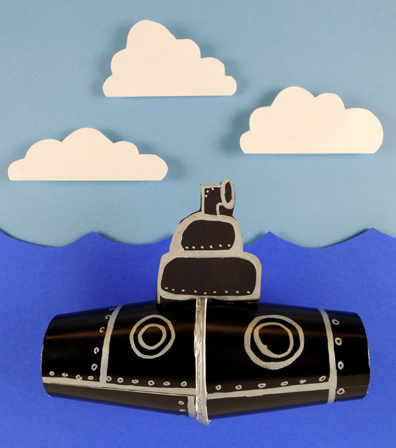
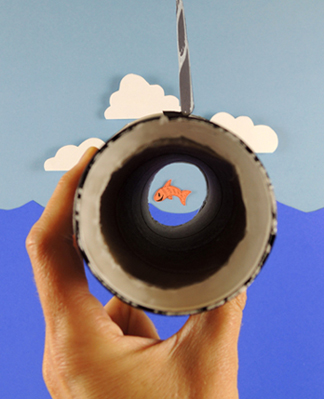 We recommend Rub-a-Dub Sub, written by Linda Ashman, and illustrated by Jeff Mack (Harcourt, 2003). Zooming around in an orange submarine, a little boy encounters numerous ocean creatures – a seal, a manta ray, a horseshoe crab, and an eel to name a few! But an encounter with an enormous shark forces him to quickly retrace his steps to the surface, where he finds himself safe and sound – in his very own bathtub.
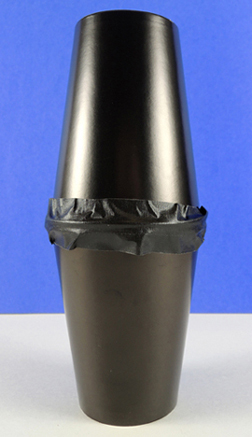
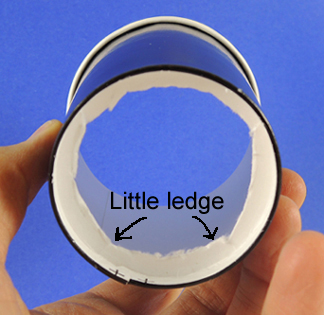 Next, turn the cups end-to-end and connect them together with hot glue. If you can’t do hot glue, simply connect the cups with tape. We used black masking tape for the photo below, but regular tape works just as well.
 For the paper towel tube version of the project, cut the holes in the bottoms of the cups. Then place a piece of paper towel tube inside the bottom cup (our tube piece was 6.75″ long but you might have to adjust yours a little). Place the second cup over top of the first…
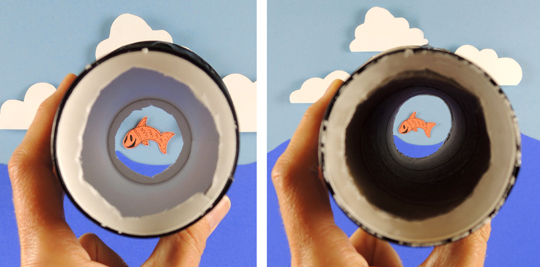
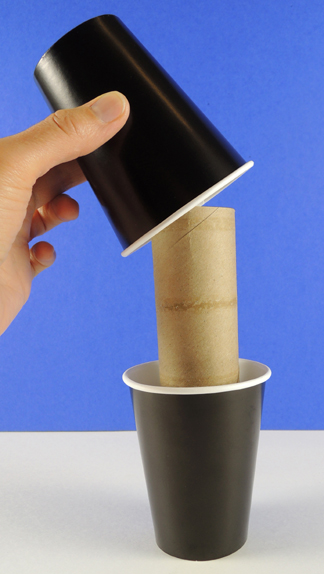 Then hot glue (or tape) the two cups together. So…is the extra effort for the paper towel version worth it? You decide! Here’s a side-by-side comparison of the 2 projects. One could argue that the paper towel tube version looks more like a spyglass, but the cups-only version is cute too.
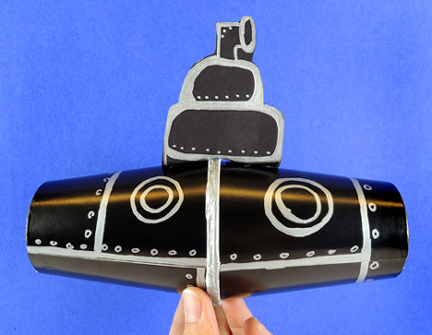
 Next, cut a periscope shape out of construction paper, tab the bottom, and attach the periscope to the top of the sub. Finally, use markers to give your sub portholes, plates, rivets, and bolts. Any markers will do, but we really liked how silver metallic marker looked on the black paper cups.
 Miss Marissa designed this awesome project, and she made a fantastic I-Spy game to go with it! To play, print up the characters in this template (click
 Just posted! A webcast with author Kevin Sands, author of the Blackthorn Key Adventures, a series that begins with The Blackthorn Key and follows with its sequel, Mark of the Plague. The third book, The Assassin’s Curse, was released this month.