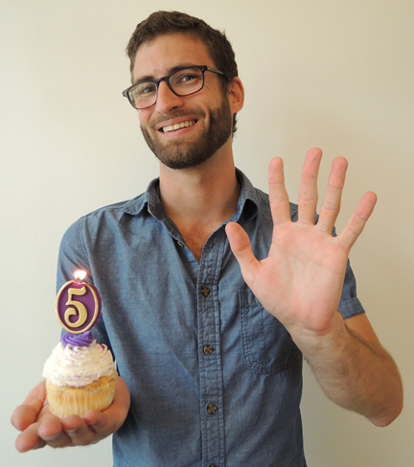
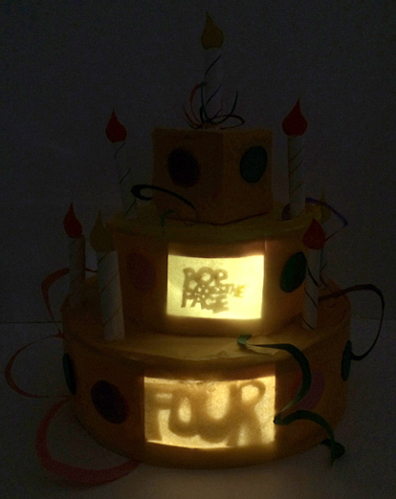
 It’s August! It’s Pop‘s fifth birthday! That’s right…5 years and 422 posts strong we be. Five years is also how long Ian has worked at our library, but ladies and gentleman, it is a bittersweet announcement I’m making today.
Ian, our Curatorial Assistant, is moving on.
But being Ian, he is moving along in the most awesome, stylin’ way possible. He completed his library degree at Rutgers AND is a newly minted Fulbright Student (he was also awarded a scholarship to Rare Books school in London this summer!). In short, Ian is shining, and we are so very proud of him.
So today’s post is a retrospective of all the things we convinced this intellectual powerhouse to do for the blog. But if you’re just here to see him smash birthday cupcake in my face, skip to the bottom of the post.
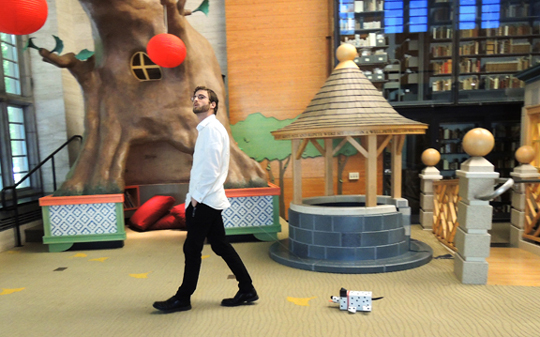 We first met Ian in this 2013 post. Usually, it only takes a couple weeks for me to ask people to start doing ridiculous things for me (like walk box dogs on invisible leashes). Ian made it 4 months. But once the flood gates opened…

Ian tests printable tattoos
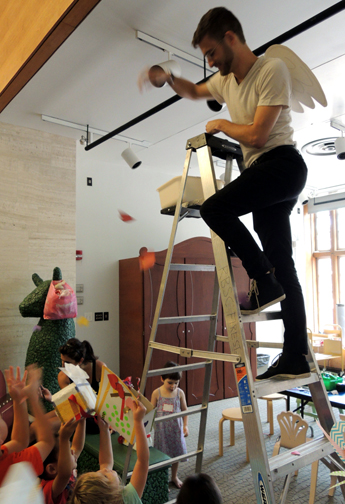 Ian strews hearts
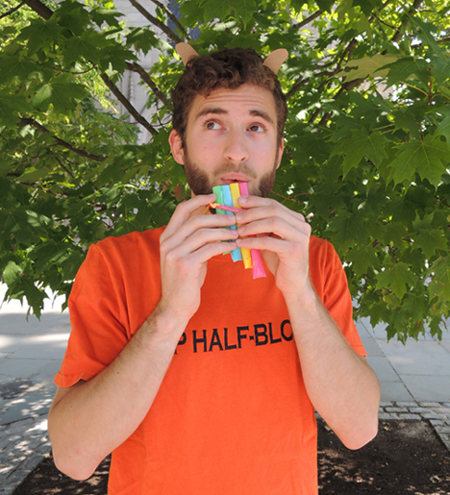 Ian jams on pan pipes
 Ian is photobombed by a penguin
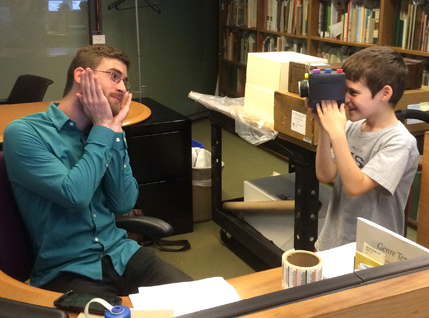 Ian encounters the paparazzi
 Ian taste tests Harry Potter pudding
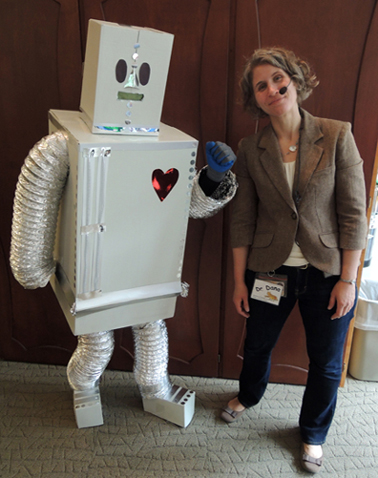 And the grand finale…Ian gets shoved in a robot costume with low visibility and questionable foot gear. For the 5th birthday post/ Ian retrospective, we thought it appropriate to ask him 5 questions:
Where are you off to, Ian?
I’m off to Baku, Azerbaijan. For the other geography nerds out there: Azerbaijan is a small country on the eastern side of the Caucasus between Iran and Russia, and Baku is the country’s bustling capital on the west bank of the Caspian Sea.
Why Azerbaijan?
I chose to pursue my Fulbright in Azerbaijan because I am fascinated by the complexities of the region. Azerbaijan is a land of mixing and clashing cultures, a border land of influences and diversity since antiquity, positioned at a crossroads of migration, colonization, and cultural exchange. I wanted to be in a modern city, but one with an ancient and medieval past. I wanted to be some place less familiar and rewardingly challenging.
What will you miss about our library?
It has been a true privilege and a joy to work with the rare books and other materials here at Cotsen. Every day is filled with new discoveries, new learning, color, art, and mystery. I forget sometimes how lucky I am to get to experience what “old books” can show us and how the chance to do what I do for a living is rare indeed. I’m not sure I’ll ever work in an “office” this fun again. And I will miss my colleagues at Cotsen most of all because one will always miss their friends when they move away.
What was your favorite thing you did for Pop Goes the Page?
Definitely the time I got crammed into a robot costume. Not only did I get to dance the robot dressed as a robot, I was also really happy to be part of a story time activity featuring a really sweet book. The kids liked it too, I got a lot of hugs that day!
Who is cooler, Dr. Dana or Katie?
Dang, honestly I think they’re both nerds! Good thing for them that at the library, nerds are cool!
A birthday is nothing without sugared toppings, so I grabbed a couple cupcakes for Ian’s final blog photo shoot. Except that meant there were extra cupcakes sitting around. To be smashed into my face. Before final consumption.
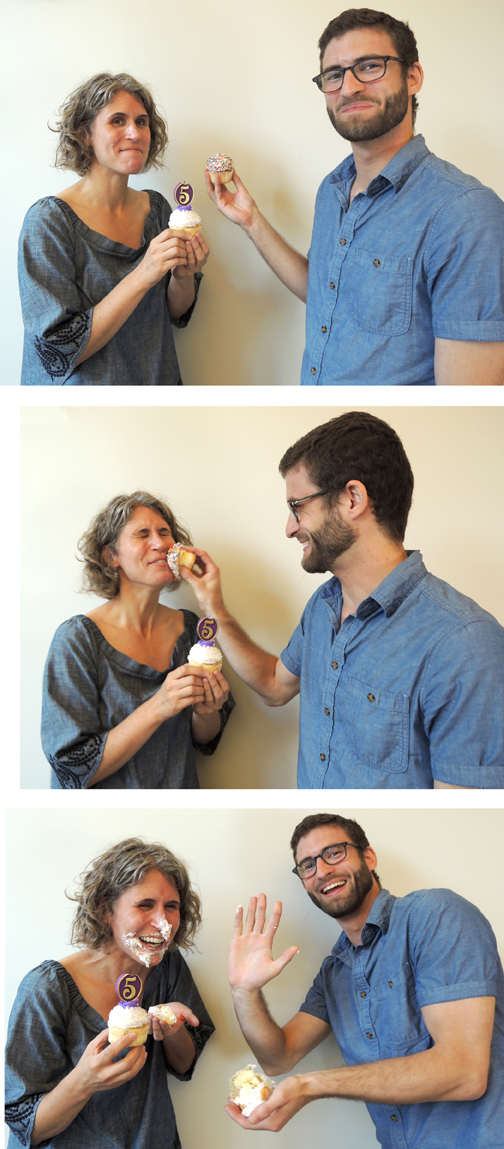
Ian, we are really going to miss you. Best of luck in your world travels, academic pursuits, hopes, and dreams! Waves of love and joy from us, your friends, to you – Ian the Indomitable.
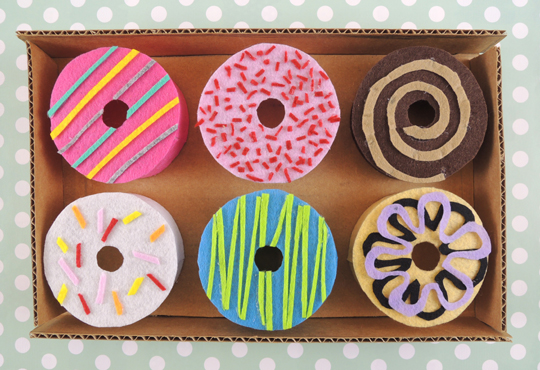
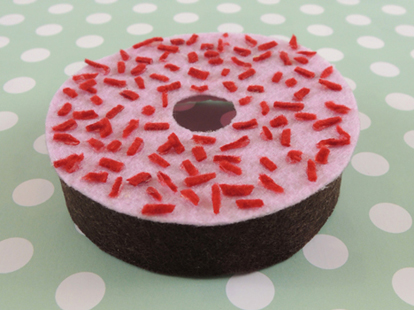
 Wrap the outside of the tape core with felt and secure the felt in place with hot glue. The top of the donut is a circle of
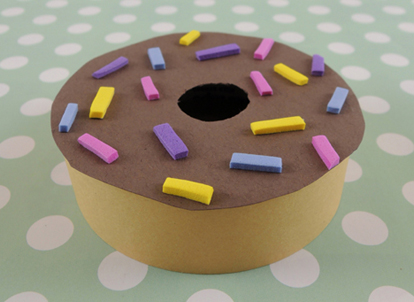
  If felt isn’t your thing, construction paper works for this project too – and you can use tape instead of hot glue. Here’s my construction paper donut with
  Marissa crafted a custom cardboard box for her set of donuts and, best of all, made a cardboard panda hand to smack away greedy donut eaters. You can see the whole thing in action on her
  When it comes to crafting, the best way to send that project over the edge of coolness is to LIGHT IT UP! We’ve wired flannel boards with
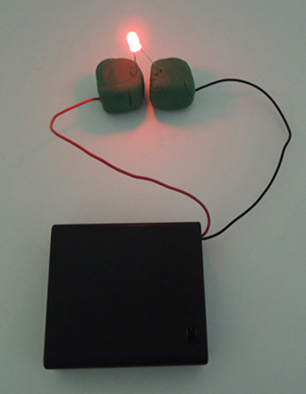
  So when we spotted the Circuit Clay kit by Klutz we were excited. Ideally, the kit allows kids to do all sorts of electrical experimenting, with the added bonus of sculpting unique creations. But conductive clay? Would that even work? I must admit, we were a wee bit skeptical.
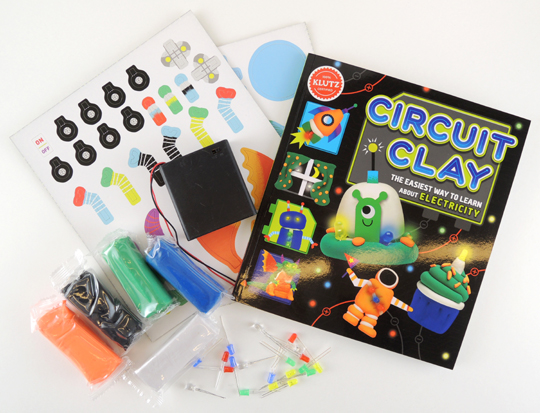 The Klutz kit retails for around $22 (ages 8 & up). It contains a 52-page instruction booklet, 4 packs of color conductive clay, 1 pack of white insulating clay, 20 color LEDs, a battery pack (4 AA batteries required), and 52 paper embellishments for your projects. Katie put the kit through its paces. Take it away Katie!
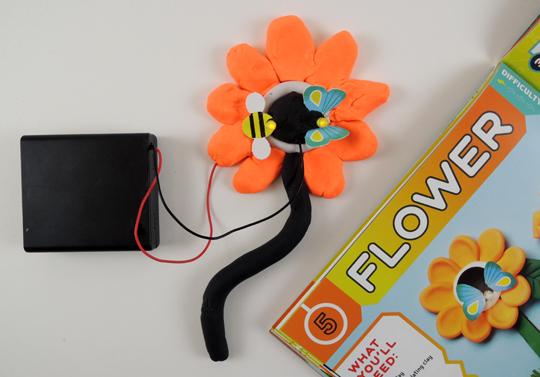
 Feeling certain in my understanding of basic circuits, I moved ahead in the instruction book and created a Princeton University-inspired orange and black flower, complete with a little glowing bee and butterfly from the kit’s paper add-ons.
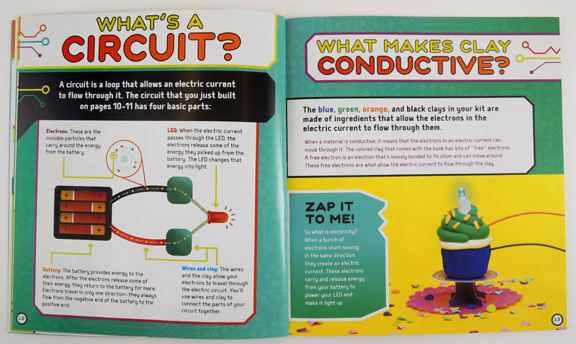
 A note about the instruction book: it is an exceptionally well written and illustrated manual that provides easy to understand lessons for kids about electricity. Kudos to Klutz for using every inch of the book with colorful images and educational descriptions.
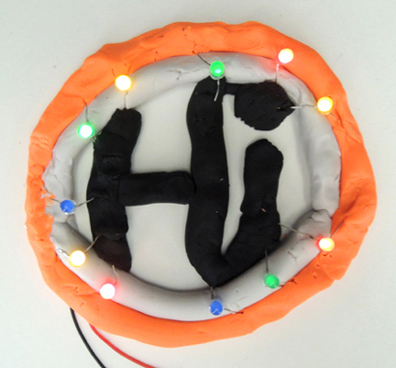
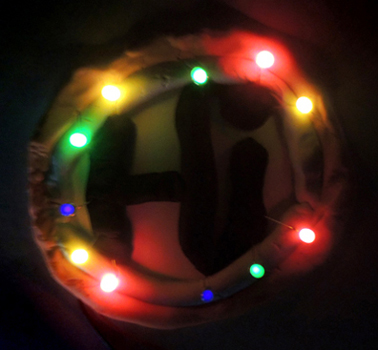
 Riding a wave of confidence, I decided to crank it to 11 and make my own design with as many lights as possible. As I was forming the letters to say “Hi” and the circle around it, I had to remember to maintain the circuit between the conductive clay and the insulting clay. I will admit this was a little challenging, and I *may* have broken several bulbs putting it together. But eventually it worked! Here’s a photo of it in full darkness. Notice that the blue bulbs are much dimmer?
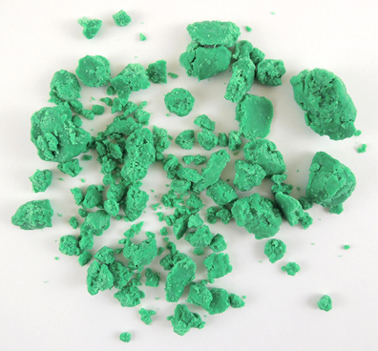
 Now for the bad news. I found the clay was quick to crumble and shred, even fresh out of the package. It was sometimes tough to keep the LED bulb’s long wire legs fully inserted into the designs, and it was frustrating at times to figure out how to set up the different circuits. Finally, the book says to “keep your clay in a resealable plastic bag or container so it won’t dry out.” I did seal it in a Ziploc bag, but a couple weeks later, the clay was dry, flaky, and nearly impossible to manipulate.
 The Klutz Circuit Clay is definitely a clever way to teach kids about electricity without them accidentally getting hurt or shocking themselves. It’s an activity children with patience and strong reading skills can do on their own, but younger kids will definitely need assistance. The suggested age range may be a little low (ages 8 & up), but I’m not sure if kids older than 10 would find this experiment worth their time and attention.