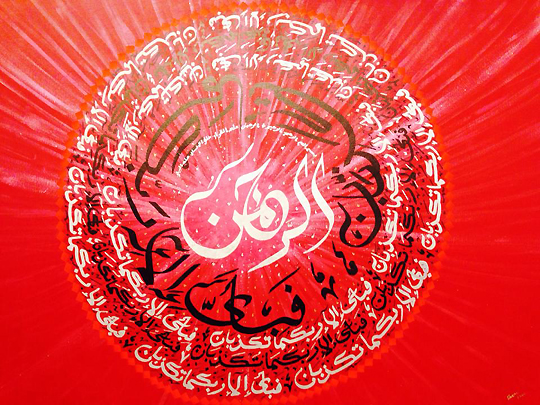
 This year, I invited Arabic calligrapher Faraz Khan to Cotsen Critix, our literary group for kids ages 9-12. Faraz is an immensely talented artist, with a mission to bring the beauty of the illustrated word to all. His hands-on workshop introduced the kids to the basics of Arabic calligraphy, provided a little bit of history, and finished with the creation of unique pieces for the group (including each child’s name!). The Cotsen Critix were completely entranced by this unique literary art form. Faraz also lectures to adults – you can see images from a recent workshop at the University of Oklahoma on his blog.
Please tell us a little about yourself!
I am a local resident artist and a teacher at the Arts Council of Princeton, New Jersey. I also work as an environmental specialist trying to protect and preserve wildlife habitats such as freshwater wetlands, streams corridors and riparian zones in the State of New Jersey. I love to hike and learn about the environment and ecosystems.
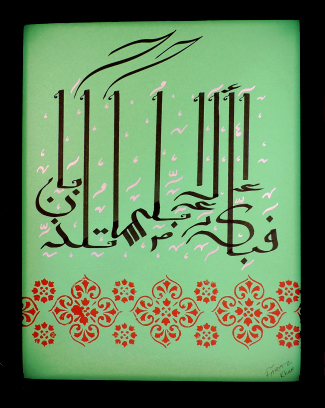 Aside from the environmental field, art is my other passion. I paint and try to create work that is based on abstract design and Arabic calligraphy. I have taught calligraphy seminars at Princeton University and am excited about teaching a full 3 credit Arabic Calligraphy and History summer course at Rutgers University. I also plan to open an art studio in downtown Princeton to share and educate people about discovering different fields of Islamic art.
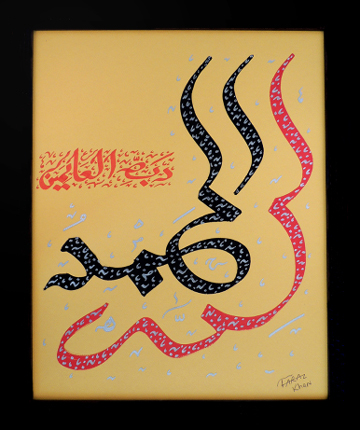 What role does calligraphy play in the Arabic world?
Arabic calligraphy is a very fluid script that catches the viewers’ attention. There is a rich history of calligraphy development and artistic expressions in the Arab and Muslim world. Arabic calligraphy is used as a decoration in communication, sacred Quranic text, architecture, art installations, etc.
When did you first start learning calligraphy, and why did it intrigue you?
It was about five years ago when I wrote a paper for my liberal arts class – “How to Decipher 6 Standard Styles of Arabic Calligraphy.” When I would visit my Muslim friends and family, I would always find these beautiful calligraphy work hung on their walls. I would always ask to understand the meaning, name of calligrapher, style, place of origin. I learned that most people did not know the answers to my questions. Hence, when the chance came to study calligraphy I was really intrigued by the possibility of learning, practicing, and explaining it to others.
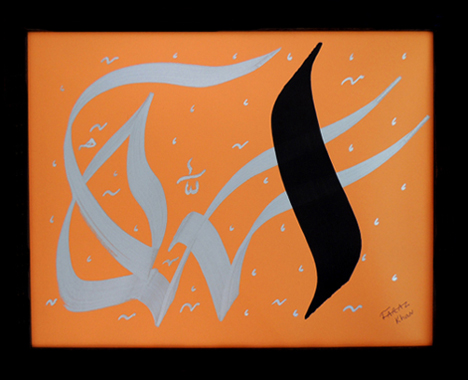 What tools and techniques do you use to create your art?
Traditional calligraphers would use a bamboo stick or reed pen dipped in ink to write calligraphy. Modern artists have taken this art to a whole new level with paint brushes, graffiti markers, flash light with the use of slow shutter speed camera techniques, and many other tools.
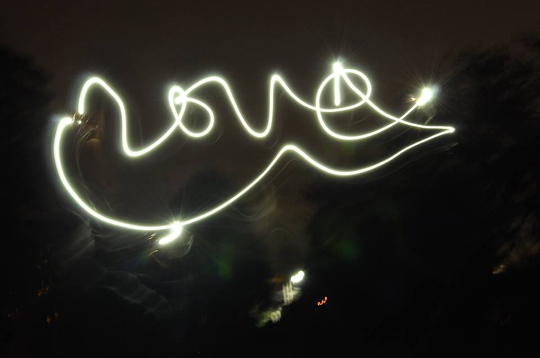 What are the essential things you try to teach children in your calligraphy workshops?
Children are special. They have such amazing pure hearts and I always learn from their simple, fun approach to life. I myself have two amazing boys, Ziyad and Zayn and they are unbelievable amount of joy and happiness.
In my classes, I simply want children to develop a love for learning. Art is about connecting beauty inside our hearts, to the beauty in the world. I would like them to be on a mission to not only decorate their classrooms with beautiful artworks but to further develop beautiful speech, writing, personality to inspire us.
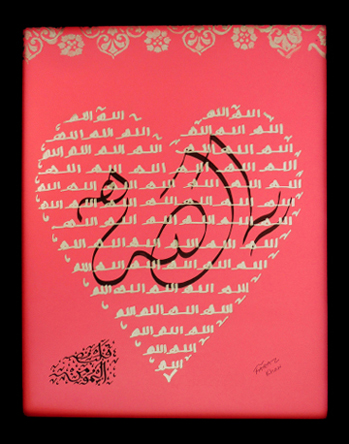 How have children reacted to your workshops and the artwork you were creating?
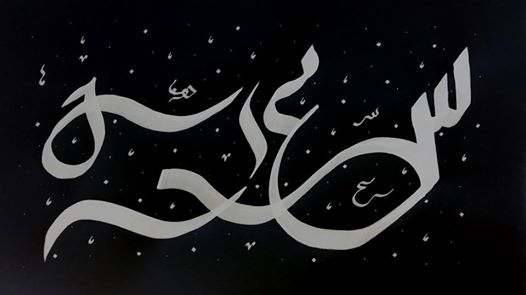
Children are amazing interpreters of art. I would draw the letter or a word in Arabic calligraphy and I can read an instant reaction on their faces. I love how imaginative children can be with Arabic calligraphy. When I do calligraphy some children find birds or ribbons or waves or a musical note in my artwork while I only intended to beautify Arabic calligraphy and not draw anything else.
 Are there other works of art that inspire you?
There are so many wonderful works of Western and Islamic art and it is hard for me to name one or two. However as an American Muslim, Muhamad Zakariya’s Eid Greetings US postal stamp has a special meaning to me. I am so proud to be part of a grassroots effort to create and educate people about Islamic art.
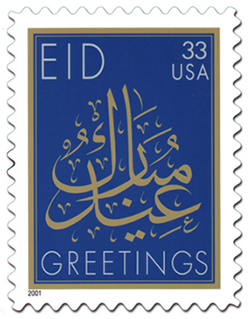
The Eid Stamp by Muhamad Zakariya. United States Postal Service, 2001
Name one thing about the art of calligraphy that surprised you.
Arabic calligraphy is written right to left but I knew that for a long time. However, last year one of my students told me that she was dyslexic and had a tough time reading and writing English until fourth or fifth grade. Once she was introduced to Arabic writing in elementary school, and while her class struggled, she picked up reading and writing Arabic within a week. It was amazing to hear how diversifying our curriculum and methodologies could impact the life of our citizens.
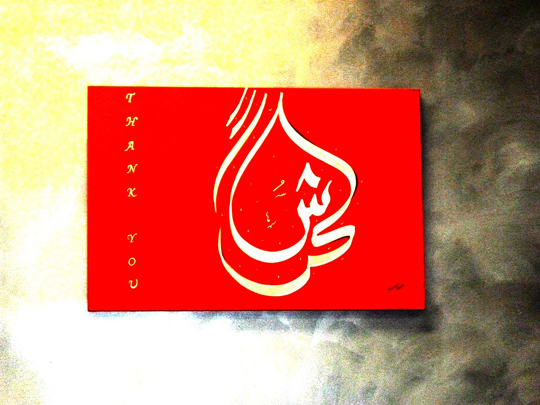
Works of art reproduced with permission of the artist.
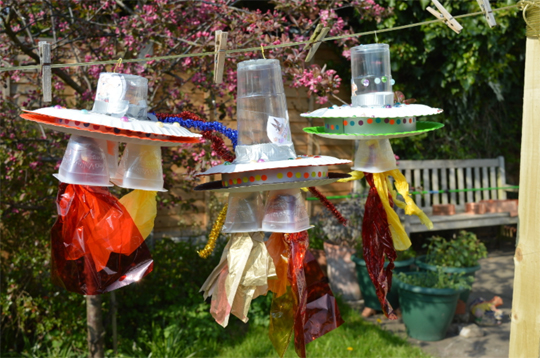 When I started Pop Goes the Page, my goal was to share the programs and projects I do at my library, but I also wanted my readers to be able to replicate the programs and projects themselves. I love the idea that children far beyond the realms of my library are enjoying a story time or two. Today, I’d like to share three Pop-inspired programs from around the globe!
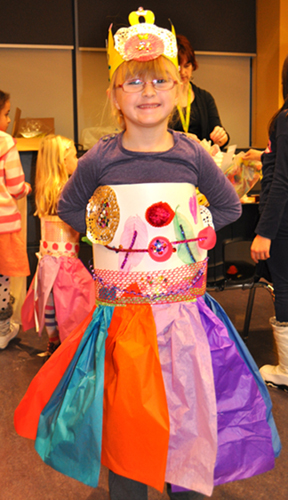
 Next, we’ll zip over to Canada, where Polly Ross adapted our Cinderella Story dress-making program for her library’s little princesses-to-be. On her blog, Story Time and Other Exciting Things, Polly shares what she learned about running the program, and gives some sound practical advice (having done the program myself, her first suggestion still has me chuckling). Here’s a daring dress designer modeling her stupendous creation:
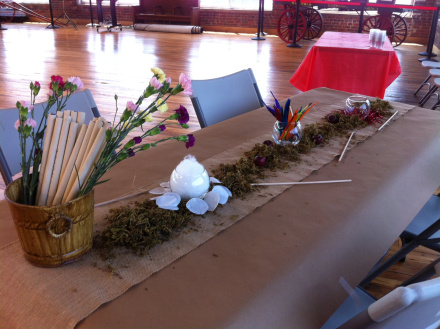
 Finally, we’ll land in North Carolina, where Brytani Fraser used our PVC wands at her library’s Harry Potter birthday celebration. On her blog, The Neighborhood Librarian, she breaks down the entire program, which sounds like it was a total blast. Five activity tables! Movie soundtrack! Spelling challenges for chocolate! Bertie Bott’s Every Flavour Beans! Here’s the wand decorating station – the flowers, the glass bowls, the moss…it’s gorgeous!
 Have you hosted a Pop-inspired program, story time, or given a project a whirl? E-mail me! I would love to see what you’ve done!