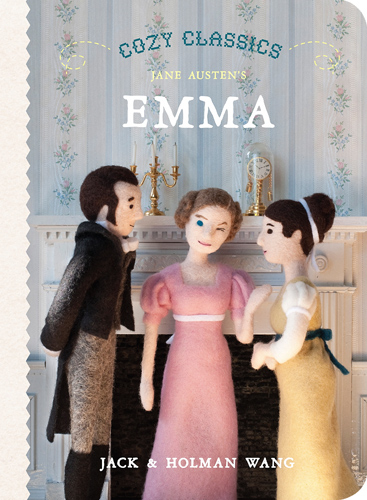
 The first paragraph of Jane Austen’s Emma contains 40 words. Imagine narrowing it down to 12. Not challenging enough? Try narrowing the entire book down to 12 words.
Twin brothers Jack and Holman Wang not only stepped up to this challenge, they also proceeded to condense other classic works such as Pride and Prejudice, Moby Dick, The Adventures of Tom Sawyer, Jane Eyre, Oliver Twist, and War and Peace.
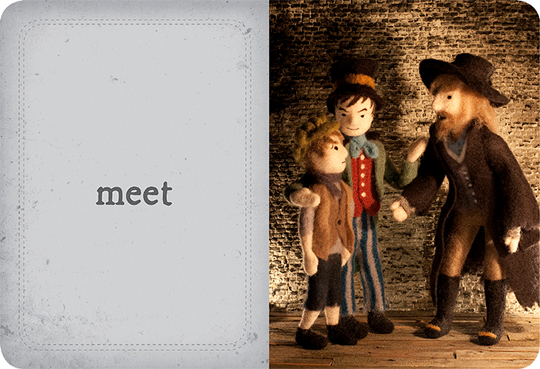
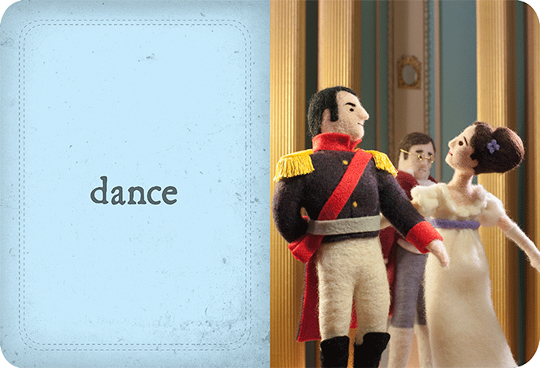
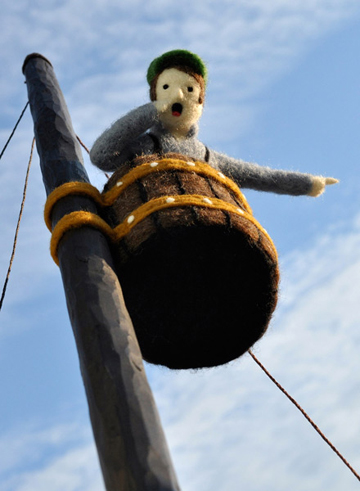
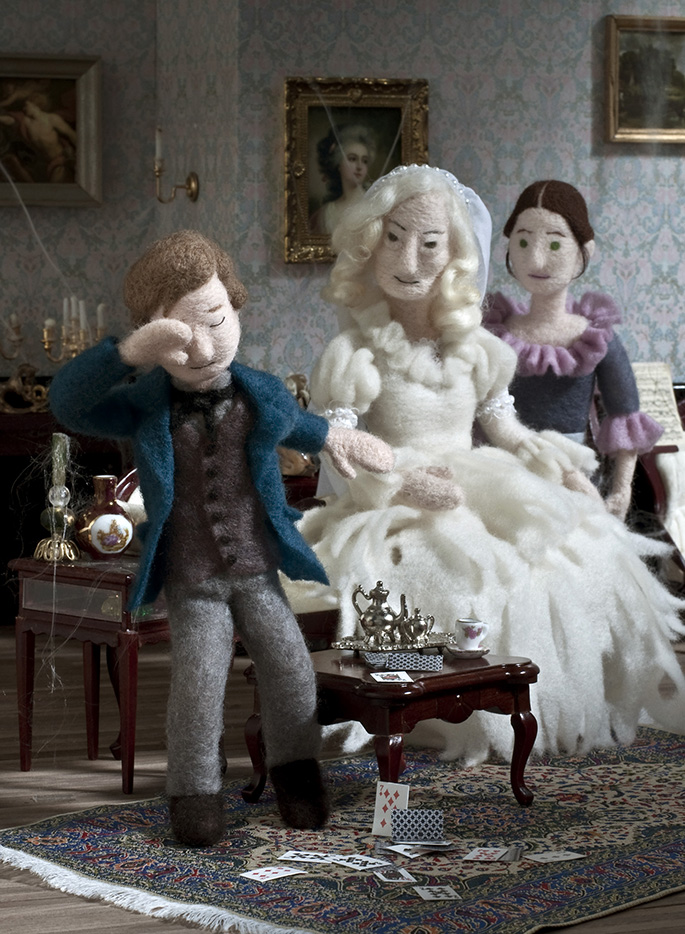
Each 12-word board book is illustrated with truly astounding needle felt models, which are beautifully posed and photographed. The books are enchanting, delightful, and obviously labors of love.
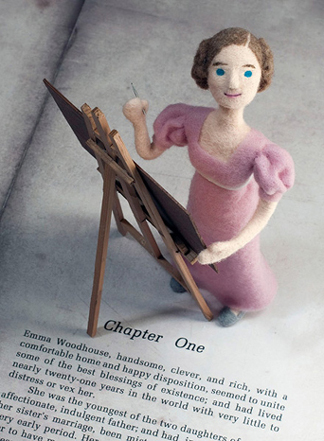 Welcome, dear readers, to Cozy Classics (published by Simply Read Books).
Intended for children age 0+, the books use child-friendly and child-familiar words to introduce works of classic literature. Accompanied by illustrations that reflect the context and mood of the original works, these books are the perfect first step towards the larger realm of literature.
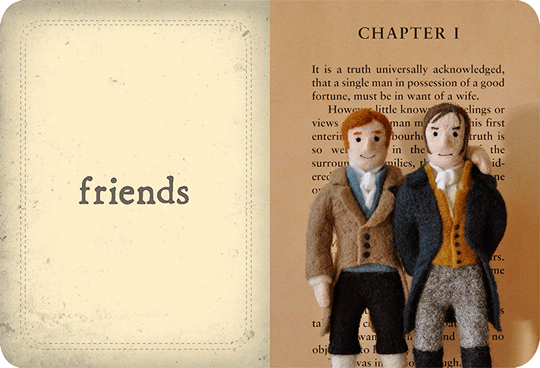 The creators of Cozy Classics are well-matched to their task. Jack has a Master’s in Creative Writing and a Ph.D. in English. Holman, an artist and former middle school teacher, holds a Bachelor’s in education and a Master’s in architectural history. Jack and Holman have D.A.D. degrees, as well (i.e., they’re both fathers)!
How did this collaborative adventure start?
Jack: I was the one who came up with the idea of abridging classics for babies. When I shared the idea, Holman loved it. At the time, we both had a child under two, so board books were definitely on our minds. The only question was how we were going to illustrate our books. We wanted to do something original that would jibe with the classics. Holman’s sister-in-law does some needle felting, and that gave him the idea. So we each contributed something important to the concept, and that’s how Cozy Classics got started.
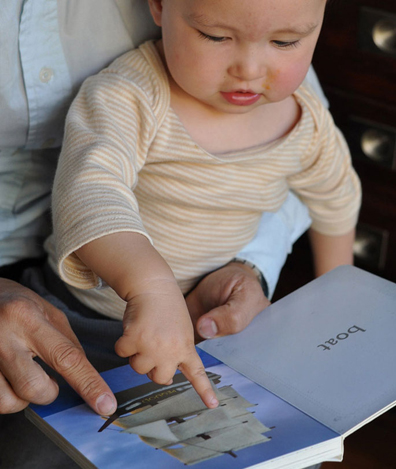 What is needle felting, and where did you learn it?
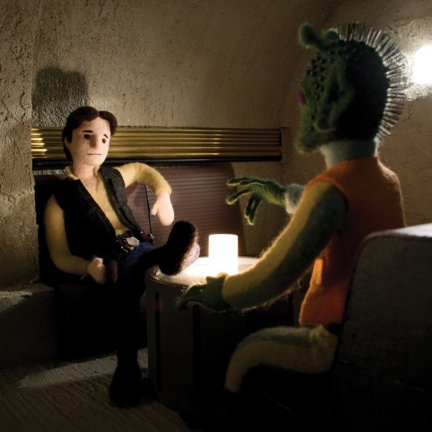
Holman: Needle felting is basically sculpting with wool. You stab loose wool repeatedly with a barbed needle, which entangles the fibres and makes the wool firm enough to hold shape. We taught ourselves how to needle felt for the purpose of these books. My very first figure, Ishmael, wound up in Moby Dick, but our technique has gotten a lot better since. For example, Ishmael didn’t have eyebrows or thumbs. He also had no armature (wire inside), which all our figures now have. This makes posing and re-posing them a lot easier.
How long does it take to craft and photograph a single illustration?
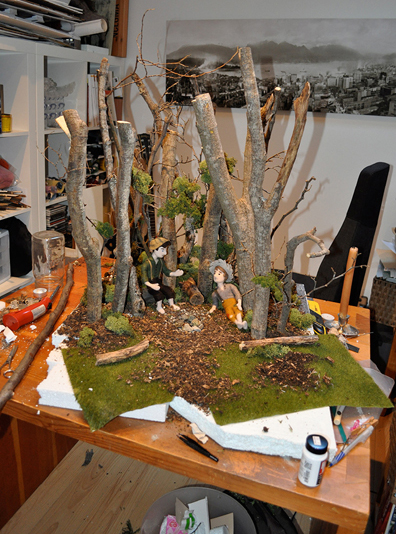
Holman: That’s hard to say. It takes 20-30 hours to complete a single figure. If a scene requires a studio set, it might take anywhere from a few hours to a few days to build. Lighting and photography generally takes three to five hours. If a scene requires an outdoor location shoot, it can again take anywhere from a few hours to a few days, depending on the weather and the travel involved. But the short answer is, a long time!
 What books did you decide to do and why?
Jack: So far, there are nine Cozy Classics: Pride and Prejudice, Moby Dick, War and Peace, Les Misérables, Jane Eyre, Oliver Twist, Emma, Huckleberry Finn, and Tom Sawyer. We have to think practically—it’s harder, for example, to do a book with a lot of characters—and we do think about gender balance, but mostly we just pick books that we care about and that we think other people care about, too.
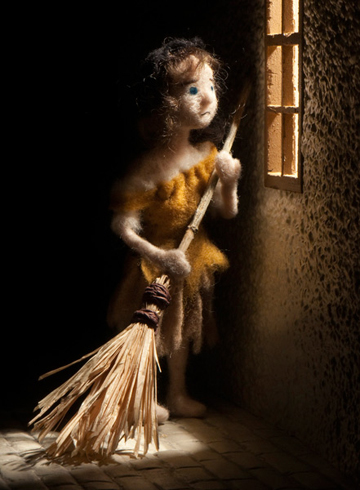 Your Cozy Classics board books consist of 12 words and 12 illustrations. How difficult is it to take a classic book that’s hundreds of pages long and boil it down to 12 simple words?
Jack: It can be challenging, that’s for sure. Some people think it’s just a matter of picking the twelve most memorable scenes, but twelve famous scenes and twelve random words won’t necessarily tell a story. So we start by choosing words that we think will give the best sense of the main storyline. Our motto is “no subplots.” And it’s not just twelve words but, as you say, twelve simple words, which means your dictionary isn’t very big to begin with. Sometimes words repeat from book to book because novels often share crucial elements. We’ve noticed there’s a lot of dancing, running, and helping in novels!
 Which story was the most difficult to adapt?
Jack: Probably Emma. You would think it’d be a tome like Moby Dick or War and Peace, but both those novels have a simple narrative arc when you boil them down. But Emma has subplots that are fairly indispensable to the story.
Some people might be surprised to learn that – at least for your Cozy Classics book series – there are no computer graphics used on the photos. Tell us a little bit about the perils of setting up the perfect shot.
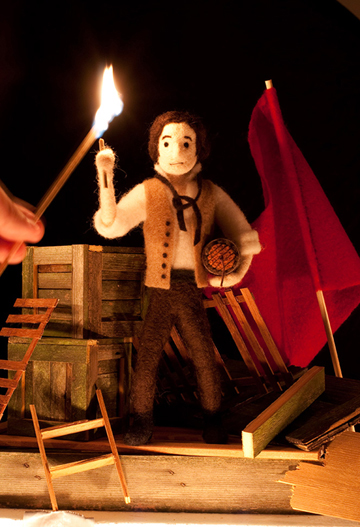
Holman: You’re right. Our attitude, at least for Cozy Classics, is that computer generated images would be “cheating”. So when you see sky in a shot, it’s natural sky. If you see a forest, it’s a real forest. Shots with stars were created by back lighting card stock with holes punched in it. Trying to do everything in camera definitely creates perils. The main peril of location shooting is wind. We’ve had figures and sets blow away on us. For studio shots, the main peril is fire. In one scene, Tom Sawyer had to hold a candle, but I let it burn too long and burned his thumb off. We’ve just finished Great Expectations, and, naturally, we had to set Ms. Havisham on fire. The trick was to do it in a way that didn’t destroy her completely (and luckily we didn’t), but she’s definitely worse for wear!
 I’m particularly interested in the cover image of Huckleberry Finn and Jim on the raft! Was that actually floating in water with you madly snapping shots?
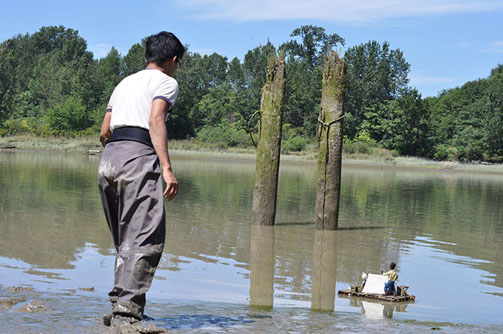
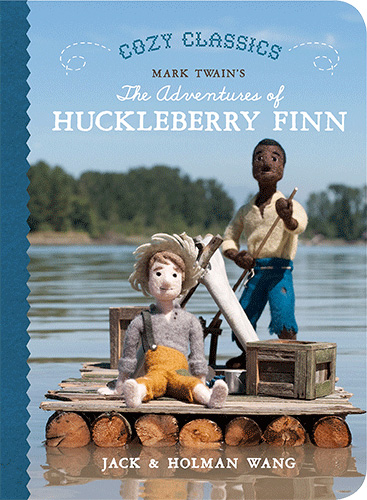 Holman: Absolutely. I borrowed a pair of fishing hip waders from a friend and ventured into a local slough. I tied the figures onto the raft securely with wire ahead of time so they wouldn’t fall into the water. But the big hazard was the whole raft floating away on me. So I would gently push the raft in motion, madly snap shots, and then grab the raft before it went too far ashore. Also, the whole time I was just one slip away from plunging my camera in the muddy water and destroying it.
 Your Star Wars Epic Yarns series (published by Chronicle Books) will be released this April. Amazing! Tell us how this project came to be!
Jack: Holman and I were in Italy in 2013, where our artwork was on display in the Illustrators Exhibition at the Bologna Children’s Book Fair. We struck up a conversation with a rep at Chronicle Books, who was kind enough to take some of our books back with him to San Francisco to show the head of their children’s division. When Chronicle asked us what other ideas we had for abridging classics, Star Wars was our first answer. Chronicle loved it.
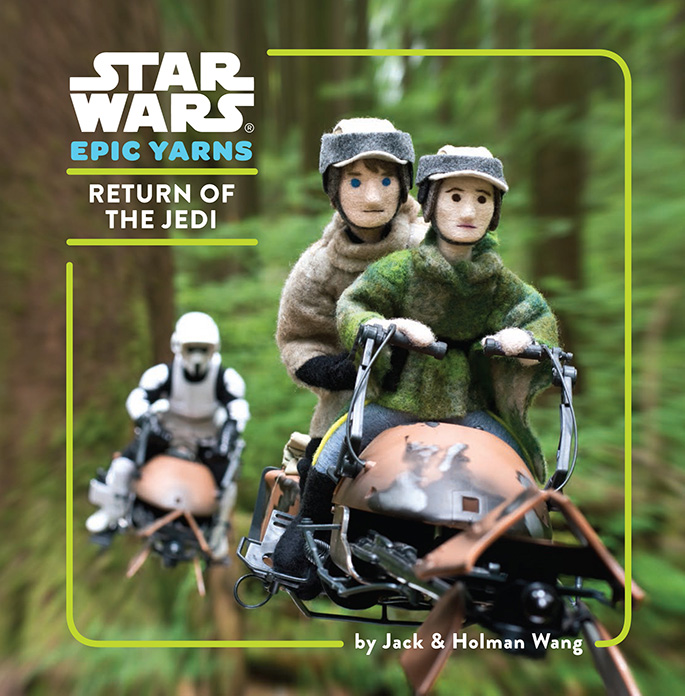 Holman: Of course, doing Stars Wars means licensing with LucasFilm/Disney. LucasFilm is very discerning when it comes to licensing Star Wars books, so we were thrilled when they came on board.
 What are you up to next?
Holman: More Cozy Classics, like Great Expectations, are coming soon, but we have other big ideas in the works, too. Unfortunately, we can’t disclose them now, but we hope that you’ll be hearing a lot from us in the future!
Images used with permission of Jack and Holman Wang. All Star Wars images © LucasFilm Ltd. Star Wars is a TM of LucasFilm Ltd.
Cozy Classics’ Moby Dick was also featured on our curatorial blog. Click here to see it!

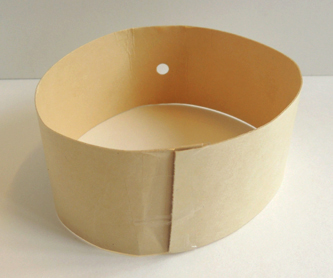
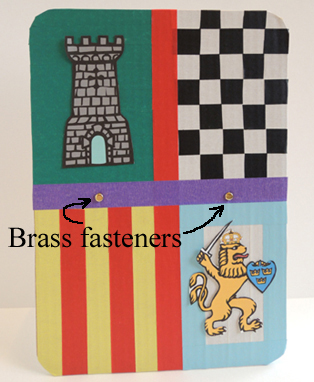 Slide the holes of the arm straps onto the brass fastener’s prongs, then open the prongs to secure the straps in place.
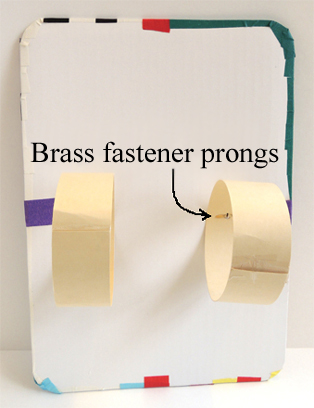 Finally, use masking tape to cover the prongs and secure the arm loops.