Click Clack Awesome

click clack awesome againCows that type? Yes indeed. You can too, using this awesome box typewriter and funny Mad Lib letters!

We read Click, Clack, Moo: Cows That Type, written by Doreen Cronin, and illustrated by Betsy Lewin (Simon & Schuster, 2000). It’s cold in the barn at night, and the cows have had enough. They type a note to Farmer Brown requesting electric blankets. When he doesn’t comply, the cows go on strike. No milk! The hens are cold too and soon it’s no milk, no eggs at the farm. Infuriated, Farmer Brown types a note demanding milk and eggs, reminding the protesting parties that they are, after all, cows and hens. The cows hold a meeting, and a counteroffer is made. The typewriter in exchange for electric blankets. Done! Farmer Brown delivers the blankets, but the typewriter appears to be missing. Until a note arrives from the ducks. They want a diving board.

You’ll need:

  • 1 box (mine was 4 ½” X 4 ½” x 9”). A large tissue box works great too
  • A box cutter
  • 2 paperclips (mine were 1.75″ long)
  • A selection of color masking tape
  • 2 jumbo craft sticks (mine were 6″ long)
  • 1 typewriter keyboard template, printed on 8.5″ x 11″ white card stock
  • 1 paper towel tube, cut down to 8.5″ long
  • 1 piece of construction paper
  • 1 balloon stick, cut down to 10.25″ long (a wooden dowel works too).
  • 2 wooden beads
  • 1 pipe cleaner
  • 1 drinking straw
  • 4 pom-poms (mine were 1″ in diameter)
  • 1 typewriter letters template, printed on two, 8.5″ x 11″ sheets of paper
  • Scissors and tape for construction
  • Markers for decorating
  • Hot glue

Optional bell:

  • A small piece of pipe cleaner (approximately 4″ long)
  • 1 jingle bell

The majority of this project will be demonstrated using a white craft box, but I’ll show you how a regular old tissue box (the long, rectangular kind) can be adapted too!

finished typewriter with paperWe’ll start with the craft box. Use scissors to cut the tabs off the box, then cut diagonally down each side like so:

typewriter box step 1Push the tall, right-hand side of the box against the diagonal sides, and secure with tape.

typewriter box step 2Fold the overhanging section over the back of the box, trim down the resulting flap, then tape the flap to the back of box.

folding the boxIf you’re using a tissue box, follow these steps. Flip the tissue box over so the opening for the tissues is resting on top of the table. Then, use a box cutter to cut a hinged top like so:

tissue box step 1Now use scissors to cut diagonally along the sides of the box:

tissue box step 2Follow the exact same steps as the craft box to finish (i.e. fold the overhanging piece over the back of the box, trim it, and secure with tape). Done! Now turn the slanted part of the box towards you, and tape a paper clip to both sides of the box.

paper clip placementThe orientation and placement of the paper clip is important. The end of the paper clip with the double curves needs to be sticking upwards like this.

typewriter paper clip

Later, the upper parts of the paper clips will hold the axle of your typewriter’s “cylinder” (i.e. the round thing that your typewriter paper wraps around).

Decorate the back, sides, and front of the typewriter with color masking tape (or just use markers). Decorate a jumbo craft stick as well (the stick will eventually become your typewriter’s “space bar”). I used color masking tape for the space bar you see in the image below, but markers work great too!

space barColor and hot glue (or tape) the typewriter keyboard template to the front of the typewriter (if you don’t like the all white template, here’s one with a black background). Note: the keyboard template doesn’t go all the way to the top of the box. That’s good! You want it to be at least 1″ below the top of the box (otherwise, the keyboard will get covered by the cylinder). Finally, hot glue (or tape) the craft stick space bar to the bottom of the box.

typewriter keyboardOK! Now for the cylinder! Wrap an 8.5″ paper towel tube with construction paper (we used gray paper). Then thread a 10.25″ balloon stick through the first paperclip, the paper towel tube, and the second paper clip.

threading paper clipThe cylinder is now secured on its balloon stick axle, which is in turn held in place by the 2 paper clips.

typewriter balloon stickWe slid 2 wooden bead on the ends of the balloon stick to keep it in place (masking tape or scotch tape on the ends of the sticks works too!).

typewriter wooden beadsYour cylinder now needs a “paper finger,” (i.e. the little mechanism that keeps the paper from flopping over). Believe it or not, it took us FOREVER to figure out how to make this simple and workable with easy-to-use materials. The winners? A drinking straw and a pipe cleaner. I only had clear drinking straws in the art cabinet, so it’s a little hard to see it in the photo below. You’ll definitely need it. The smoothness of the straw allows the paper slide easily!

attached paper fingerThread a pipe cleaner through a drinking straw. Bend the ends of the pipe cleaner inside the cylinder and secure with tape. The paper finger shouldn’t be super tight against the cylinder – leave a little wiggle room for the paper!

attached pipe cleanerAlmost there! Flip your typewriter on its back, and hot glue 4 pom-poms on each corner. Hot glue a jumbo craft stick to the front of the box. This will add some weight to the front of the typewriter, and act as a counterbalance the cylinder.

underside of typewriterYour typewriter is finished!

finished typewriterReady to load some paper? Starting from the back, slide an 5.5″ x 8.5″ piece of paper under the cylinder, then curl and tuck the paper under the paper finger. Tug it upwards a little, and you’re done!

typewriter paperYou can put a blank sheet of paper in your typewriter, or you can use the Mad Libs we created on our typewriter letters template. I recommend the Mad Libs. The kids and their caregivers had quite a bit of fun filling them out! I managed to catch a couple at story time.

letter 1letter 2letter 3letter 4letter 7letter 8letter 5letter 6

letter 9One last thing! You’ll notice that the finished typewriter has a bell. The bell is optional, but I have to say, it was pretty cute. There are a couple ways to attach it.

finished typewriter with bellFirst, thread a jingle bell through a 4″ piece of pipe cleaner, then curl one end of the pipe cleaner to keep the bell from sliding off.

Then you can either:

  1. Tape the uncurled end of the pipe cleaner to the upper right-hand corner of the typewriter before you hot glue the keyboard on.
  2. Peel the upper right-hand corner of the keyboard back, tape the uncurled end of the pipe cleaner to the typewriter, and re-adhere the corner of the keyboard.
  3. Tape the pipe cleaner to the side of the typewriter.

At our story time, we went with option 1, and attached the bell early in the project. For option 1 or 2, just make sure that the keyboard completely covers the uncurled end of the pipe cleaner. Otherwise, the pipe cleaner could snag your typewriter paper (or poke your fingers) as you’re loading it on the cylinder.

Out of This World

flying saucerMake a flying saucer and watch it whiz down a zip line! This project is the perfect blend of simplicity, creativity, and action. We even have a saucer flight video for you!

We read Space Case, written by Edward Marshall, and illustrated by James Marshall (Puffin Books; reprint edition, 1992). When a bright yellow saucer-shaped thing arrives from outer space, it doesn’t find the natives (a cow, a chicken, and a jack-o-lantern) to be very forthcoming in conversation. But then it encounters three trick-or-treaters, who mistake him for a new kid in the neighborhood. The quartet have a wonderful time trick-or-treating until Buddy McGee realizes that the thing isn’t wearing a costume. He invites it home, and even takes it to school the next day. But when the thing learns there will be no trick-or-treating that night, it prepares to depart. It promises, however, to return for Christmas!

You’ll need:

  • 2 sturdy paper plates
  • 1 strip of poster board (approximately 1.5″ x 22″)
  • A selection of dot stickers
  • 2 toilet paper tubes
  • 3 rectangles of grey construction paper (approximately 2″ x 6″ each)
  • 1 jumbo pom-pom (mine was 1.75″)
  • 1 large wiggle eye
  • 1 clear plastic drinking cup (I used a 2.75″ tall hard plastic cocktail glass)
  • 1 jumbo paper clip (mine was 1.75″ long)
  • Flying saucer decorating materials (more on this below)
  • 6 squares of yellow and/or red cellophane (approximately 5″ x 5″)
  • A length of 24-gauge wire
  • Scissors, stapler and tape for construction
  • Markers for decorating
  • Hot glue

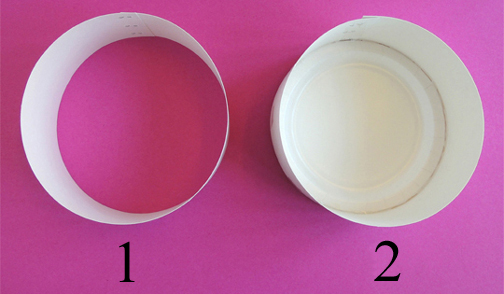
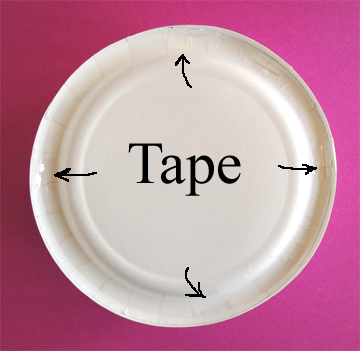
finished saucerFirst, decorate a strip of poster board with dot stickers “lights” (we used silver metallic poster board and yellow dot stickers, but any color combination will do). Circle the poster board strip around the bottom of a paper plate and staple (or tape) the circle closed. In the demonstration photo below, I used purple poster board so it would stand out against the white plate. For the actual project, the poster board was silver with white backing.

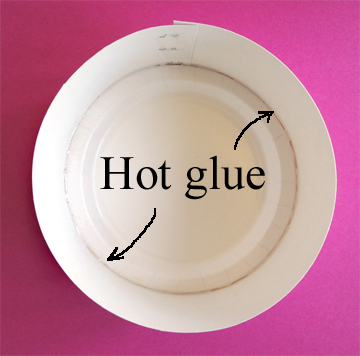
circled stripHot glue the poster board circle to the paper plate. Next, squirt a ring of hot glue around the top rim of the poster board circle, then press the second paper plate on top. Your saucer will now look like this:

two plate saucerCut 2 toilet paper tubes in half. Wrap 3 of the tube pieces with grey construction paper, then hot glue them to the bottom of the saucer in a triangular fashion. These are your saucer’s “rocket boosters.”

attached tp tubesSet the saucer aside for the moment. Hot glue a single wiggle eye onto a jumbo pom-pom. This is your “alien.” We prepped a bunch in advance of story tine.

aliensPlace the alien on the top of your saucer, then tape a clear plastic cup over top of it.

undecorated saucer Next, bend the halves of a paper clip apart until it forms a right angle,

bent paper clipThen tape the bottom part of the paper clip securely to the top of the cup. This is the “hook” that connects the saucer to the zip line.

attached hookIt’s time to decorate your saucer! We offered tin foil, embossed foil paper, sparkle stems, dot stickers, and some foil confetti stars I picked up in the party section of Michaels craft store. Try to keep the art materials nice and light so they don’t weight the saucer down too much. Also, don’t let kids attach anything to the paper clip hook. Otherwise, the saucer’s flight down the wire might be hampered.

When you’re finished decorating, stack 2 squares of cellophane on top of one another (we used red and yellow). Pinch the middle of the cellophane squares together, twist them tightly, and secure with tape. Repeat the above steps twice more. You now have 3 “flames” for your saucer’s rocket boosters.

flames  Tape a flame inside each booster. Done!

attached flamesReady to flying your saucer? You’ll just need some wire! I dug this spool of 24-gauge craft wire out of the supply closet. The smoother the wire, the better.

crafting wire

Katie and I stretched 25 feet of wire between the launch site and the landing pad. I handled the launches, Katie handled the landings. To help my grip on the wire, I wrapped my end of the wire around a wooden dowel. I slipped the saucer’s paper clip hook onto the wire, lifted my end of the wire to give the saucer a sliding start, and watched it fly!

Important: Katie and I tested the wire the day before the program. When we were finished, we lightly coiled it and set it on a table. Unfortunately, that was enough to cause the wire to kink. The next day, the first saucer on the wire got snagged on the kinks. We had to quickly unspool a fresh length of wire. After that, it was smooth sailing.

pink saucer

If you’re going to do this project with a crowd of kids, I suggest doing some prep ahead of time. Definitely prep the upper and lower halves of the saucers  (i.e. hot glue the poster board circle to one paper plate, and the 3 tube boosters to the other plate). While the kids were decorating the top half with markers, we used a number system (similar to the ones used in delis and bakeries – we also used it on this project) to call them to the hot glue stations to get the bottom half of their saucer’s attached. Then they wrapped the boosters with grey construction paper, attached the cup, and proceeded to decorating.

Also, in our version of this activity, the kids brought their alien-free saucers to the launching site. I loaded an alien in it, taped the cup down, and then sent the saucer zooming down the zip line. If you decide to do this, make sure the kids attach the cup with just 1 piece of tape. This will allow you to easily lift the cup and place the alien on the saucer. But don’t forget to tape the lid down tightly after that!

Katie also prepped the cellophane flames in advance so there would be plenty of time to fly the saucers. Kids could take as many flights as they wanted.

It was…wait for it…a total blast!

Say Freeze!

say freezeWhat happens when you give a bunch of penguins a camera? In order to find out, we made oatmeal container penguins and armed them with tea tin cameras. The results? Here’s one image…scroll to the bottom of the post to see the rest!

penguin with witherspoonWe read Penguins by Liz Pichon (Orchard Books, 2008). It’s a regular day at the zoo…until a little girl accidentally drops her camera into the penguin habitat. Curious, the penguins gather round. It doesn’t take them long to figure out how the camera works, and pretty soon everyone is having a good time taking pictures! When the camera stops working, the penguins quickly put it back where they found it. The next day, the zookeeper finds the camera and returns it to the little girl. After the pictures are developed, she’s surprised to find photos of monkeys, lions, tigers, elephants, and lots and lots and lots of penguins (don’t miss the adorable fold out photos at the end of the book)!

Both parts of this project are very simple to make. Parents, caregivers, and kids were especially tickled by the tea tin cameras with a clicking shutter button.

camera frontYou’ll need:

  • 1 large oatmeal container
  • 2 rectangles of orange poster board (approximately 2.25″ x 3.25″)
  • 1 circle of black construction paper (approximately 5.25″ in diameter)
  • 1 rectangle of white construction paper (approximately 5.75″ x 9″)
  • Black construction paper
  • 1 triangle of yellow self-adhesive foam (approximately 1.5″ tall)
  • 2 black dot stickers for eyes (optional)
  • 1 Twinings brand tea tin
  • 1 strip of construction paper, any color (approximately 2.75″ x 12″)
  • A selection of patterned tape
  • A selection of color masking tape
  • A 17″ piece of ribbon, any color
  • 1 scotch tape core (approximately 1.5″ in diameter)
  • 1 small circle of mirror board or tin foil (approximately 1″ in diameter)
  • 1
  • 1 small small gemstone
  • 1 penguin viewfinder template, printed on 8.5″ x 11″ white card stock
  • 1 bug clicker (more on this below)
  • Scissors and tape for construction
  • Markers for decorating
  • Hot glue

finished penguinPenguin first, then camera! First, tape (or hot glue) a black construction paper circle to the top of a large oatmeal container. Then, cut 2 rectangles of orange poster board into penguin feet. Hot glue them to the bottom of the container.

penguin feetWrap a rectangle of white construction paper around the front of the oatmeal container (right above the feet) and secure with tape. Next, wrap a piece of black construction paper around the back of the oatmeal container and secure it with tape (or hot glue). The black construction paper will overlap the white construction paper, creating your penguin’s white tummy and black “jacket.”penguin tummy and jacketCut a pair of rounded penguin flippers out of black construction paper, then tape (or hot glue) them to the sides of the container. Add a self-adhesive foam triangle beak and two dot sticker eyes (or skip the stickers and draw the eyes with markers). Use markers to add a pair of eyebrows and you’re done!

Now for the camera! Wrap a tea tin with construction paper (I went with classic black). Add strips of patterned tape to the top and bottom.

camera steps 1 and 2To make a camera strap, take the lid off the tea tin and tape the ends of a ribbon inside it. Close the lid, and your strap is extra secure!

interior of tinNow for the camera’s focusing ring, lens, flash, shutter button, and viewfinder:

camera front labeledTo make the “focusing ring,” wrap the outside of a tape core with construction paper. Since I used cardboard tape cores, I colored the outside rim with a black marker. Here’s a before and after shot:

wrapped tape coreHot glue the core to the middle of the tin, then hot glue a small circle of mirror board inside the core. The mirror board is your camera’s “lens.” You could also use tin foil. To make your camera’s “flash,” hot glue a small clear plastic gemstone to the top of a large plastic button, then hot glue the button to the upper right corner of the tin.

flashThe “shutter button” of this camera is actually a bug clicker. Have you seen these things?

bug clickerWhen you press the little plastic tab on the back of the device, it makes a crisp clicking sound. I bought my clickers on Amazon, but I’ve also seen them in party supply stores and the dog training section of pet stores. At our story time, we covered the outside and sides of the clicker with black masking tape, then hot glued it to the lid of the tea tin. But you can skip the tape and glue them straight to the tea tin if you’d like!

clicker placementYou’ll notice the clicker is mounted off-center on the lid, and the clicker’s tab is close to the edge of the lid. That’s important! You want those little fingers to be able to reach up and click the shutter button.

Because most kids are used to digital cameras with viewfinders, I added a viewfinder to the back of the tea tin (with an image of a penguin, of course!). Print and cut a penguin from the template, and then use masking (or patterned) tape to attach it to the back of the camera.

camera back Project in hand, kids scattered to different parts of the gallery to pose their penguins and take “pictures” with their cameras.

penguin in galleryThere may have been a penguin photobomb or two…

penguin photobombThe fun continued at home! Look at this lovely photo shoot:

penguin posesMysteriously, my camera went missing for a few hours that day. Imagine my surprise when the following shots were e-mailed to me…

penguin 0penguin 1penguin 2penguin 3penguin 4penguin 5penguin 6penguin 7penguin 8penguin 10penguin 11penguin 9penguin 12


Charles Willson Peale, George Washington at the Battle of Princeton, 1783–84. Oil on canvas. Princeton University, commissioned by the Trustees. Courtesy of the Princeton University Art Museum.