Let Us Ride

let us rideDon your finery and trot the countryside on a beautiful, ornate steed! And if you happen to see a sturdy little pony named Fritz, don’t forget to stop and say hello!

We read Fritz and the Beautiful Horses by Jan Brett (HMH Books for Young Readers, 1987). Once upon a time, there was a walled city that was famous for it’s beautiful horses. But outside the city lived a plain little pony named Fritz. Fritz wanted to be like the beautiful horses, but no one was interested in a pony with a shaggy mane, fuzzy ears, and a whiskery muzzle. That is until one day, when the bridge is threatening to collapse and the children of the city are stranded on one side. The beautiful horses are too flighty, skittish, and snobbish to cross the river and take the children to safety. But Fritz, being both gentle and kind, is more than willing to help. Now, the walled city is proud of it’s beautiful horses…and it’s hero pony.

You’ll need:

  • A 2.5″ x 22″ strip of poster board
  • 1 sheet of tissue paper (mine was 19.5″ x 11.5″)
  • 1 goose quill
  • 1 large embossed foil seal
  • 1 pony head template, printed on 11″ x 17″ paper
  • A 11″ x 27″ piece of white poster board for head
  • 2 rectangles of white construction paper for ears (approximately 2″ x 3.5″)
  • Construction paper for mane and forelock
  • 2 wiggle eyes
  • 2 black dot stickers for nose
  • 2 strips cut from a manilla file folder (approximately 0.75″ x 9″)
  • 2 small embossed foil seals
  • A 41.5″ piece of PVC pipe for stick
  • A 35″ piece of ribbon for the reins
  • Hole punch
  • Packing tape
  • Stapler, scissors, tape for construction
  • Markers for decorating
  • Hot glue

If you’d like to make a jingling tassel for your bridle, you’ll need:

  • 1 book (mine was 6″ long)
  • 12′ of yarn, plus a separate 3″ piece
  • A 9″ piece of curling ribbon
  • 1 jingle bell

 We’ll start with your noble hat, and then proceed to the pony with optional jingle tassel!

hatFirst, use the markers to decorate a strip of poster board. Circle the poster board strip around your head, then remove and staple. To create the poofy top to your hat, lay a sheet of tissue paper flat on a table.

hat step 1Gently lift and pull each corner of the sheet to towards the middle, gathering the corners together like this:

hat step 2As you can see in the above picture, the tissue paper sheet now has 4 “points” sticking out of it. Fold those points towards the center of the sheet as well.

hat step 3Your tissue sheet is now fully bunched. Carefully drop your hat band on top of the bunched tissue paper, and reopen the bunched edges until they meet the inside of the hat band. Staple the tissue paper around the interior perimeter of the hat band.

hat step 4Flip the hat over and tape a jaunty feather to the outside. Stick an embossed foil seal over the shaft of the feather to compete the look.

hatUp next…the perfect pony!

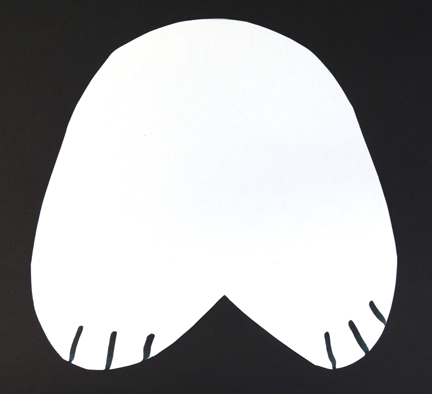
ponyFold the large rectangle of white poster board in half to form a smaller, 11″ x 13.5″ rectangle. Then, place the pony head template (shown below in red for better contrast) onto the folded poster board. Make sure that the nose of pony is lined up with the fold in the poster board. Cut along the template, leaving the “nose fold” intact.

pony templateNext, shape two ears out of the white construction paper rectangles, color the insides with markers, and staple each ear at the bottom.

earsThen staple or hot glue an ear to each side of the pony’s head.

forelock 1To create a forelock, make a 1.5″ cut down the fold of the head, directly between the ears.

forelock 2Fringe a small piece of white construction paper. Slide the fridge into the cut and secure it to the interior of the pony’s head with hot glue. Repeat on the left side.

forelock 3To create the mane, fringe a piece of white construction paper (use a 9″ x 12″ piece for a long mane, or a 4.5″ x 12″ piece for a short mane). Secure the mane inside the pony’s head, along the neck with hot glue. Repeat on the other side of the pony’ head.

manePunch a hole on each side of the pony’ mouth. This is where the reins and tassel will loop through.

reinsTime to decorate! Hot glue two wiggle eyes onto the head, and create nostrils using black dot stickers (you can also skip these materials and simple use markers to draw the eyes and nostrils). If you’d like a curly mane, wrap the construction paper fringes around a marker or pencil.

To make a bridle, decorate 2 manilla file fold strips with markers, and attach them on both sides of the head with tape or hot glue. Add a pair of small embossed foils seals at the bottom. If you have time, bring out the Bling Bin to add some extra flourishes, wind some curling ribbon through the mane.

ponyYou can see reins and a tassel in the above photo, but don’t put them on just yet! It’s time to attach the pony’s head to the stick. Open your pony’s head. Lay the stick on one side of the head, making sure that the end of the stick is 1.5″ away from the fold. Use packing tape (not regular tape) to attach the stick to the neck. Use at least 4 pieces of packing tape to make it really secure.

attaching stickThen, close the head and put a few staples into the base of the head, around the stick.

close up of stick staplesThread a ribbon through the holes in the pony’s head and knot it behind the stick. The jingle bell tassel dangling from the pony’s bridle is purely optional, but I have to say the kids LOVED them. I prepped the tassels in advance. To make a tassel, wrap yarn around a book (my book was about 6″ long).

tassel step 1 Cut the yarn off both ends of the book. You now have a little pile of yarn like this:

tassel step 2Knot a piece of curling ribbon around the middle (curling ribbon is easier to thread through the opening of the jingle bell)

tassel step 3Fold both sections of the yarn downwards and knot another piece of yarn around it like so

tassel step 4Trim overlong pieces of yarn off the sides and bottom of the tassel and you’re done!

finished tasselThread a jingle bell onto the curling ribbon, then thread the curling ribbon through the holes your punched in your pony’s head. Knot securely. Your pony is finished, climb on and ride!

If you’re still not feeling the decadence, may we suggest a cape? Attach a large piece of tissue paper to your shoulders using two embossed foil seals like so:

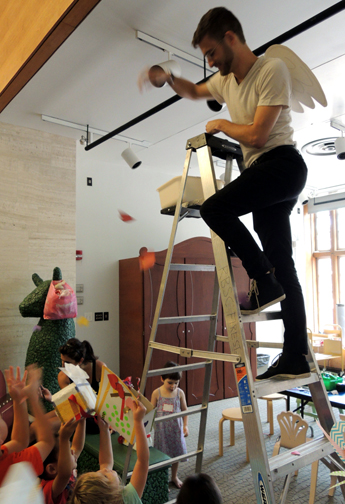
cape Then RIDE LIKE THE WIND!

flying rider

Copying…It’s Not Just for Cats

copy crocsCopy cats? How about copy crocodiles? What happens when everyone has to copy at least ONE element from a highly artistic crocodile? Ravishing repetitious reptiles of course!

We read The Copy Crocs, written by David Bedford and illustrated by Emily Bolam (Peachtree Pub Ltd, 2004). Crocodile is sick and tired of being bashed about in the croc pool by all of his friends. So he slips away to be alone. But everywhere he goes – slippery mud, a sun-filled river bank, a floating log in the river, even the top of a mountain – the copy crocs follow and do exactly what he’s doing. Finally, Crocodile manages to shake his friends and enjoy the splendor of his pool, all alone. But is he really enjoying it? It turns out that having some friends around is actually pretty wonderful. But so is being alone – every once in a while.

Each kid built a crocodile and decorated it, but while decorating, he/she also had to copy at least one thing from my model crocodile. We’ll begin, as we did at story time, with building the crocodile body first.

plain crocYou’ll need:

  • A rectangular box (mine was 4 ½” X 4 ½” x 9”)
  • 4 small rectangles of poster board for the legs (approximately 2″ x 3.5″)
  • 1 medium rectangle of poster board for the tail (approximately 3.5″ x 11.5″)
  • 1 large rectangle of poster board for the mouth (approximately 4″ x 15″)
  • 4 small strips of white construction paper for the teeth (approximately 1.5″ x 4″)
  • 2 small rectangles of poster board for the eyes (approximately 1.5″ x 2″)
  • Materials for decorating (more on that later!)
  • Scissors, tape for construction
  • Hot glue

First, cut crocodile toes in one end of 4 small rectangles of poster board. Bend the bottom of the poster board to make a foot, then bend the top to create a tab

legs 1Squeeze some hot glue on the top of the tabs, and attach each leg to the bottom of the box. For the tail, cut a medium rectangle of poster board into a pointed tail, tab the non-pointy end, and then hot glue (or tape) the tab to one end of the box. For the mouth, fold a large rectangle of poster board like so:

mouth step 1But before you attach it to the box, round the upper and lower edges to make it look more like a crocodile snout.

mouth step 2Hot glue the mouth to the box. If you’d like to add teeth, cut pointy tooth shapes into strips of white construction paper (definitely use construction paper, poster board is too heavy). Tab the tops of the tooth strips, the hot glue or tape inside the mouth. Last step – the eyes! We found that a tall and slightly rounded eye shape looked best.

croc eye shapeCut the eye shapes out of the small poster board rectangles, tab the bottoms, and hot glue (or tape) them to the top of the box. Done!

plain crocAt this point, everyone had the same croc. So we turned the kids loose with plenty of art supplies and let them decorate. Again, the only rule was to copy at least one thing from my example croc. And we made sure there was no lack of options…

decorated crocDecorating supplies included:

The resulting crocs were magnificent. I would guess that the pom-pom eyes, sparkle stem eyelashes, and the self-adhesive foam fruit shapes inside the crocodiles’ mouths were the most copied elements.

gang of crocsWhen everyone was finished, we celebrated by taking our crocs for a swim in our cozy crocodile pool (i.e. a blue sheet sheet stretched on the floor)!

swimming crocs

Incredible Illusions

incredible illusionsBehold the mystery…the wonder…the spectacle…of your very own mini magic show!

magic tricksThis project was the culminating event at To Be Continued, our weekly story time for 6 to 8-year-olds. Every week, we read from a chapter book and celebrate the the end of the entire book with a project and/or activity.

We read Horten’s Incredible Illusions by Lissa Evans (the sequel to Horten’s Mechanical Mechanisms (Sterling Children’s Books, 2012)). Young Stuart Horten moves to the town of Beeton and expects to be thoroughly bored. However, he soon discovers that he is part of a magical legacy left by his Great Uncle Tony, who was a stage magician and illusionist. In the first book, Stuart and his friend April solve a series of complicated clues and find Uncle Tony’s secret workshop. In the sequel, the friends again embark on a journey. This time, they’re searching for Great Uncle Tony’s will, which bequeths the contents of his workshop to whoever finds the document first. Clues are hidden in each of his magical stage illusions, but…the magical worlds inside the illusions are real and in some cases, dangerous. And Stuart and April aren’t the only one interested in getting their hands on those tricks.

We definitely needed some incredible illusions to celebrate the conclusion of these awesome books. I designed these individual mini magic shows to be easy enough for 6-year-olds to do, but intriguing enough for 8-year-olds. After consulting a number of children’s magic books, I found Amazing Magic Tricks: Beginner Level by Norm Barnhart (Edge Books, 2008) to be the most useful. The 4 tricks described in this post are from this book.

You’ll need:

  • 1 memory box (more about this below)
  • A 10.5″ piece of PVC pipe (05.” in diameter)
  • A selection of color masking tape
  • 1 paper cup
  • 1 paper (or fabric) flower
  • 1 empty seed packet (or small envelope simply marked “Magic Seeds”)
  • A 9″ x 12″ piece of felt (I used the glitter variety)
  • hat rabbit carrot template printed on 8.5″ x 11″ card stock
  • 1 Styrofoam coffee cup
  • A selection of foil star stickers
  • 2 playing cards
  • A 1″ foam paintbrush (or regular paintbrush)
  • Scissors and tape for construction

You’ll need a box with a lid to store your tricks and shield your hands from the audience as you prepare your tricks. A memory box is perfect for this. I purchased mine at Michaels Craft store. I went with black, but they come in all sorts of colors and patterns.

memory boxDecorate the lid of your box however you like (I found some self-adhesive glitter foam stars in the clearance section at the craft store) then slide the lid onto the box like so. This creates a “screen” and a “backstage” area to prep your tricks.

magic boxNext, wrap color masking tape around the PVC pipe. Your magic wand is ready!

wandTRICK #1: HIDDEN FLOWER

The most important thing about this trick is making sure the flower is small enough to hide in your fist. I purchased 1.25″ paper flowers for the kids (scored on discount from the scrap booking section of the craft store).

flowerBehind your box’s screen, grab the flower in your fist. Then use the same hand to hold the paper cup with your fingers.

flower trick 1To perform the trick, show the audience that your cup is empty. Then say “Oh no! It’s empty. Well, good thing I have some stupendous magic seeds!” Pick up the empty seed packet and pretend to pour seeds into the cup.

flower trick 2Wave the wand around muttering magical incantations. While the audience is distracted by the wand, open your fingers and drop the flower into the cup. Shout “Ta da!” and show them that a flower has magically appeared!

flower trick 3TRICK #2: FIND THE RABBIT

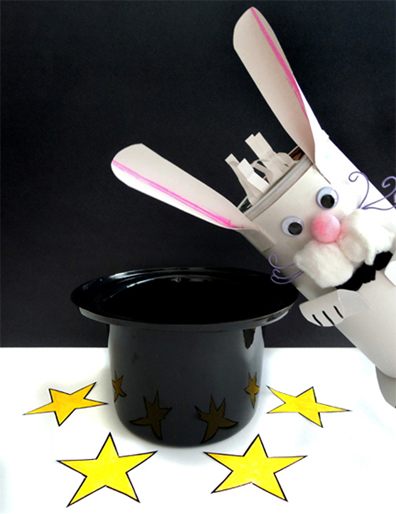
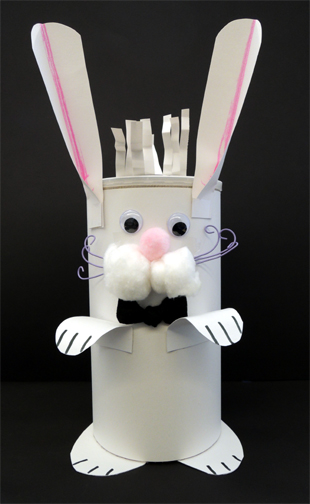
Print the hat, rabbit, carrot template. Fold and tear the strip in 2 places, like your see below. It’s really important that your TEAR the strip. Don’t cut it with scissors!

rabbit trickTo perform the trick, hold up the 3 image cards and say “You see a hat, a rabbit, and some carrots, but with my amazing magical skills, I will pull the rabbit from under this cloth every time!” Turn your back and have an audience member arrange the 3 image cards on the table and cover them with felt.

rabbit trick 2Reach underneath the felt and feel the edges of the image cards with your fingers.

rabbit trick 3The rabbit will be the only image card with two torn edges. Remove it from under the cloth with a flourish! Repeat with a difference audience member. Astounding!

rabbit trick 4TRICK #3: BALANCING CUP

First, decorate a Styrofoam cup with foil star stickers. Next, cut a playing card in half, lengthwise. Tape one half of the cut playing card to the back of another card. The half of the playing card should “hinge” outward like so

cup trick 1To perform the trick, flatten the hinge to the card and hold it up to your audience, keeping the taped side facing your body. Invite an audience member to come forward and try to balance the Styrofoam cup on top of the card. Then say “You see it is impossible. But I will now use magic to make the impossible, possible!”

While you’re talking, sneak a finger up the card and open the hinge on the back, forming an area for the cup to balance. From the side, it looks like this:

cup trick 2But from the front, it looks like the cup is now balancing on the card!

cup trick 3TRICK #4: MAGIC GLUE

To perform this trick, tell the audience that you have magic glue. Hold up a paintbrush and Invite an audience member to come up and “paint” your hand with the magical glue. For my version of the trick, we used 1″ foam paintbrushes I had left over from another program.

wand trick 1Now hold the wand in your “glued” hand. Say “Observe my stupendous magical glue!” Extend your arm across your body and out to your side, still grasping the wand. Next, wrap your free hand around the wrist of your wand hand. Slowly and dramatically, lift each finger from the wand until you no longer appear to be holding it.

wand trick 2But you are holding it of course. Because when you grasp your wrist, you sneak a finger behind your wand hand and hold the wand like this:

wand trick 3Now have the audience clap once to have the wand “detach” from the magic glue. Carefully lift your finger to release the wand, and let it fall dramatically to the floor. Take a big bow.

The kids absolutely loved this project. I performed the whole show first, and then I deconstructed all the tricks and each kid made his/her own set. If, by the way, you’d like to see the awesome mechanisms we made after reading Horten’s Miraculous Mechanisms (the first book in this set), click here.

In May 2015, I interviewed Lissa Evans about her fantastic books. If you’d like to hear it, click here!