Today, I am delighted to introduce guest blogger Dr. Miranda Sachs! Miranda studied History at Princeton University, and graduated in 2011. She worked extensively at our library, both in special collections and with me in community outreach. Miranda earned her PhD at Yale, and is now an assistant professor of European History at Texas State University.
That’s where she met Percy Jackson.
Or more accurately, that’s where she visited the Rick Riordan archive in Texas State’s Wittliff Collections. The collections “collect, preserve and present the cultural heritage of Texas, the Southwest & Mexico through works of the region’s storytellers—writers, photographers, musicians, filmmakers and other artists,” and Riordan’s papers and ephemera are part of the Southwestern Writers Collections (along Sandra Cisneros, Sam Shepard, Naomi Shihab Nye, Cormac McCarthy, and J. Frank Dobie to name a few).
Miranda found some incredibly cool stuff, and I will now turn the post over to her very capable hands. Take it away, Miranda!
Many, many years ago I was an undergraduate at Princeton and I had the privilege of working for Dr. Dana. It was the best job ever. I did things like glue lizards onto visors for a Holes watch party or tell jokes using a shark puppet. Dr. Dana introduced me to Percy Jackson and I loved the books. I even got to dress as a Greek lady for Princyclopedia, an event that Dr. Dana used to organize.
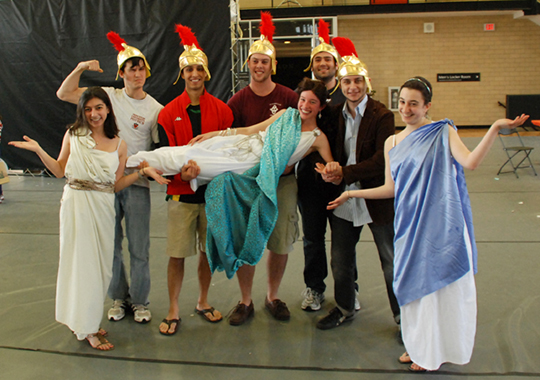
Miranda, on right, being fabulous. Department of Special Collections, Cotsen Children’s Library, Princeton University Library.
Since my time at Princeton, I’ve become a professor of French history. Imagine my surprise and delight when I discovered that Texas State, the university where I teach, has the personal collection of Rick Riordan, the author of the Percy Jackson books. I reached out to my old friend Dr. Dana and she sent me on a quest to check out what Rick Riordan sent to the Witliff Collections.
 Because of the new Lightning Thief mini-series, the library has some of the highlights from Riordan’s collection on display. As soon as I walked in the door, I saw a shirt for Camp Half-Blood. The display case had a replica of Riptide used for the film and some neat photos of Riordan speaking to kids. It also had hand-written copies of stories Riordan wrote as a kid! The room where I got to look at the documents had art on display from the covers of some of the books.

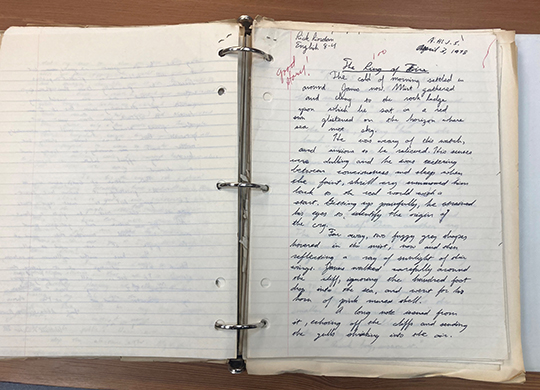
The archivist let me look at some of Rick Riordan’s childhood stories. It turns out that Riordan was writing fantasy and mythology even back then. One story was about a god named Jzais living in a world called Tharcas. He wrote some of these stories by hand and others with a typewriter (yup, he was a kid before the computer.)
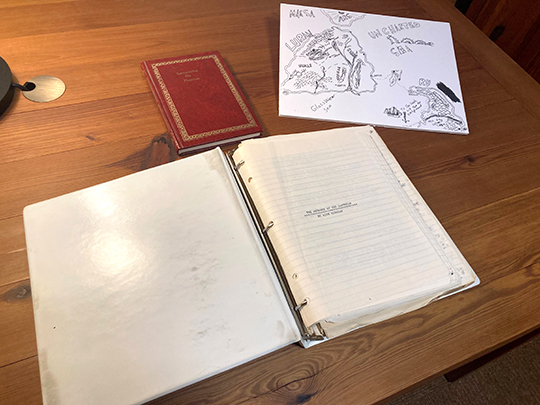
All the stories were on the original pieces of paper on which he’d written or typed. It was fun to look at stories he wrote in junior high school (back in 1978) and see comments from his teachers. One story called “The Ring of Fire” received 100/100!
Rick Riordan was a teacher before he was a writer. One of the boxes in the collection includes a photo album with pictures from the final class of students he taught in 2004. Six years later, he went back to visit the school and those kids were seniors. Many of them wrote letters sharing how much he had meant to them as a teacher. They still remembered the story of Gilgamesh because he had told it to them with funny voices. Multiple kids recalled that they had carried out a mock trial using Hammurabi’s Code in his class. It seems that Riordan was a creative teacher who got kids excited about the ancient world even before he published the Percy Jackson books.

My favorite thing to look at was fan letters from kids. Some of the kids were harsh critics. A 7th grader named Caitlyn complained that the books droned on, and it took too long to get to the exciting parts. A boy named Sean was confused why Percy was dry when he came out of the water given that his father was the sea god. Others asked great questions. They wanted to know his favorite character and his favorite band. A girl named Lauren asked “ARE YOU A HALF BLOOD?” Another girl was curious if he would consider casting Arnold Schwarzenegger as Zeus in the film adaptation. (Sorry.)
Mostly, the kids wanted to express how much they loved the books. By the time Sea of Monsters came out, Riordan was getting multiple letters each day. It was super cool to see evidence of how much those books meant to kids. It was also cool to think that Riordan chose to save the kids’ letters. He decided they needed to be preserved in the archive alongside his fancy prizes and the early drafts of his books.
Before I left, I asked to hold Riptide. It was surprisingly heavy. I guess I’m not a demigod…

Photo by Katie Salzmann
We would like to thank Texas State University for so generously sharing their collections, and to Miranda for being awesome (as always!). Miranda is also an author! She published a book all about kids in nineteenth-century Paris called An Age to Work: Working-Class Childhood in Third Republic Paris.
Collections images courtesy of Miranda Sachs
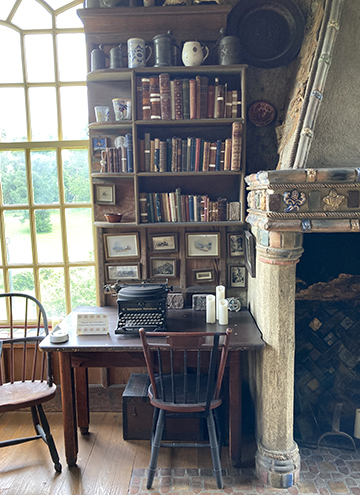
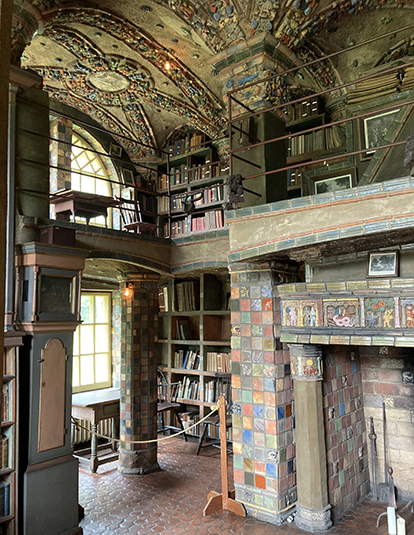 Over the years, I have found myself in a number of interesting libraries and literary settings, but today I wanted to share one that is truly unique. The entire room…in fact the entire mansion is constructed of poured concrete. This unusual library is just one of the rooms in Fonthill Castle, the Victorian home of the eclectic and eccentric Henry Chapman Mercer in Doylestown, Pennsylvania.
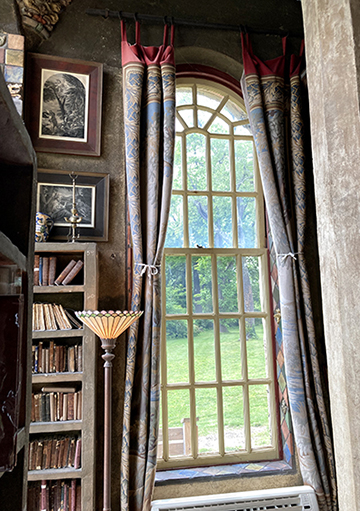 An “archaeologist, anthropologist, ceramicist, scholar and antiquarian,” Mercer had the home built between 1908-1912. It has over forty rooms, extensive grounds, a multitude of fireplaces, and a plethora of windows (including a little one I spotted embedded in a chimney!). The mansion’s exterior and frame was crafted exclusively from poured concrete. Much of the interior is concrete as well, including shelves, desks, chairs, even dressers!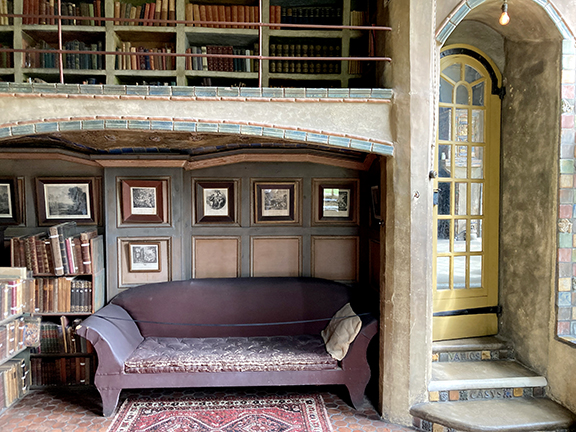
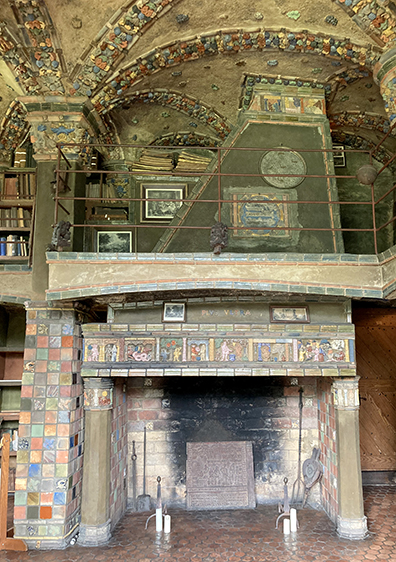
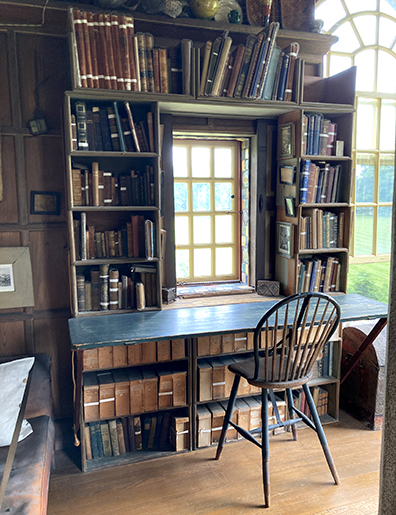
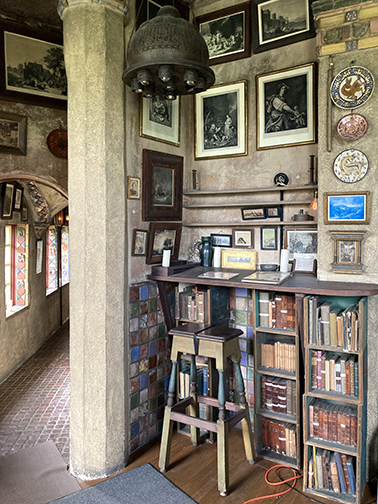
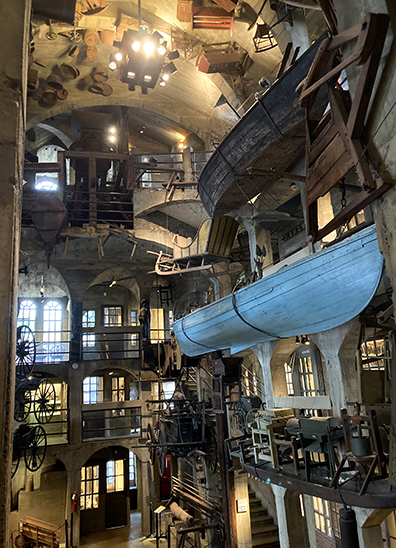
 The home tour was fascinating, but we were wholly unprepared for Mercer’s other building, a six-story castle (also made of reinforced concrete) that now serves as the Mercer Museum. If a photo is worth a thousand words, I leave you with this, and urge you to see the museum for yourself!