Scrolls, Secrets, and Symbols: Unlocking the Mysteries of Alchemy

[Ripley alchemical scroll], 1624

When is a toad not a toad? To answer that question, we’ll need to delve into the fascinating history of alchemy!

Mysterious, fantastical, and shrouded in secrecy, alchemy in medieval Europe was the study of change and transformation. Practiced (both illegally and openly) from at least the first century until well into the eighteenth, alchemy’s obscure imagery of flasks, feathers, dragons, and lions disguised it’s more practical side: dissolving, distilling, and coagulating substances, either for riches, or for healing.

Girolamo Cardano (1501-76), De rervm varietate libri XVII , 1558 (Lyon: Stephanum Michaelem)

Recently, the Department of Special Collections at Princeton University Library hosted an amazing exhibit, “Through the Glass Darkly: Alchemy and the Ripley Scrolls 1400-1700.” Curated by Jennifer M. Rampling, Associate Professor of History at Princeton University, the exhibit is a fascinating exploration of the Ripley Scrolls.

With some scrolls clocking in at over 22 feet in length, the lavishly illustrated Ripley Scrolls are named after English alchemist George Ripley (d. Ca. 1490), although Ripley may not have invented them himself. Through the centuries, the Ripley Scrolls and their depictions of alchemical processes have been interpreted, copied, annotated, and studied by famous scientists including John Dee and Issac Newton.

[Ripley alchemical scroll], 1624

Interestingly, alchemists would sometimes use birds, animals, and unusual images to represent scientific processes. A toad, for example, represented “prime matter,” the substance the alchemist would start with at the very beginning of an experiment.

[Ripley alchemical scroll], 1624

In some works, a serpent and an eagle represent two salts (sal ammoniac and saltpeter). Ravens, peacocks, and eagles represented color changes. You can see some of those illustrated in the book below.

Basilius Valentinues, pseud. Letztes Testament (1667). Strasbourg, G.A. Dolhopff and J.E. Zetzner.

But probably the most exciting creatures gallivanting throughout the collections materials are …DRAGONS! The dragon pictured below very dramatically depicts the transformation of metallic substances into a life-giving elixir. Please note that the dragon is not, in fact, dying. It is happily giving forth healing.

[Ripley alchemical scroll], 1624

And now…how about an alchemy challenge of your very own?

We loved the concept of ingredients disguised as animals and secret recipes, so we put together a little alchemy experiment of our own. We’re calling it “Ye Olde Mysterious Rainbow Elixir of LYFE.”

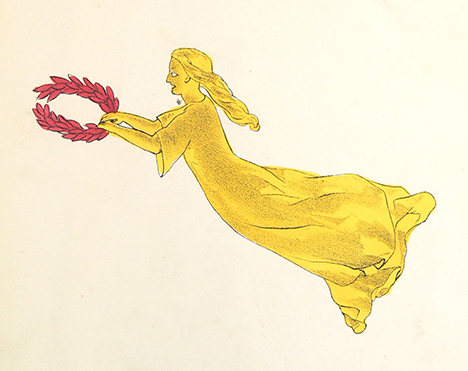
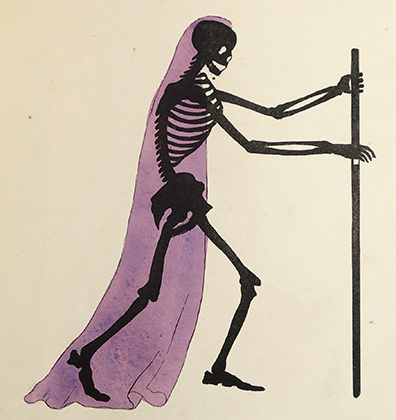
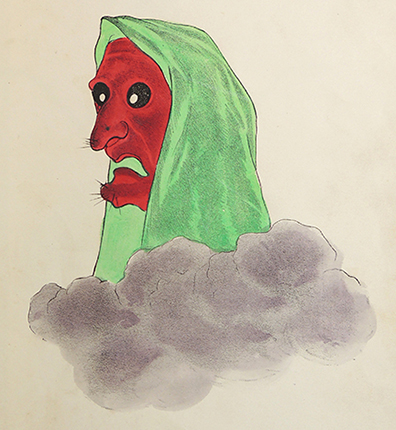
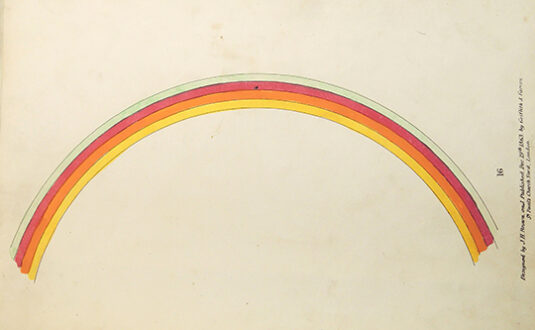
Here’s the Ye Older Elixir of LYFE recipe (including a legend to held you decode it)! The original recipe can be found here, on Andrea Hawksley’s blog.

You can stop reading here, or continue to see how the experiment went for us. Spoiler alert: we had a MAJOR fail the first time. But honestly, that’s in keeping with the history of alchemy!

The Ye Olde Mysterious Rainbow Elixir of LYFE experiment was carried out by August Roberts, Princeton University freshman, budding alchemist, and intern extraordinaire. Take it away August!


Recently, I visited Princeton University’s exhibit on alchemy and learned all about how alchemists each had their own way of documenting and encoding their processes. Whenever I saw this challenging recipe for rainbow lemonade, I knew I just had to test my alchemical skills. We gathered the supplies, headed over to the staff kitchen, and set out to make our very own alchemical lemonade!

When we started, we knew we had to be careful because we only had two lemons and one cup of sugar. Just like the alchemists who were working with rare, expensive, precious metals, our supplies were limited and valuable.

Our first challenge was how to dye each of the five layers to get a rainbow. We had a box of food coloring, but there was only red, yellow, green, and blue – no orange! We experimented with different amounts of red and yellow food coloring until we found just the right amount: one drop of red per every three drops of yellow.

Our next step was getting the lemon juice. Before cutting and juicing the lemons, we applied gentle pressure to the fruit and rolled it back and forth on the counter. This allowed us to get the most juice possible out of our precious lemons.

Once we had all the parts ready, we began mixing each layer separately for assembly. We poured each colorful layer over the back of a spoon into a cup of ice, which was supposed to slow the flow and encourage the lemonade to settle into neat layers. However, we quickly realized something was wrong – our beautiful alchemical lemonade looked much more like a watered down coke.

Like a good alchemist, we persisted despite our first failure. After a bit of puzzling over our recipe, we realized that we had been pouring the more dense layers on top of the lighter layer, causing the colors to blend. With the limited amount of ingredients we had left, we decided to try again, this time pouring the most dense lawyer first and working our way to the lighter layer.

This time we had much more success! Although there was still a bit of blurring between the layers, our alchemical lemonade looked just as fantastic as we had hoped. When it came time to taste test, the flavor was admittedly pretty weak, but it was still a wonderful experience!

A Library for the Birds

A heads up for our readers…in addition to eggs and nests, this post contains multiple images of bird taxidermy, which some may find unsettling. If you do, no problem! Skip this particular post, and we’ll see you on the blog next Tuesday!

Deep within Princeton University’s Department of Ecology and Evolutionary Biology, there is a plain door with a fairly innocuous sign mounted nearby:

Behind that plain door, however, is an amazing treasure trove of natural history. It’s the Princeton Bird Collection, which contains a taxidermy catalog of over 6,000 bird specimens, some of which are over 150 years old! Many were collected by William Earl Dodge Scott, who was appointed Curator of the Department of Ornithology in 1879.

Princeton’s bird room contains a multitude of hulking gray metal cabinets. While I’m used to our library’s special collections cataloged and ordered on regular bookshelves, the bird room’s cabinets open to reveal horizontal wooden drawers containing various specimens. These collections are available for teaching and research, including the Stoddard Lab’s research on avian coloration and morphology.

The drawers also contain nests and eggs, which are similarly laid out for researchers:

There are larger nests as well, including this amazing one that I’m pretty much ready to curl up and take a nap inside:

Beyond the drawers are a fantastic assortment of standing taxidermy, both large and small. Below are just a few the staff unwrapped for me to photograph…from top left to bottom…an emu, ground hornbill, kiwi, barn owl, macaw, snowy owl, and golden eagle.

And check out this! It’s a quetzal, which hails from Central America. It was was considered sacred by the Ancient Mayas and Aztecs. The photo really doesn’t do it justice. The coloring on the bird is simply exquisite.

The bird collection also contains the documents and journals of Charles Roger, a professor of ornithology at Princeton from 1920-1977. The journals, which he began as an eager boy of eleven and continued until he was eighty-four are a fascinating and informative body of work. You can read more about the digitization of his works, and find some awesome coloring pages from our special collections here (as well as a couple fun bird projects!).


A very special thank you to Cassie Stoddard, Assistant Professor in Ecology and Evolutionary Biology, for arranging for me to photograph the bird room, and answering my questions about ducks!

Saddle Up and Read

caitlin gooch saddle up and readIn the beautiful fields of North Carolina, you will find some very well-read horses.

They are part of Saddle Up and Read, a non-profit organization founded by Caitlin Gooch. In 2017, Caitlin noticed the low literacy rates in North Carolina and how they disproportionately affected children of color. Concerned, she reached out to her local library and proposed an incentive. If kids checked out 3 or more books, they could spend a day at her father’s horse farm and share a book with an equine friend!

The response, of course, was unbridled enthusiasm. Caitlin’s idea bloomed into a full-scale operation that has earned national recognition as a program of excellence, both on the farm and in the community. Recently, I caught up with Caitlin to learn more about her amazing organization.


Can you take up through a typical day on your farm?

A day on the farm is never the same. My husband and I have four daughters so I plan things around what we can do. Typically I get myself and my children ready for the day. Once that is squared away, I’m either running errands like checking the mail, going to the bank, checking my emails or picking up books. At the farm I am not solely responsible for cleaning out stalls but I will if I need to. I wash water buckets, pick up trash, and check the water troughs in the pastures. Next, I spend time grooming my horses. Sometimes in their stall or out in the round pen. If I am expecting kids to visit, I lay out everything we need. Books, activities, tack and horse treats.

What came first, your connection to books? Or to horses?

Oh! This is a great question. Based on my memory alone (without asking my mom lol) I believe it was my connection to books. I was an early reader. Reading books was something I could do independently. Unlike with horses, kids have to be supervised. We have always had horses but I don’t really remember how often I was at the farm as a kid. I know when I was 6 years old I asked my dad if I could move my bed into the horse stall.


.What are the names of your horses and ponies?

I have 6 horses and 1 miniature horse. Their names are Barbee, Ardent, Ruth, Khaya, BLM Rare Doc Leo, Rainbow and my mini’s name is Man Man. My childhood horse, GOAT just passed away last year. I miss her so much. She was a huge part of Saddle Up and Read.

Tell us a little bit about the readers who come to your programs!

The sweetest and funniest kids you could ever meet! Most of the readers are of elementary age. More so 3rd to 5th grade. They love to lend a helping hand around the farm. As long as horses are involved, they are for it. We have a very diverse crowd of readers. Majority of the readers are Black and Hispanic, need encouragement to read or practice reading, or they love to read. The programs are open to all children but we do emphasize on children of color because statistically they have lower reading scores.

You are building a library of books featuring Black equestrians. What are your current favorites?

Yes I am! I started collecting these books around the same time I started Saddle Up and Read. Two of my favorites are Let Er’ Buck! George Fletcher the Peoples Champion and Black Cowboy Wild Horses. From my collection I have created a coloring book series called Color & Learn. The first volume is out now. It is titled Black Equestrian Coloring Book Volume 1: The Trail Blazers. It is available on my website and Amazon.

Can you tell us about one of your favorite moments in this program, big or small?

Wow, I have so many. I wish I had a running list of all the people to thank for supporting Saddle Up and Read. Not just the celebrities like Oprah, LeVar Burton and Soledad O’Brien, but everyone who has taken the time to show love. The power of social media has helped us get a truck, a horse trailer, over 2,000 books, and so many donations.

Picking a favorite moment is hard but I’ll say at the end of any event we have, there is always one child who doesn’t want to leave. Sometimes they are crying, “No, I want to stay here.” It makes me both happy and sad. Happy because it means they are having a great time. But sad because I wish they could stay as long as they need to LOL.


All images courtesy of Caitlin Gooch, Saddle Up and Read. And if you want to see some serious adorableness, check out their Instagram!