The Famous Bucket

famous bucketPrior to 2007, if you had asked a young reader to name a famous bucket, I’ll wager most would have replied “Charlie.” But that was before a new bucket arrived on the scene. A fire-engine red bucket, wielded by an acrobatic young lady with a blonde ponytail. I speak, of course, of Kate Wetherall. Katie is one of the fantastic characters in The Mysterious Benedict Society, written by Trenton Lee Stuart (Little, Brown, 2007).

Intrigued by a curiously-worded advertisement in a local paper, orphan Reynie Muldoon spends a most unusual afternoon taking a series of strange tests. Later, he joins three other children (Sticky Washington, Constance Contraire and Kate Wetherall) who also passed the tests in unique ways. The children are invited to join a secret mission to stop Ledroptha Curtain, a criminal mastermind. The book is filled with puzzles, riddles, and action, but what I love the best is the friendship that forms between the children as their strengths (and weaknesses) are put to the test.

In the books (there are 3 in the series, plus a prequel), Kate always carries a red bucket stocked with a number of useful supplies. So when To Be Continued, our story time program for 6-8 year-olds finished the book, I just knew we had to something with Kate’s bucket! So I designed this game.
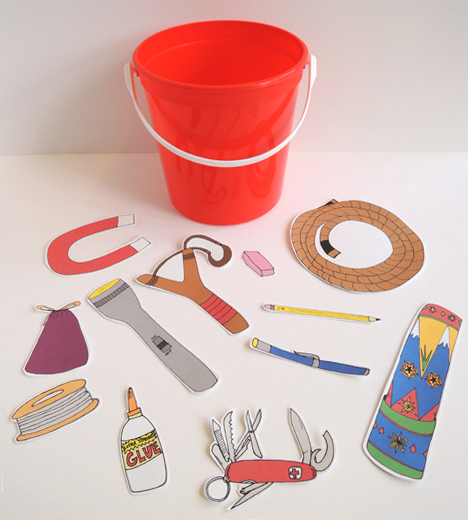
bucket gameAll you’ll need is 1 red bucket, a bucket game template printed on white card stock, and a copy of the bucket game scenarios. You’ll need markers to color in the template (or you can just go with the full color version), and scissors. I also gave kids a list of the bucket’s contents.

A quick word about the bucket. The 6.5″ bucket in the above photo can be purchased from Lowe’s for $2.35. However, since I required close to 20 buckets for my program, I needed something cheaper. I found a 4.5″ treat pail at Party City for 99¢. Nice! I also spotted 8.5″ paper bags at Party City for 79¢. Yes, a bag is technically not a bucket, but it’s a budget-friendly option nonetheless.

buckets and bagTo play the game, read a scenario aloud. Ask the kids to select the bucket items they would use to solve the scenario. Once everyone’s selections are made, go around the room and ask them to display which tools they selected, and how they would use them to solve the scenario. As you can imagine, there were some pretty innovative answers!

I’m a big fan of the Mysterious Benedict Society books, and in 2010 I was delighted to interview the author. If you’d like to listen to (or read) my interview with Trenton Lee Stewart, just click here.

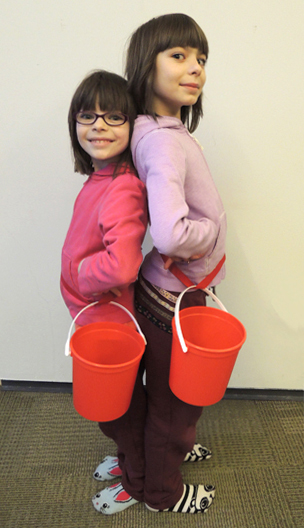
Also, I don’t know if you noticed the amazing footwear on the two models at the top of the post (who also happen to be huge fans of the books). If not, scroll back up and prepare for some serious cuteness!
Shadow Play

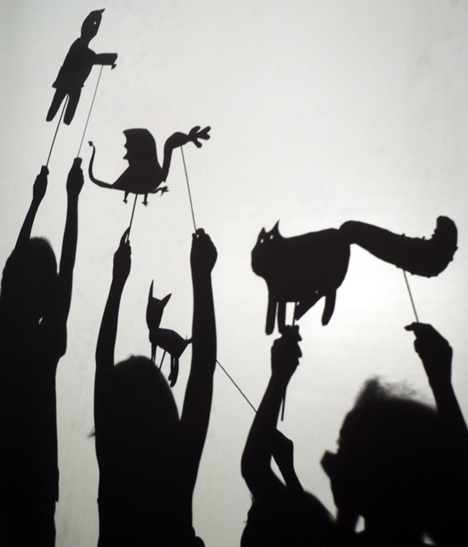
shadow playWe made these fantastic shadow puppets as part of To Be Continued, our chapter book story time for kids ages 6-8. We had just finished reading The Books of Elsewhere: The Shadows by Jacqueline West (Dial, 2010).

Olive Dunwoody and her parents have just moved into an old house. And the house doesn’t like it. The house’s previous owner, Mrs. McMartin, was involved in witchcraft, and not very nice witchcraft at that. The house wants Mrs. McMartin, and the rest of her dark family, back. Olive soon discovers that she can enter the house’s enchanted paintings. She also discovers a trio of talking cats (who totally rock), a be-spelled boy named Morton, and the nefarious plans of Aldous McMartin, the evil patriarch of the ancient McMartin family. Can Olive and her friends fight off the shadows? This book is spooky, exciting, funny, and kept the kids in the group on the edges of their seats (or pillows, rather).

You’ll need:

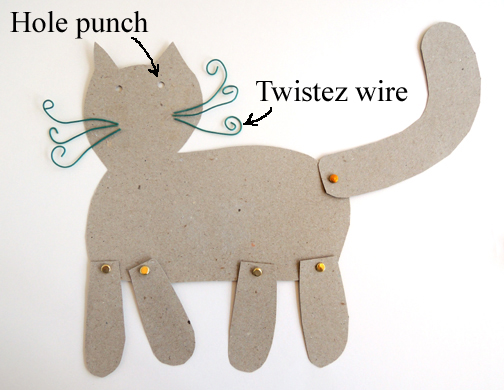
I made two example puppets – a cat (because the cats are such fantastic characters in the book), and a ghost. But the kids could make anything they wanted. We had cats, ghosts, dragons, zombies, and some sort of monster with a detachable brain. Oh yeah.

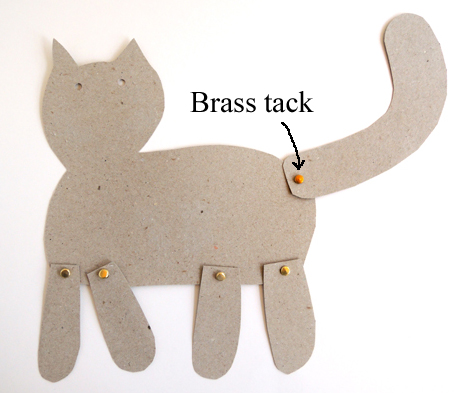
The kids started by using markers to sketch their puppets on a sheet of tagboard. They cut the entire figure out first, and then made specific cuts on the portions they wanted to manipulate later (such as cutting the tail off and reattaching it with a brass fastener).

cat with brass tacksWe used the hole punch to make eyes (you can use scissors to cut eyes and mouth holes too). I had some tissue paper, twisteez wire, pipe cleaners, and cellophane handy to add some texture to the shadows as well.

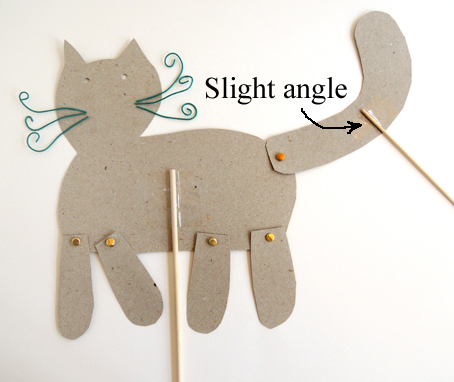
cat with whiskersWhen it came time to put the sticks on the puppets, we used a wooden dowel as the central stick and a lighter bamboo skewer for the moveable part. We attached the sticks with tape.

One hint about the stick placement. It’s best to attach the stick that manipulates a part of the puppet (like an arm or tail) at a slight angle. This will give it a better range of motion.

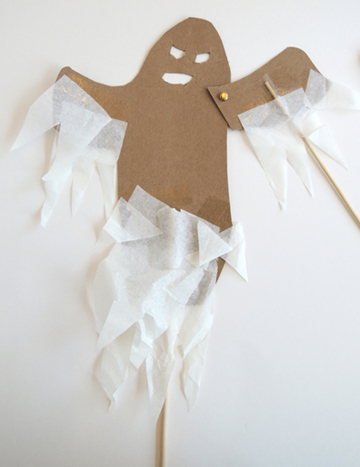
cat with sticksHere’s my ghost puppet. I made one arm moveable, cut out the eyes and the mouth with scissors, and added tissue paper drapery.

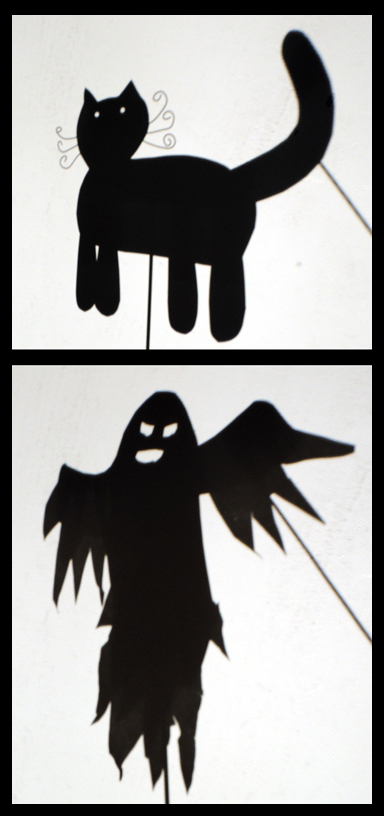
ghost puppetFor the grand show, I lowered all the shades, turned off the lights, and fired up the overhead projector (you can read more about the joys of overhead projectors here). I pointed the projector at wall and…magic!

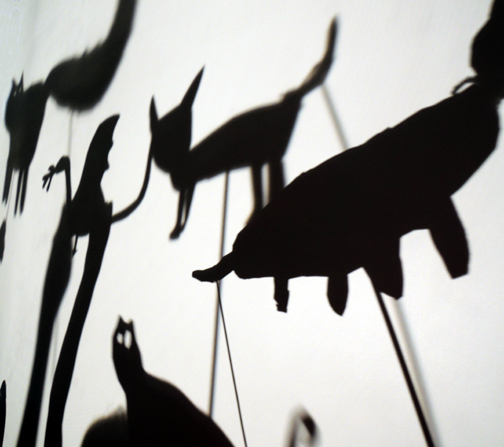
finished puppetsNeedless to say, we had a total blast playing with our shadow puppets. The program ran for less than an hour, but it would have been interesting to keep it going for a few more – experimenting with different types of puppets, textures, and launching into spontaneous narratives. There are some interesting multicultural angles to shadow puppetry as well. Hmmm…maybe a more extensive weekend workshop is in order?
more shadows

Yes, They Do Float

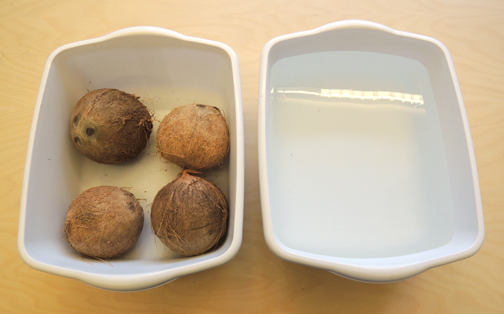
coconut experimentI’m talking about coconuts of course. If you’re ever stranded on a tropical island and need to make an escape raft…yes, coconuts do indeed float. This experiment was part of To Be Continued, our reading program for 6 to 8 year-olds. You can read about some of our other activities here and here.

We read Nim’s Island by Wendy Orr (Yearling, 1999). Nim is a little girl who lives on a beautiful, yet isolated, tropical island with her scientist father, Jack. When Jack leaves for a three day research trip at sea, Nim is left alone on the island with her friends Fred the marine iguana, Selkie the sea lion, and Chica the sea turtle. The family hut is equipped with a laptop computer, and Nim is delighted to learn that Alex Rover, world-famous adventure novelist, has written Jack to inquire if it is possible to build a coconut raft. So far, so good…but…Jack doesn’t return as expected, days pass, and Nim finds her surivival skills put to the test. Her correspondence with Alex (i.e. Alexandra!) Rover continues, and another story begins to unfold. A story about facing fears, courage, and love.

The kids asked many questions during the reading of this book (more on that below), but the one that intrigued me the most was – do coconuts really float? I decided that we needed to find out.

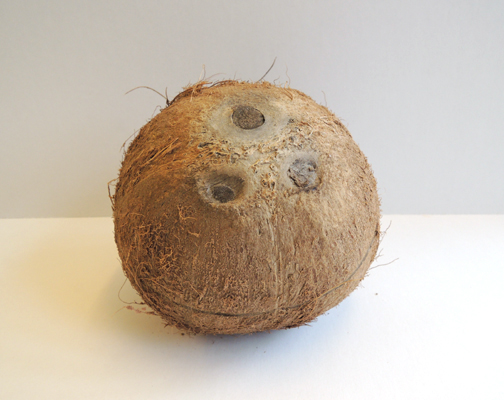
coconut Finding coconuts wasn’t difficult. Whole Foods Market carries them in their produce section, as did Wegman’s, a local grocery chain here. I never realized how cute coconuts were – in a hairy sort of way.

I put the coconuts in one dish tub, and filled another dish tub with water. The experiment was ready!

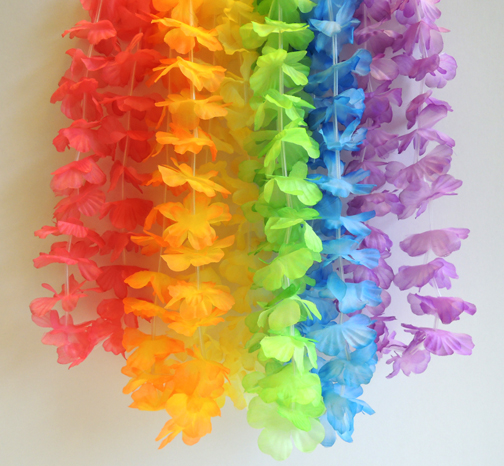
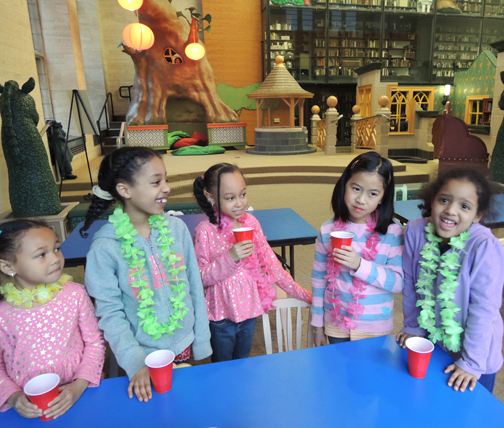
coconut experiment set upBut before we embarked on some coconut science, I set a tropical mood by handing out colorful leis and putting on an Echoes of Nature: Ocean Waves CD (Delta Music, 1993).

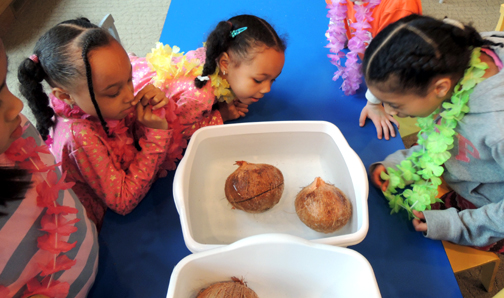
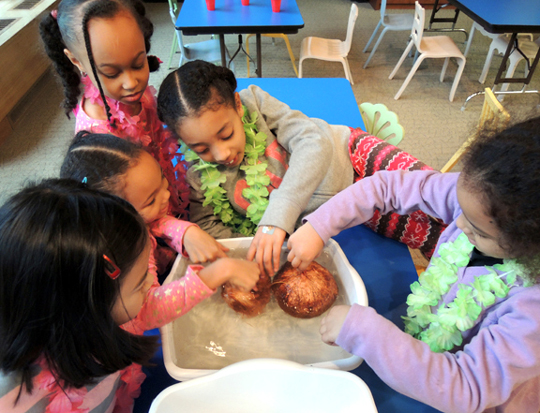
leisI let everyone pick up the coconuts and examine them. Then we took a vote. Who thought the coconuts were going to float? Why? Who thought they were going to sink? Why? Coconuts are very hard and rather heavy. So they’re going to sink, right? I rolled them into the water. They floated!

they floatThen we moved to a different table to try yet another coconut experiment – a taste test!

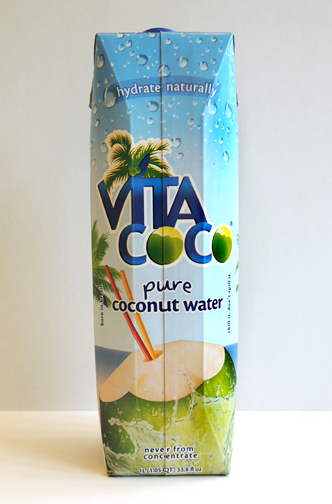
coconut waterCoconut water is all the rage these days. It’s the actual liquid that comes from inside a coconut (as opposed to coconut milk, which is made from the grated meat of the coconut). This is the stuff Nim drinks in the book, so we tasted it! The reactions to the flavor, as you can see, were a bit mixed…

taste testBut everyone gave it a good try (one little girl even asked her mom if she could get some for home!). Typically, I don’t do food in my programs (you can read more about this in my food allergy post). And, in fact, one of the kids participating in this program did have a food allergy to dairy. But the connection to the book was so fabulous, I decided to put in some legwork to make it possible.

First, I checked Vita Coco labels to see if there was any potential contamination with dairy products (there’s not, it’s actually a vegan product). I doubled checked by calling the company. Then, the week before the activity, I approached the mother of the child with the food allergy and explained what I wanted to do and what I had learned from the company. I brought the Vita Coco packaging with me so she could check the label herself. After Mom gave the OK, we were good to go!

Having floated coconuts and tasted coconut water, we had one more connection to make. In the books, Nim plays coconut soccer with Fred, Selkie, and Chica. Unfortunately, it was raining outside so we couldn’t try our version of it, but we did try coconut bowling!

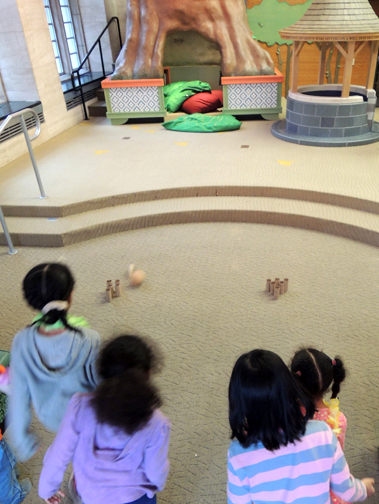
coconut bowling 2Basically, I set up two sets of 6 toilet paper tube “pins” and let ’em rip! And there you have it. Three fabulous Nim’s Island activities, all inspired by the humble, yet surprisingly versatile, coconut!

A few of the other questions that came up during this book were:

  1. What’s a machete?
    A quick trip to Google images solved this one.
  2. What does a marine iguana, sea lion, and sea turtle look like?
    Google images again!
  3. What’s the difference between an ocean and a sea?
    A sea is part of the ocean partially enclosed by land (from National Ocean Service)
  4. Are coconut pearls real?
    Apparently, they’re a myth. Boo.