 While archaeology can’t always be fedoras, bullwhips, and jaunty theme music, it is a fascinating field of study. Plus, you get to dig really, really big holes! In 2013, my library had a large-scale Journey to the Centre of the Earth event, and archeology seemed just the thing to include. But we needed to be realistic about what we could do. I mean, we couldn’t set up a dig site on the event floor…or could we?
Today, I’m going to share how Katie and I built a portable archeological dig site. It has it all – grids, brushes, artifacts, scientific sketches, field notes, and a clipboard activity that got kids thinking about how all the artifacts were connected. The dig was hosted by the Historical Society of Princeton, who put their own fantastic twist on things (I’ll share what that is at the end of the post!).
Katie and I created the dig in the pre-blog days, so you’ll have to excuse me if there aren’t as many detailed process photos!
Our dig consisted of 4 different “sites.” Each site was a group of 6 corrugated cardboard boxes and a clipboard. I ordered the boxes from Uline (model S-16746). They are 15″ x 15″ x 3″. Originally, the boxes had attached lids, but we cut those off. We connected the boxes with tons of hot glue, then ran brown packing tape around the outside as well.
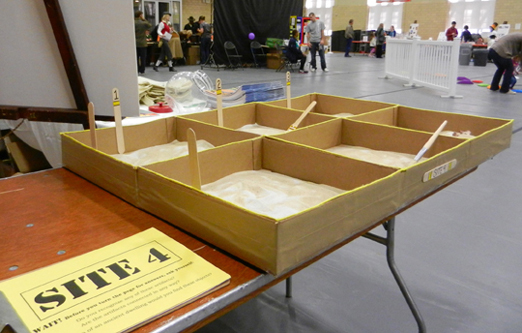 Archeologists use string to divide their sites into grids. We replicated this by hot gluing yarn along the tops of the boxes. We color-coordinated the sites as well. Site 4, for example, had yellow yarn, yellow stripes on the markers, and a yellow cover sheet on the clipboard. The other site colors were green, orange and red.
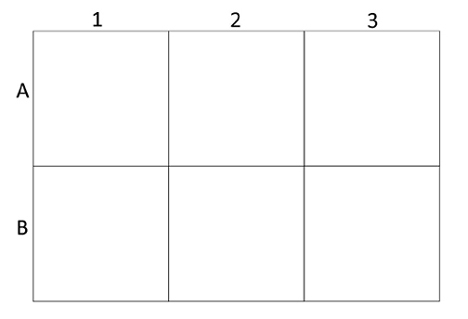
Since the artifacts would later be matched to a site map, we hot glued wooden craft sticks markers around the grid as well. Here’s how each site was marked:
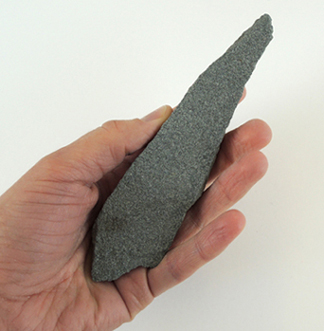
 The next step was to find artifacts to put in the boxes. We had a lot of fun with this! Among other things, we used old metal jewelry, non-plastic beads, and owl pellet bones. We used air dry clay to make cups, plates, bowls, and spoons (a couple of which we intentionally shattered and used as shards). A library contractor donated some small deer antlers, and I snagged a “stone knife” from a broken piece of paving tile.
 Each of the 4 sites had its own theme: 1) Fire Pit; 2) Pantry; 3) Treasury; and 4) Armory. We sorted the artifacts under the different themes, and then arranged them in the appropriate boxes. Because we needed the artifacts to match the site map, we hot glued them inside the boxes. And we really, really hot glued them. We even had an emergency hot glue gun at the event in case an over-eager archeologist yanked an artifact out of the box.
Next came the dirt! Except, for sanitation reasons, we used playground sand purchased from Lowe’s. Specifically, we mixed white and yellow playground sand together to give it more texture.
To keep the mess at a minimum, we added 1″ of sand to the boxes. It was just enough to cover most of the objects, but still left a few sticking out in a tantalizing way. Each individual box got 4 cups of sand, which meant each site used 24 cups of sand. In the end, we used 50lbs of sand for the whole dig site. For obvious reasons, we transported the prepped boxes to the event and THEN filled them with sand.
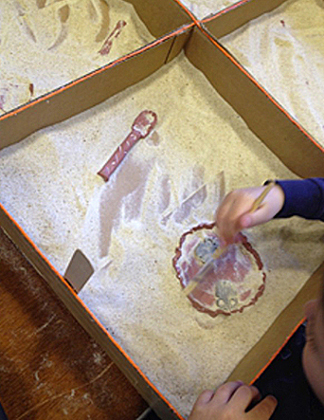
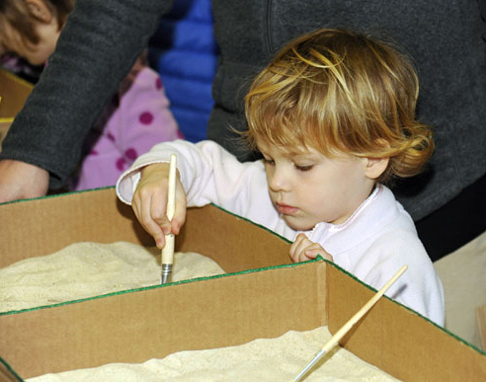
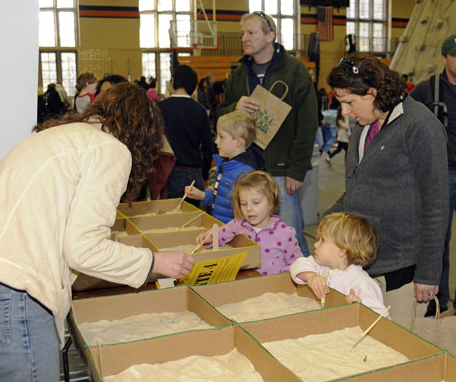
At the event, young archeologists used paintbrushes to uncover the artifacts. They were natural bristle brushes with wooden handles in assorted sizes (the widest being 2″). There were at least 4 brushes per site so multiple kids could work at once.
 Remember the clip boards by each site? The clipboards contained a site map of where all the objects were buried. But before kids looked at the map, we asked them to think about what they had just uncovered. So the cover sheets for the clipboards looked like this:
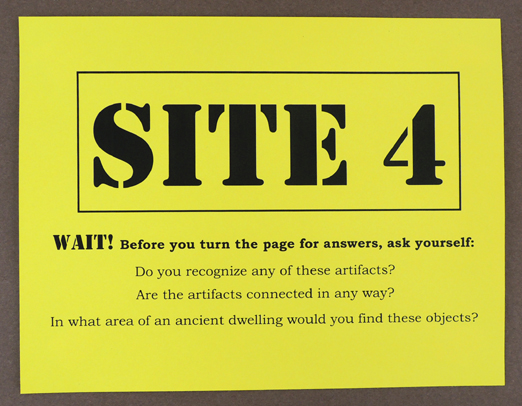
Kids would talk about what the artifacts looked like (“That looks like a spoon!”), how some artifacts were located close together (“I saw a plate and a spoon together…”), and then make guesses as to what dwelling the artifacts were used for (“I think someone was eating here. A kitchen maybe?”).
Flip up the cover sheet, and there was the site map with the artifacts. If kids hadn’t found an artifact, they could use the grid markers to locate it. The map also had the title of the site, so kids could confirm their hunches as to how the artifacts were connected. If they excavated all the sites, they would also see how those were related (the Pantry was located next to the Fire Pit, the Armory was located next to the Treasury).
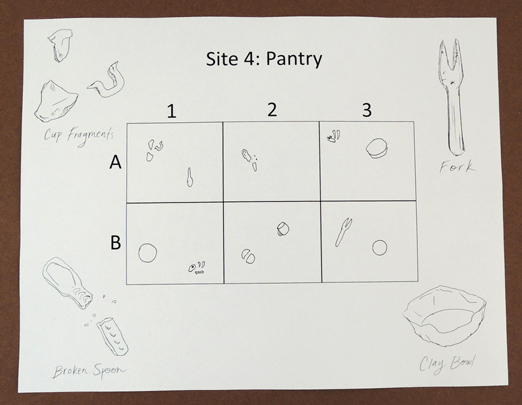 Bordering each site map were cool “field sketches” identifying some of the objects on the site. These were drawn by the awesome Aliisa Lee.
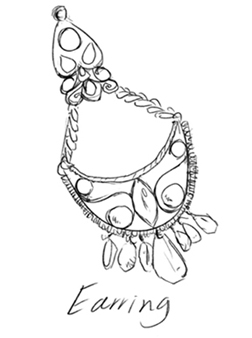 Aliisa even added cool little notes to some of the sketches…
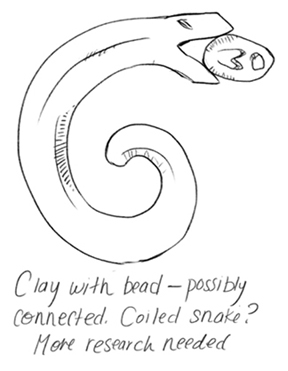 You might have noticed that we didn’t label everything on the site map. That was intentional. Many of the objects were obvious (beads, spoons, a bracelet), but we left a few mysteries to show that, sometimes, you don’t get all the answers right away. It might take a little more research and consultation with your colleagues.
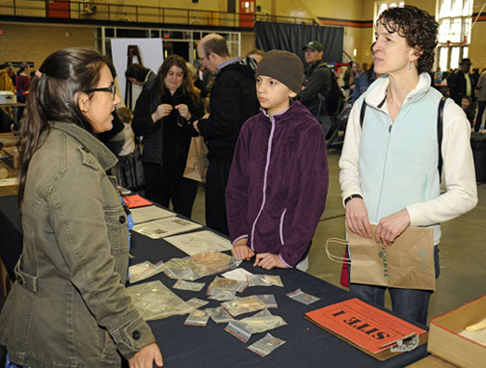
I mentioned that the Historical Society of Princeton added their own special twist to the archeology activity. YES! They displayed, and in some cases let kids handle, a multitude of artifacts that had been discovered and excavated from actual dig sites in Princeton! Some of the artifacts included broken dishware, glass piece, the base of a flowerpot, arrowheads, and a stone ax.
 The two Princeton excavation sites were the Houdibras Tavern and the Updike Farmstead (where the Historical Society now houses its headquarters). They had this fantastic photo on display too. Kids at the Houdibras Tavern dig in 1969. It was the PERFECT archeology and history connection. So cool.
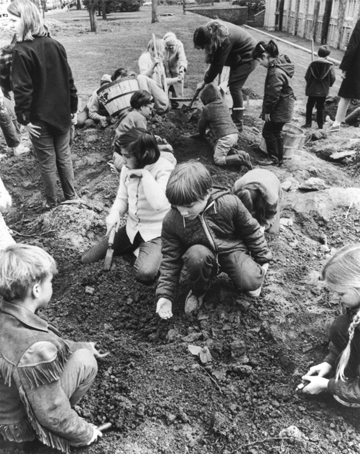
Photographer Warren E. Kruse of the Trenton Times, from the Collection of the Historical Society of Princeton
And there you have it! An archeological dig site to spark the imaginations of budding young archeologists (with their dedicated research assistants offering a boost when needed).
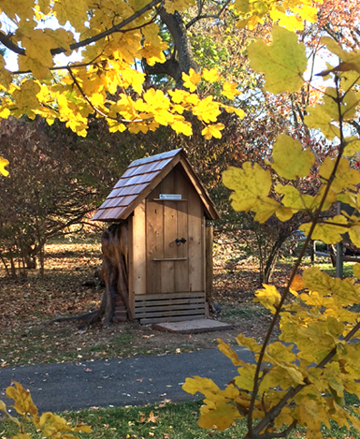 It might look an elvish cottage, but this structure houses a mighty amount of knowledge! May I introduce you to the Little Free Library in Princeton’s Marquand Park?
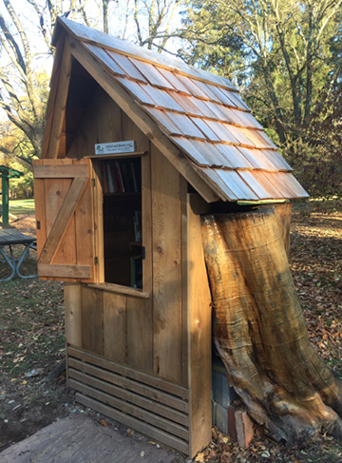 Robert Wells, founder and steward of the Marquand Park library, first spotted a Little Free Library while visiting the Outer Banks. Returning to Princeton, he realized that the park’s hollow stump, with its interesting curves, would be a perfect library location. He commissioned cabinet maker Gui Nelesson of Lost inStudio to build it, and a new Little Free Library was born! Here’s a shot of the back:
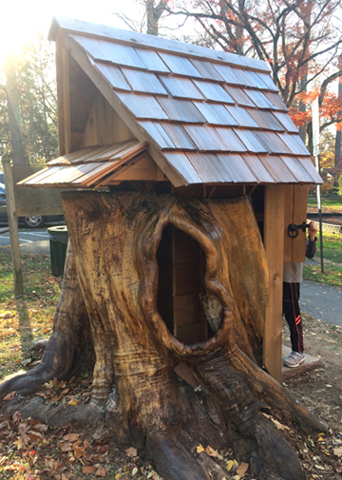 The size of this library is also unusual. Most Little Free Libraries are smaller than a copy paper box, and mounted on a post. The Marquand library can hold 300 books! It’s dedicated to children’s books, and even includes a interior bench for little readers to get comfortable.
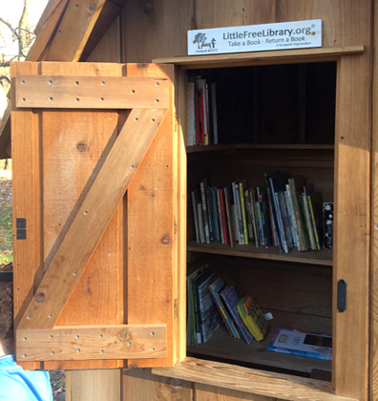 In case you’re wondering, you enter and exit the library through the window. The shutter gently swings shut to keep the books dry and protected. Not far away is a big sand play area, a playground, swings, picnic benches, walking paths, and lots of big open spaces to run around. And trees! Gorgeous trees!
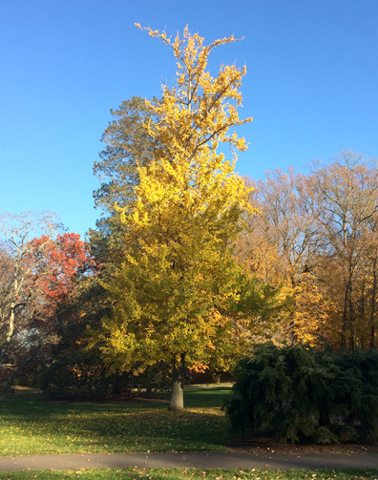 Marquand Park is located on Lovers Lane in Princeton, New Jersey. Please come by for a visit – and perhaps you’d consider exchanging one of your gently used children’s book at a very special Little Free Library?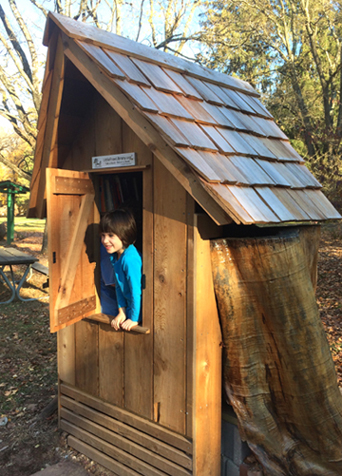
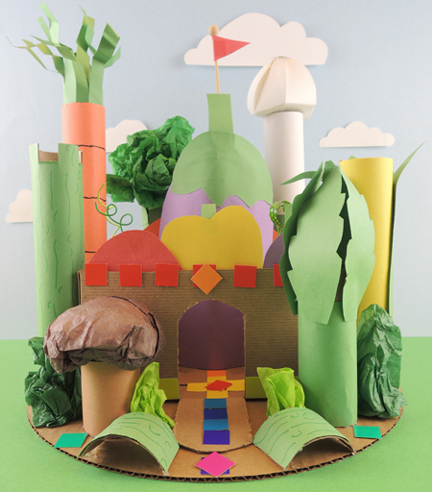 Craft a castle packed with phytochemicals! Behold towers of corn, asparagus, and carrot. Admire the eggplant and pepper wall fortifications. Stride through the cucumber slice gates. Vegetables have never looked so noble!
 And now for the giant vegetables! Here they are, in no particular order.
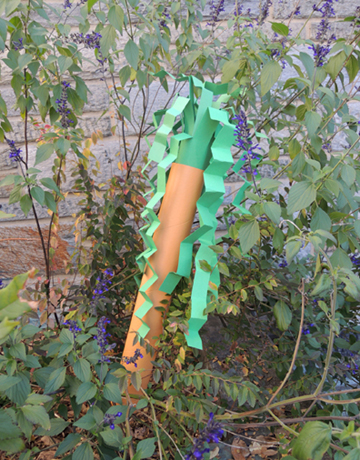
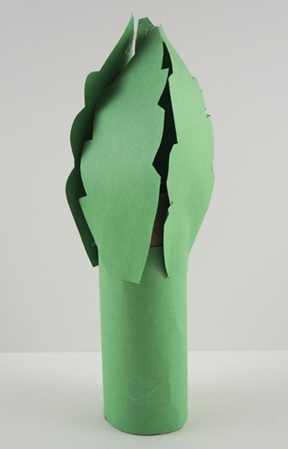 We used a toilet paper tube, but if you want a taller stalk, cut a paper towel tube to the desired height. Wrap the tube with green construction paper. Cut 4 serrated leaves out of green construction paper, and tape (or hot glue) them close to the top of the tube. Pinch the tips of the leaves together, then secure them with tape or hot glue.
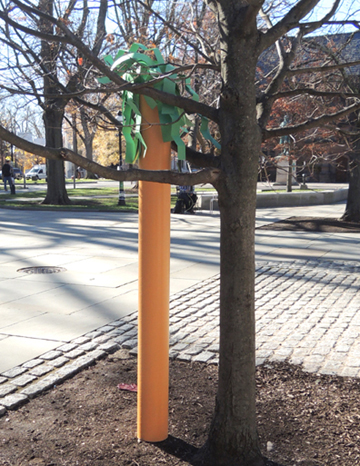
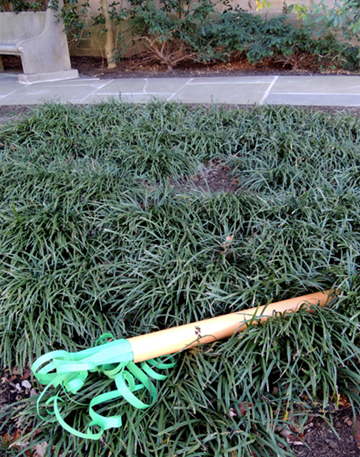
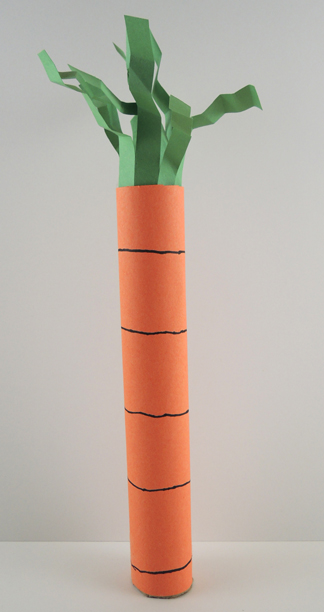 Cut a paper towel tube to the desired height, then wrap it with orange construction paper. Add a little green construction paper fringe to the top. Drawing black lines around the carrot are optional!
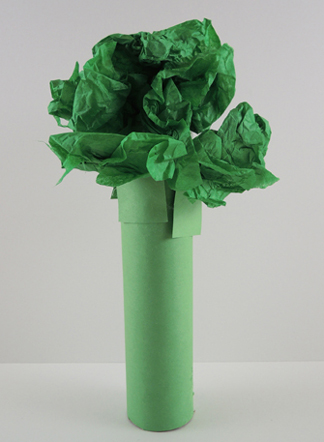 Cut a paper towel tube to the desired height, then wrap it with green construction paper. Crumble up a piece of green tissue paper and hot glue it to the top of the tube. To make the broccoli’s “floretes,” crumble up 4 smaller pieces of tissue paper, then hot glue them to the tops of four, 1.5″ x 2.25″ pieces of green construction paper. Tape or hot glue the floretes close to the top of the tube.
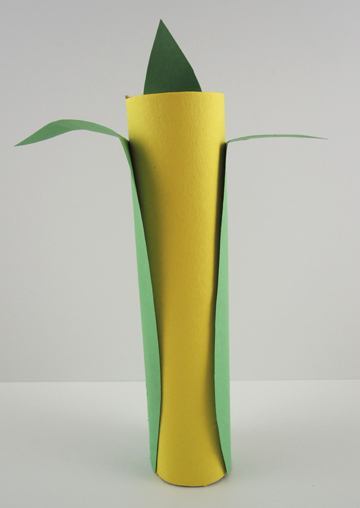 Cut a paper towel tube to the desired height, then wrap it with yellow paper. To make the corn’s “husk,” wrap a piece of green construction paper 3/4 of the way around the tube. Cut three points in the top of the green paper. Attach the husk with glue or tape, leaving the front of the corn exposed.
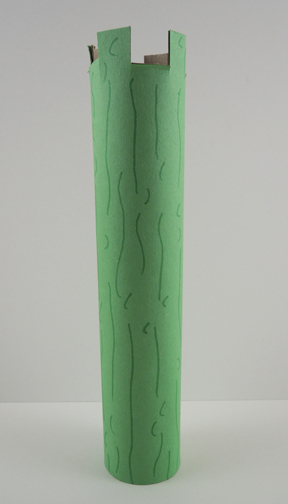 Cut a paper towel tube to the desired height, then wrap it with green construction paper. We cut castle parapets in the top as well. Use a green marker to draw cucumber lines and bumps.
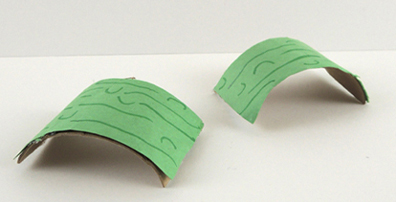 Cut a 1.5″ ring off the top of a toilet paper tube. Cut the ring in half and cover the tops of both sections with green construction paper. Use markers to draw cucumber lines and bumps.
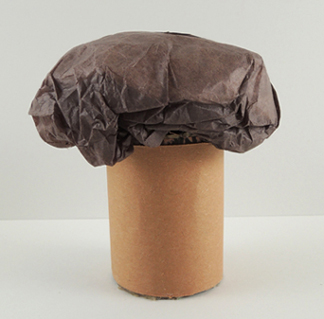 Cut a toilet paper tube to the desired height, then wrap it with brown paper. To make the mushroom’s cap, crumble brown tissue paper and wrap another piece of tissue paper over the crumbles. Squish the tissue paper to make a cap shape, then hot glue the cap to the top of the tube.
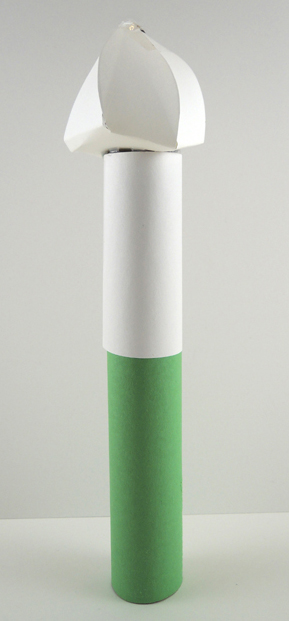 Cut a paper towel tube to the desired height, then wrap it with green construction paper. Next, wrap the top half of the tube with white paper. To make the bulb of the onion, cut the onion dome from the template. As you can see, it resembles a flower with multiple points. Fold each point inward toward the center of the template, then open it back up again.
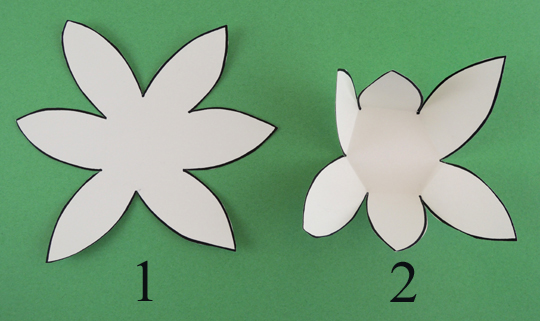 Gather two of the points over the center of the template and tape the tips together. Repeat with the remaining sets of points until you have 3 sets altogether.
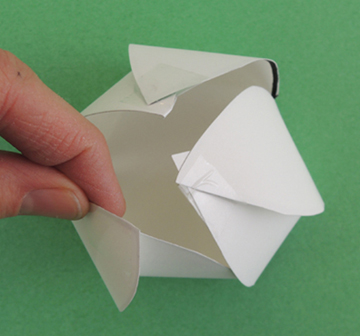 Gently push the 3 sets together over the center of the template, and tape together.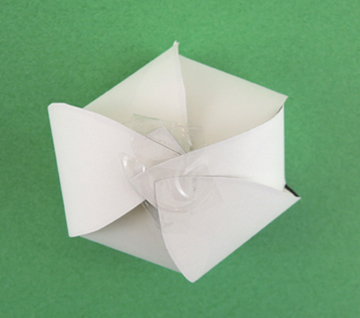
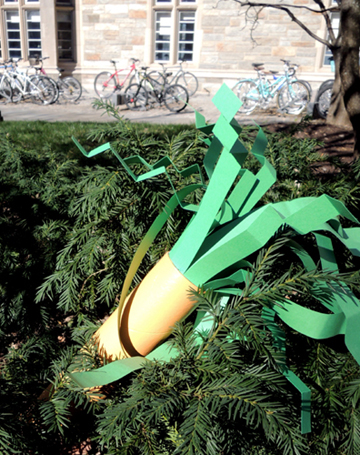 Carrot, frolicking amidst flowers…