 Before I answer this question, I must tell you that, in addition to conducting story times, author interviews, and creative literacy programming at my library, I also teach children about our rare books and special collections.
The Cotsen Children’s Library is part of the Department of Rare Books and Special Collections at Princeton University. We have six centuries of illustrated children’s books, manuscripts, original artwork, prints, and educational toys. It’s part of my job to engage and educate young scholars with these fantastic materials.
Sometimes I select and write about collections items like the one featured in this post. Sometimes I’ll exhibit special materials at Cotsen Critix, our children’s literacy group for 9 to 12 year-olds. But our most extensive program was Cotsen in the Classroom, in which I would take reproductions of collections materials to K-5 classrooms. Students learned about Beatrix Potter’s nature drawings, Japanese street theater from 1930, Hans Christian Anderson’s paper cuts, school in the 1700’s, illuminated manuscripts, and 19th century geographical objects (click here to read a post about the program).
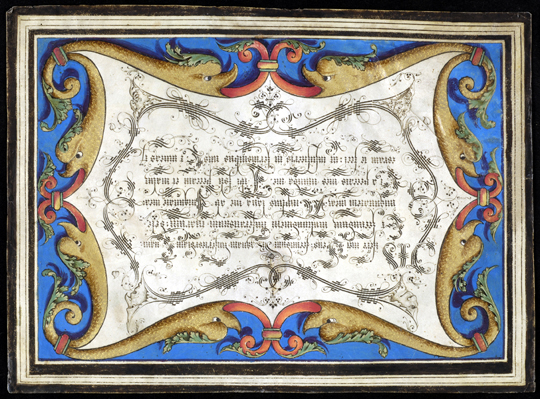
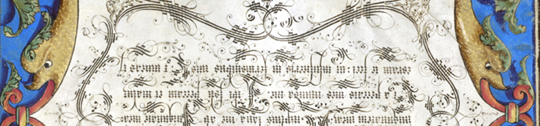 So…to return to the question that stated this post…is this an ancient code? Actually, they’re minims! Minims were a type of writing used in the Middle Ages when writing materials were very expensive. Letters are reduced to short vertical lines with small flourishes added at the top and bottom, which allowed scribes to write faster and use less ink.
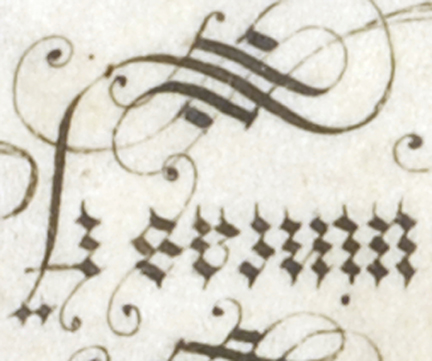 The minim above, however, is quite elaborate. That’s because it was created by Venetian master scribe and artist Francesco Alunno for his calligraphic masterpiece, the Alunno Manuscript. Created between 1539 and 1550, The Alunno is considered one of the most beautiful manuscripts produced during the Renaissance. It was created at a time when the art of handwriting was disappearing. A new Renaissance invention, the printing press, would soon replace scribes and their manuscript pages forever.
Interested in learning more about the collections? Cotsen also has a curatorial blog, which you can visit by clicking here.
Rothschild Alunno Manuscript
Created in Venice, 1539-1550
Cotsen Children’s Library, Princeton University Library
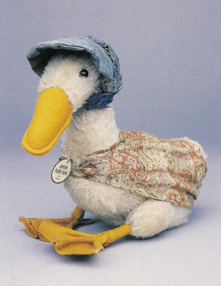 Next to Peter Rabbit, Jemima Puddle-Duck is one of Beatrix Potter’s most endearing and memorable characters. This charming stuffed animal version was created for Potter in 1910 by two of her neighbors, Miss Hammond and Miss Mills. The cloth for the shawl even came from the calico factory owned by Potter’s mother’s family. This toy was the prototype used to secure a patent for a mass-produced stuffed animal. In fact, you can still buy a version of the stuffed toy today.
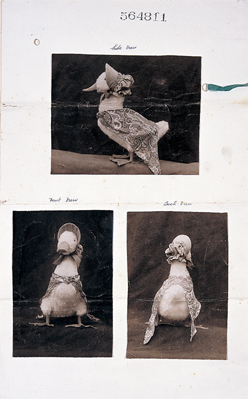 Jemima had a place of honor on top of Beatrix’s book case until she was given to Freda Jackson (nee Storey), the daughter of Beatrix’s farm manager in the late 1950s. Imagine what a wonderful present that would be!