 Last month, I gave a keynote address at the NJ Library Association & NJ State Library Youth Services Forum. I always like to leave time at the end for questions, and here is one question I wish I could have answered better and more thoroughly. Hence, this post.
Q: What sorts of programs do you do for teens?
A: My library does have some opportunities for teens, but…
Most of my work is with preK – grade 8. There are two reasons for this. Firstly, I’m a single staffer, so my program roster is limited to what I can manage by myself (currently, I’m juggling two weekly story times, a weekly classroom program, a bi-weekly children’s literary club, an author interview program, a publication, an annual writing contest, this blog, occasional weekend programs, the launch of a new program for underserved kids, and the development of new online middle school programs).
Secondly, I primarily read children’s chapter fiction. YA is not my territory (I also joked that YA is scary to me. I mean, do I really want to revisit all the pain and suffering I went through as a teen? Even if it does mean scoring an awesome sparkly vampire boyfriend?).
That said, my library does offer some opportunities for teens, and I thought I would share them here, along with some suggestions for developing teen programs. Here’s our current programming:
- Teens can submit writing pieces to the Picture Book Press, our children’s literary quarterly. Click the title to read An Ode to the Radish, one of my favorite haiku poems of all time. It was submitted by a 17 year-old.
- Our annual writing contest, 350 for 50, has three age categories. The top age category is for 14 -16 year-olds. Click the title to read The Pit, last year’s winner in that category.
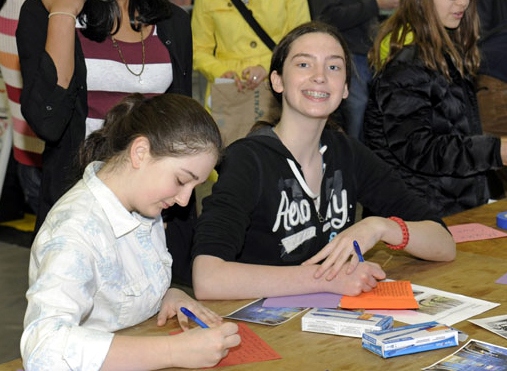
- Princyclopedia, our (former) massive annual event was for ages 4 -14. You can get a little taste of what Princyclopedia was like in the beginning of this post.
- Cotsen Critix, our children’s literary club, is all about books, writing, and doing unusual activities related to literacy. Initially, the club was for children ages 8 & up. So I worked with a number of 13 – 16 year-olds. Unfortunately, it was a difficult to develop content that was appropriate for such a wide age span, so the current age range for Cotsen Critix is 9 -12-year-olds.
- Cotsen sometimes offers specialized Saturday programs for teens such as Elvish 101, a 2-hour workshop devoted to learning to read, write, and speak Quenya, the high language of J.R. Tolkien’s elves. During a program break we sipped New Zealand spring water from crystal goblets and munched on lembas bread. Elen sila lûmenn’ omentielvo!
Presently, I’m developing some collections-based programs for middle school students, but someday…oh someday…I would love to do high school lectures based on Cotsen’s collections. Depictions of war in picture books, gender identity as evidenced in children’s magazines, analyzing the zeitgeist of period artwork…I’ll get there someday! By the way, if you’d like to learn a little more about Cotsen’s collections, click here to visit the curatorial blog).
In the meantime, here are my top four recommendations for developing teen programming.
- Offer Experts. Whenever possible, I staff my programs with specialists. Some are hired, and some are volunteers. A geologist at a Journey to the Center of the Earth event, a University lecturer at a Chemistry of Magic program, professional stage fighters at a Robin Hood event, a historical reenactor bringing a past century to life, a local artist or student poet leading a creative workshop. I try to create opportunities for teens to engage in a mature, intellectual dialogue that satisfies their curiosity and encouraged their interests.
- Collaborate. I like to work one-on-one with teens on creative projects. Currently I’m working with a high school junior to create a full-size Cinderella dress out of trash. We’ll feature it in the Picture Book Press and display it at princess program we’re developing for the spring. Not only do I get to work with a fantastic young mind, but I can offer her an opportunity to engage in a creative collaboration while still (and this is important) managing to meet deadlines.
- Ask. If you’re stumped, put together a teen focus group and ask them what they want, what they need, and if they could really use a particular program. With the investment of a little time (and possibly a couple pizzas) you could gain a treasure trove of information (or at the very least, some insight into the minds of your target group).
- Fun is good, but…it might be that the needs of your population are homework help, computer skills, English as a second language, or locating resources to get them through tough times. Movie screenings, trivia contests, and gaming conventions are great, but there’s nothing wrong with focusing your resources on the not-so-glamorous-but-very-much-needed programs. Especially if your time and budget are limited.
Postscript: In Fall 2015, we launched a new program for teens called First Draft. Writers ages 13-17 can submit creative writing and personal essays, and Princeton University student editors give their constructive feedback! For more information, click here.
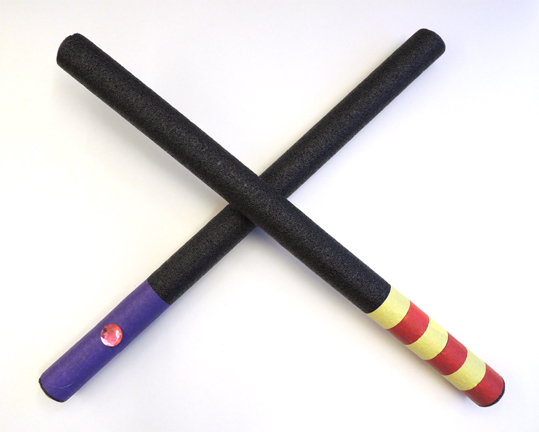 Every pirate needs a cutlass, every musketeer needs a saber, and every knight needs a sword! But the combination of kids and swords can get a bit… dicey. Someone always get dinged, bonked, poked, or conked.
 It’s tubular foam pipe insulator. Also called “that gray foam tube that gets wrapped around pipes.” It’s made out of polyethylene (the same stuff as pool noodles and kickboards). I use the 1/2″ diameter foam, which comes in 6′ tubes and costs 97 cents. You can cut it easily with scissors. I can get 3 good-sized (i.e. 20″ – 21″) swords out of 1 tube. That’s 32 cents a sword. Oh yeah.
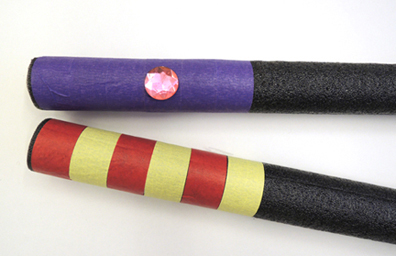 Pssst! If you’re looking for another amazing find in the plumbing section, check out this post. If you’re yearning for a cannon to go with that pirate sword, you can find it here. Looking for a dragon to adventure with? Click here!