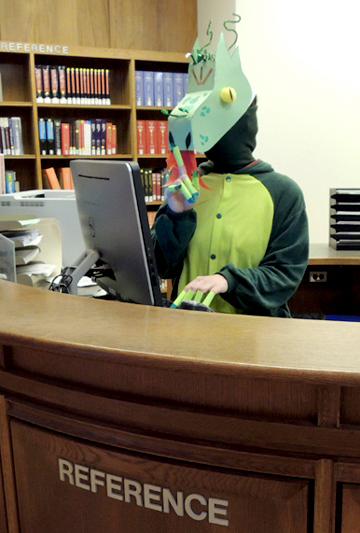
 Wow I hear that new librarian is a total dragon. Like…literally.
We read The Library Dragon, written by Carmen Agra Deedy, and illustrated by Michael P. White (Peachtree, 1994). Miss Lotta Scales, the new librarian at Sunrise Elementary School, is, in fact, a dragon. A dragon who takes her book-guarding duties very seriously. The students (and the staff) are all but exiled from the library, lest they face the wrath of Miss Scales and her fiery temper. Then one day, little Molly Brickmeyer wanders into the library, looking for her lost glasses. She happens across a book and starts reading aloud. Shocked but entranced, the other students gather in the library to listen. Mean Miss Scales moves in to grab the book…but then stops. Hmmm. The children appear to be enjoying themselves in the library. And the book is about a magic dragon so…Miss Scales finishes the story herself. And as she reads aloud, her formidable scales fall off, revealing Miss Lotty, the new, and very kid-friendly, librarian.
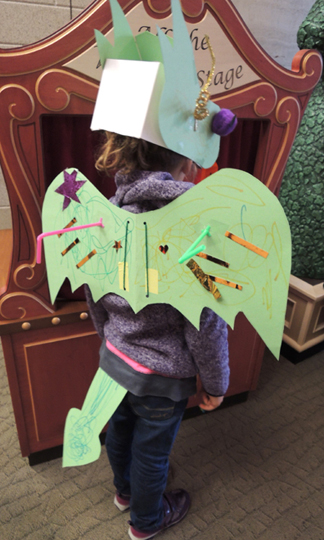
We transformed into dragons with wings, tails, and heads with crackling tissue paper flames that activated with a quick puff of air!
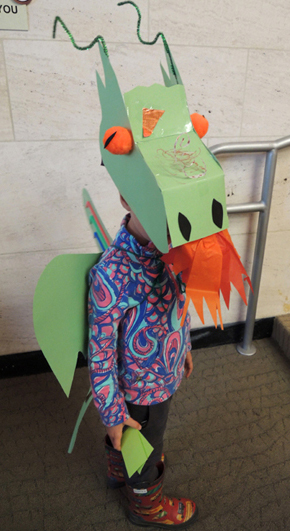 You’ll need:
First, cut the lid and tabs off one side of a box (or, if you’re using a large tissue box, just cut the entire top off). Set the box aside for a moment.
We spent quite a bit of time figuring out how to make the dragon head template fit easily over a box. The final template turned out to be over 22″ long, so I broke it into 3 separate pieces to create a printable template for you.
Print all 3 paper template pieces and cut them out. Place the middle section down first, then lay the left and right sections on top of it, using the curves of the dragon’s nose as guides. Secure the 3 template pieces together with tape.
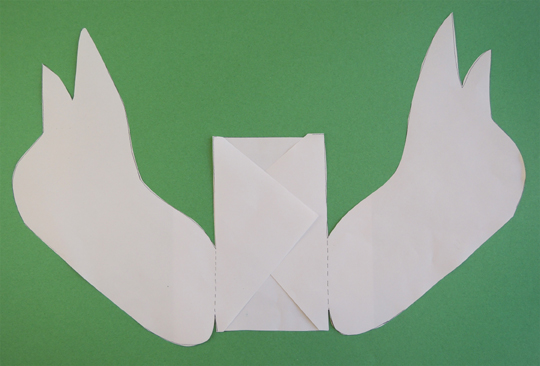 Next, lay the paper template on a piece of poster board (we ultimately decided to use light green). Trace the template on the poster board, then cut the entire thing out as one big piece. You’ll notice that there are 2 dotted lines on the paper template. Fold the poster board template downwards along the dotted lines. Then slide the poster board template on top of the box, and hot glue the sides of the template to the sides of the box.
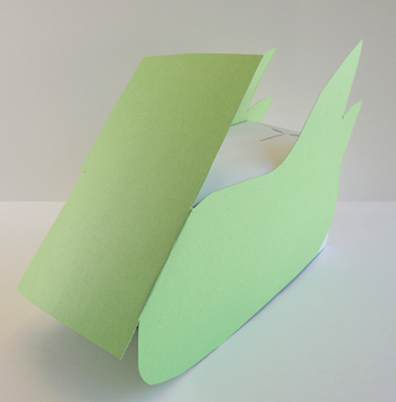 Next, hot glue the middle section of the template to the top of the box.
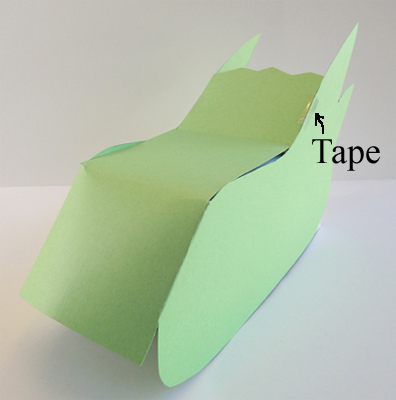
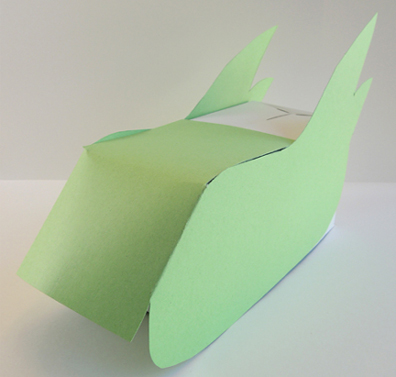 Trace the forehead template onto green poster board, and tape it to the front of the dragon’s head.
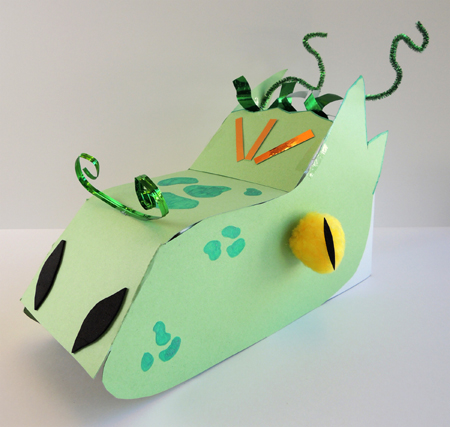
 Now decorate! We used markers to create spots, slivers of self-adhesive foam for nostrils, some embossed foil paper for hair, 2 sparkle stems for horns, gold mirror board pieces on the forehead, and a craft tie curly whisker. Our eyes were 2 jumbo pom-poms with self-adhesive foam pupils. You could also just use markers or construction paper to decorate the head.
 To create flames, cut 2-3 rectangles of tissue paper into flame shapes, then staple them together. Hot glue (or tape) the flames to the underside of the nose. Make sure to attach the flames to the end of the poster board nose, not the end of the box. Otherwise, the flames won’t flutter properly. Here’s a shot of the underside of the box, so you can see where the flames are attached.
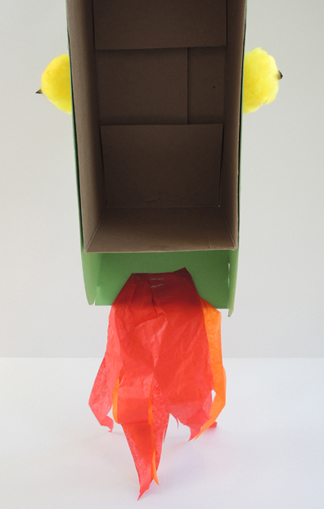 Try your head on. If it’s a little loose, stuff the back and front of the box with sheets of tissue paper. To breath fire, simply blow upwards and outwards on the tissue paper flames!
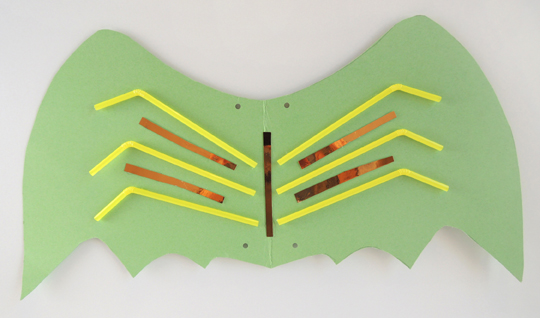
Now for the wings and tail! Unfortunately, the templates for these were too big to fit on a printable page – you’ll have to freehand them. We drew half a wing, then traced it onto a folded piece of poster board. Unfolded, our wings were approximately 12″ x 22″. Bendy straws make awesome wing ribs, and so long strips of mirror board. Punch 4 holes in the wings and run yarn through them. Knot the yarn around your shoulders like backpack straps!
 Here’s our dragon tail, which was roughly 6″ x 19″. We decorated ours with a couple pieces of mirror board (some kids went with drinking straws or just markers).
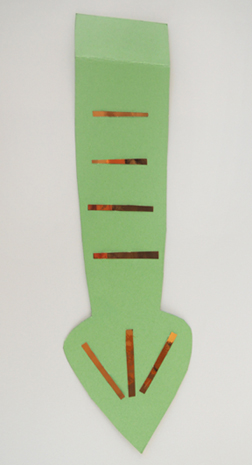 You’ll notice that the tail in the above photo has a 2.25″ fold at the top. The folded end tucks into the back of your pants (or, if you’re wearing a dress, punch a hole in the tail and run a yarn belt through it).
 If you’d like dragon claws (and some kids really liked this part), wrap a 3.5″ x 4″ piece of green paper around your finger, then secure the tube with tape. Wrap one end of the tube with green masking tape and cut the masking tape into a point. Here’s Marissa modeling a fine set of claws and a truly awesome dragon onesie.
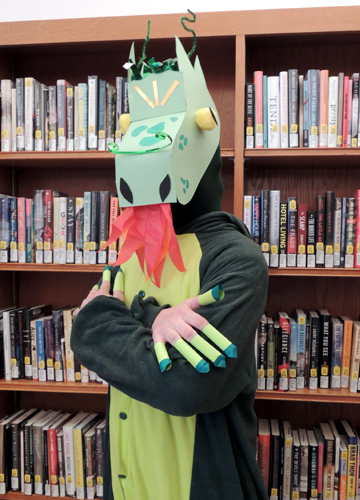 Now go forth dragon, and guard some books!
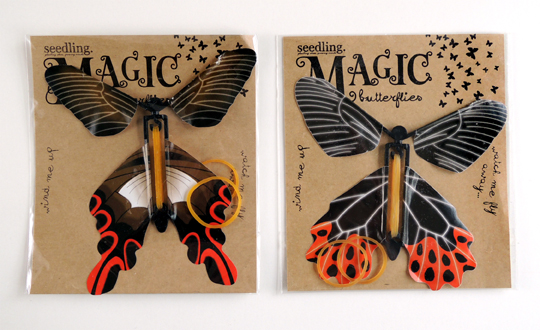
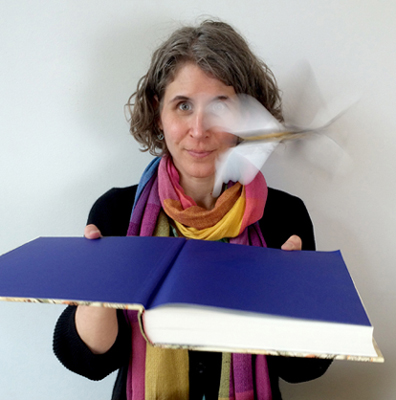 Recently, while in Brooklyn, I wandered into a little toy store called Matt & Juliette. There, I discovered some neat-o wind-up butterflies by Seedling. The clerk at the toy store explained that some people like to put the butterflies inside birthday cards. When the recipient opens the card, the butterfly flutters out. If it works for cards, I thought, it’ll totally work for books! I immediately purchased a pair to test out. They retail for $3 each and come in 4 different colors and styles.
 As you can see, the toy is pretty simple. You hold one half and twist the other half. This motion winds the 2 rubber bands, which ultimately propel the toy skyward.
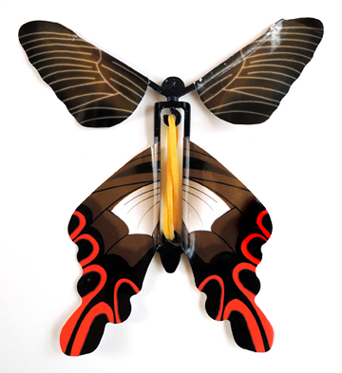 The directions warned that winding the rubber bands too tightly could cause them to snap. This is true. Over the course of 20 test flights, we broke 2 rubber bands. But there are two spare rubber bands in each package, so no problem! Alas, one of the plastic hooks on the smaller butterfly snapped within 5 minutes, rendering the toy useless, but the other one held out just fine. Ready to see a butterfly in action?